Drought remains a recurring challenge for South Dakota livestock and forage producers. Annual Forage Rainfall Index (AF) insurance is one tool that may help reduce the financial risk associated with below-average precipitation.
For producers interested in insuring annual forages for the 2027 crop year, July 15, 2026 is the sales closing date for coverage. Understanding how the program works before that deadline can help producers determine whether it fits their overall risk management strategy.
What is Annual Forage Rainfall Index insurance?
Annual Forage Rainfall Index insurance is crop insurance administered through the USDA Risk Management Agency. Often crop insurance protects against multiple hazards, such as flooding, hail, prevented planting, and other damages to yield. AF insurance uses a rainfall index to estimate losses resulting from insufficient precipitation.
AF shares many characteristics with Pasture, Rangeland, and Forage (PRF) insurance. As such, it is area coverage based on geographic grids within a county. Because payments are based on grid-level rainfall rather than conditions at an individual operation, forage losses may occur without a payment, and payments may occur even when forage production is adequate.
Annual Forage Rainfall Index insurance may be appropriate for producers who depend on annual forage crops as a vital component of their livestock operation. This includes producers who grow annual forages for:
- Grazing livestock
- Hay production
- Silage production
- Green chopping
How the Insurance Works
AF allows producers to customize coverage based on their operation and risk tolerance. Working with a crop insurance agent, producers select:
- The acreage to insure
- The intended use of the forage crop
- A coverage level
- A productivity level
- The growing intervals when precipitation is important
Because forage crops vary in their periods of peak moisture demand, selecting appropriate index intervals is an important management decision. Producers should work closely with their crop insurance agent to identify intervals that best align with expected crop growth and yield potential. Premium costs vary based on coverage level, productivity selection, and insured acres, making it important for producers to evaluate cost alongside coverage decisions.
Annual Forage Coverage in South Dakota
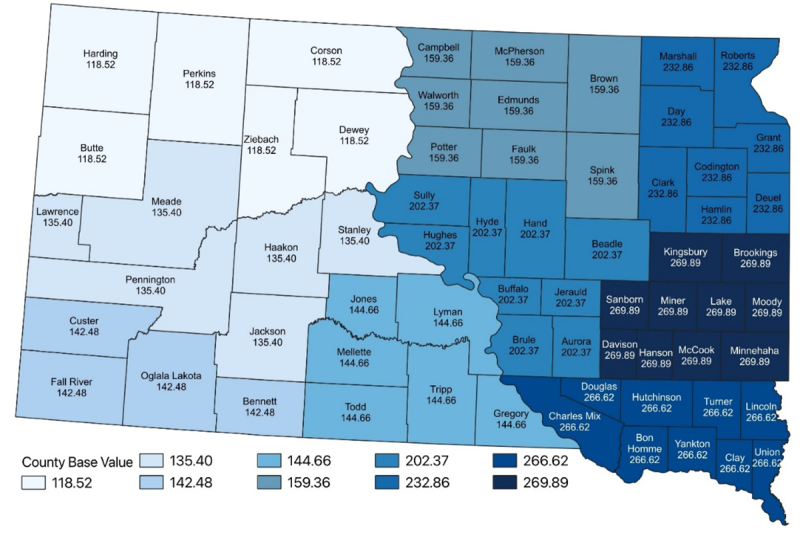
Base values vary across South Dakota counties, reflecting differences in expected forage values and regional production conditions (Figure 1). Understanding county-specific values can help producers estimate potential coverage levels and compare insurance options among regions of the state.
Participation in AF insurance has changed over time as producers have become more familiar with the program. There were still just over 16,000 acres insured with AF in South Dakota as of early July of 2026. The total is down from the 27,102 acres insured in 2025. The number of policies sold in 2026 was higher than in 2025.
For comparison, perennial forages such as alfalfa and alfalfa mixes can be insured using Forage Production insurance. Such coverage is currently in place on 466,970 acres in South Dakota in 2026. Hayland of all types can be insured using Pasture, Rangeland, and Forage (PRF) insurance. There are 653,215 acres in South Dakota with PRF haying coverage in 2026.
Producers should remember that payments are based on rainfall within a geographical grid, not conditions at an individual operation. In addition, annual forage production is influenced by factors beyond rainfall, including soil type, fertility, planting date, temperature, and weed pressure. For these reasons, AF insurance should not be viewed as a guarantee of forage production or revenue. Rather, it is intended to provide financial assistance when widespread precipitation deficits occur within an insured area.
Take-Home Message
Annual Forage Rainfall Index insurance can help reduce some of the financial risk associated with drought and may complement other management strategies such as sound grazing management, forage diversity, and drought planning. Producers interested in 2027 coverage should contact their crop insurance agent before the July 15, 2026 sales closing date to review available options.
For more information on Annual Forage Rainfall Index insurance, visit the USDA Risk Management Agency website.