Written collaboratively by Evelyn Prempeh, Whoi Cho, Sarah Sellars, Jason Clark, and Clarence Winter.
Unlike nitrogen (N), phosphorus (P) is regarded as a nutrient of low mobility, and most of the applied P remaining after crop uptake is known to carry over to the following growing season. The soil is considered a stock of P, so a common rule of thumb in P management is to apply more when fertilizer prices are low (building up soil P), and to draw that remaining soil P down when prices are high.
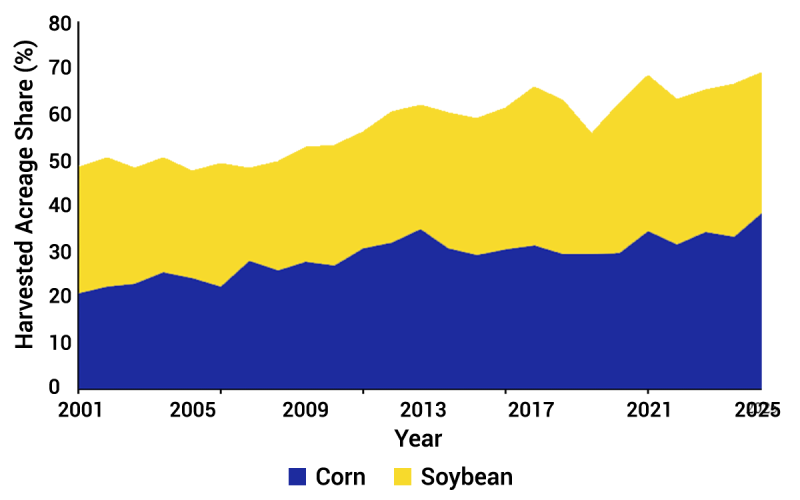
Soybeans are among the crops that mainly require P fertilization.Although corn requires mostly N fertilization, it still has a P requirement. Over the past 20 years, corn and soybeans have remained South Dakota’s main cash crops, while their share of the state’s total harvested acreage has continued to increase (Figure 1). In 2025, they represented approximately 69% of the state’s total harvested acreage (USDA-NASS, 2025).
Note: Shares are calculated as the harvested acreage of each crop divided by the total harvested acreages in South Dakota for each year (USDA-NASS, 2025).
What Happens to P Fertilizer in Alkaline Soil?
Across much of the central and western parts of South Dakota, the soil is naturally alkaline (soil pH above 7) (USDA-NRCS, 2022). In high pH soils (alkaline soil), P fertilizer can react with calcium already in the soil and form compounds that crops cannot easily use. It means that applied P fertilizer can become “tied up” in the soil, leaving many farmers wondering whether the P fertilizer they pay for is really working for them.
Following our study (Prempeh, 2026), only about 45% of the applied P carried over to the following year. The fixation that comes with high pH was quietly pulling the rest out of the crop's reach. That single fact changes the whole economics of the field, because it means that when applying P fertilizer to build soil P, it is largely being locked away rather than saved for a future crop.
That soil dynamic raises a very practical, dollars-and-cents question: Is it worth spending extra money to build your soil P level over a period of years, like the way the “build-and-maintain” approach suggests, or are you better off applying just enough to feed the current crop?
Our study tried to answer these questions using four years of corn and soybean data from an alkaline field at the Dakota Lakes Research Farm near Pierre, SD, that had an average pH of 7.7. We conducted economic analysis based on this data, comparing three approaches a grower might take: applying no P at all, applying only a small starter band at planting to feed the current crop, or applying that starter plus extra fertilizer intended to raise and hold soil test levels over time.
Which P Strategy Pays Off?
In alkaline soils, little of the available P in soil carried over to the following season because the applied P fertilizer was tied up in the soil. Applying extra P did build up soil test P, but the increase was small, and the resulting yield gain did not offset the added fertilizer cost. Our results indicate that starter P application was the most profitable management practice in fields with high soil pH. Rather than accumulating P in the soil, P should be placed with the seed so that the crop can take up the applied P before it is fixed. Our study evaluated a single starter rate of 18 lb P2O5 per acre. As expected, no P fertilizer application was the least profitable strategy, because soil P drawdown reduced yield.
Our study evaluated two planning horizons, a short-term horizon of 4 years and a long-term horizon of 10 years, under two P prices ($0.68 and $0.85 per lb P2O5.) Starter P fertilizer application was the most profitable strategy regardless of horizon or price.
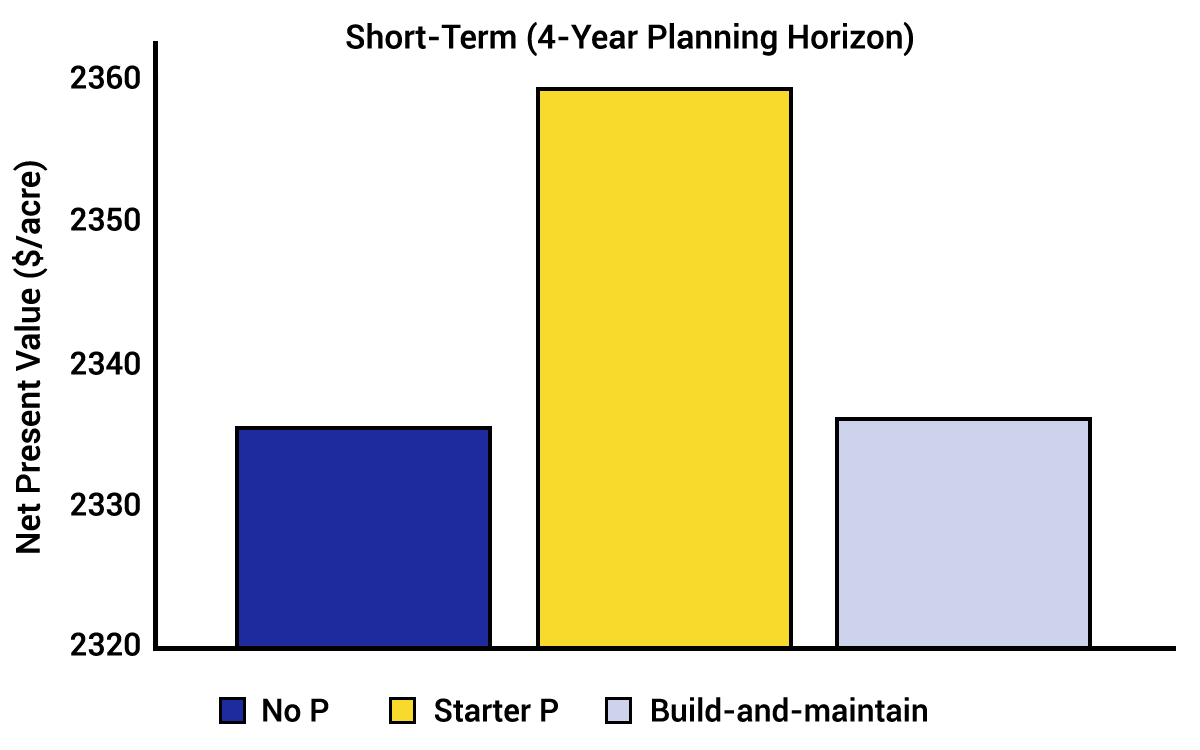
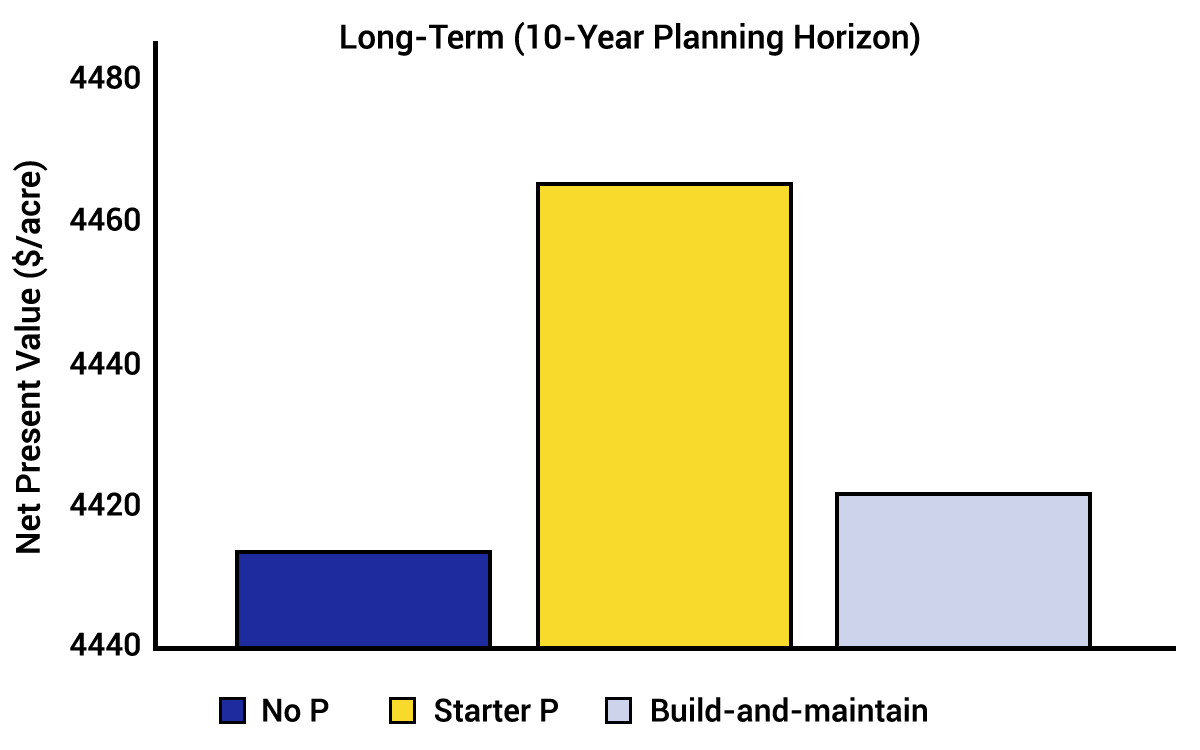
Note:Results are based on the P fertilizer price of $0.85 per lb P2O5. Starter P remained the most profitable practice under the lower-price scenario of $0.68 per lb P2O5.
Takeaways
For corn and soybean producers on high-pH soils, a starter band of P near the seed at planting is the clear choice, as it was the most profitable. Building soil P in alkaline soils is hard to justify because fixation ties up most of the added P fertilizer, and the payback rarely arrives even over a decade.
However, Prempeh's (2026) findings come from a study with a single four-year rotation at a single high-pH site, and are based on some assumptions about how crops take up P, the shape of the yield function, and the discount rate . Producers should therefore have their soil tested by a laboratory and review the SDSU Extension Fertilizer Recommendations, or visit their SDSU Extension office to discuss the results when deciding on P fertilizer rates.
References
- Prempeh, E. 2026. “Economic Analysis of Phosphorus Management Practices for Corn-Soybean Farmers in High Soil pH Fields.” M.S. thesis, South Dakota State University.
- U.S. Department of Agriculture National Agricultural Statistics Service. 2025. 2025 State Agriculture Overview South Dakota. Census of Agriculture.
- U.S. Department of Agriculture Natural Resources Conservation Service (NRCS). 2022. Keys to Soil Taxonomy.