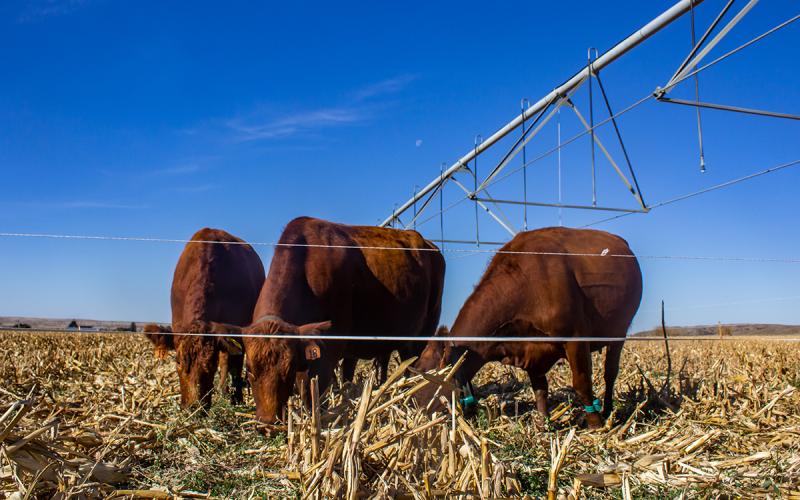
Minimizing disturbance and keeping the soil covered are two of the soil health principles. One of the best ways to incorporate these principles is to adopt no-till. Keeping residues on the soil surface benefits the soil by returning organic matter and nutrients. To be successful when adopting no-till, it starts when combining the crop from the prior year. Having crop residues spread properly is important to ensure good crop establishment the following year. With corn, it is important to have the crop germinate at the same time so that plants do not compete with neighboring plants and to pollinate at the same time. Having crop residue spread evenly across the field is important to ensure even emergence of the corn crop throughout the field. This is also important for other crops that would be planted via no-till to ensure a good stand. Having residues spread evenly is important for having uniform soil moisture and temperature at planting. Having the combine set up correctly is important to establish success when adopting no-till farming.
Managing Harvest for No-Till

Make Sure Combine Is Working Properly
Prior to harvest, the combine should be inspected to make sure that all the parts are working correctly. Having the knives of the combine sharp is important when cutting up the residues left after the grain is separated from the rest of the harvested crop. This will allow for even-sized pieces of the crop to be spread back onto the field. Also, make sure the chopper and spreading mechanism of the combine are adequately functioning so it can spread residue the width of the combine head.
Spread Residue the Width of The Head
Having equal amounts of residue across the surface is important to ensure that soil temperature and water content are similar throughout the field. This leads to uniform germination of the crops in the field. Sometimes when there is uneven residue distribution in the field, plants will be larger, and germination may appear to be better where there is little residue compared to parts of the field with thicker residue. When beginning to combine the field, the adjustments on the chaff spreader should be checked to make sure that it is spreading residue even to the width of the combine head. This will allow for even residue distribution throughout the field.
Start Combining Downwind
Wind can play a major role in where residue falls when it comes out of the combine. When combining, run the combine perpendicular to the direction the wind is coming from if possible. This will allow for more even residue distribution behind the combine. If combining across the wind, more residue may be pushed in the direction the wind is blowing, and subsequent combine passes place residue on the previous combine pass. Combining at a perpendicular angle to the wind will help more evenly spread the crop residues.
Cut Off Crop Stalks Taller Than Normal
Cutting stalks off taller than normal has many benefits; the first is to better capture snowfall, another is to keep the crop residue from blowing away for the purpose of ground cover, and lastly, not cause too much cover that may make it more difficult for planting. Cutting the stalks off higher leads to less residue lying on the surface. Combine height should be set low enough to harvest the grain but still leave as much of the stem standing as possible. This will help to improve plant germination when no-till planting. This goes against the theory that you want to have as much residue left on the surface, but it helps establish successful no-till planting.
Some producers may be concerned with combining soybeans planted into tall corn stalks, but this is not really an issue to be concerned about, as most of the corn roots and standing stems are broken down by soil microbes by the time soybeans are harvested and pass through the combine without notice.
Manage Residue by Grazing with Livestock (a soil health principle)
When adopting no-till practices, the soil microbes (fungi) that break down residue may not be very abundant. Also, in Northeastern South Dakota, there are high amounts of residue produced from crops such as corn, but there are long, cold winters that lead to slow breakdown of crop residues. Grazing corn stalks with livestock helps to cycle crop residues into organic materials that release nutrients for the following crop.
Livestock integration helps to prevent buildup of crop residues on the soil surface when adopting no-till practices. Also, this keeps most of the organic matter and plant nutrients in the field compared to when residues are baled and removed. The manure released from cattle has a carbon: nitrogen ratio closer to what soil microbes prefer compared to the high carbon: nitrogen ratio of many crop residues.
Combine with Chopping Corn Heads
Modern combines are equipped with corn heads that have chopping knives to cut crop residues into small pieces. Many think this helps break down crop residues because they are in smaller pieces. However, this also makes the crop residues susceptible to wind movement. This can lead to uneven residue levels across the field and cause some of the residue to blow off the field. Having uneven residue in the field can lead to uneven plant stands throughout the field. Also, in long–term corn–soybean rotations under no–till, soil microbes break down residue too fast, and not enough residue is added to the soil, which negates the need for using the residue chopper. Turning off the chopping mechanism can help improve success when adopting no tillage.
Summary
Having harvest equipment set up correctly is essential when adopting and using no tillage. This helps maintain even soil moisture and temperature throughout the field, leading to better stand establishment and causing the crop seeds to germinate at about the same time. Ways to properly manage crop residues include making sure the combine is functioning properly, spreading residues the width of the combine head, leaving crop stems as tall as possible, combining perpendicular to the wind direction, managing crop residues with livestock, and possibly turning off the chopping mechanisms of the corn head. Having evenly spread residues is important to establish successful no-till crops.