Written collaboratively by Eric Jones, Philip Rozeboom, Jill Alms, and David Vos.
Planting soybeans started early in South Dakota, but growth has been slow due to dry and cooler conditions at the beginning of the season. Recent, intermittent rain events have occurred across the state with temperatures reaching 80° F, which promotes soybean growth as well as weed growth.
Over-the-top (OTT) dicamba products (i.e., Engenia, Tavium and Stryax) for application in soybean have been relabeled for the 2026 growing season. A stipulation for applying these herbicides is a cutoff date of June 30 or R1 soybean. What should you do if you cannot get dicamba sprayed before June 30? Do not spray dicamba! While you have purchased dicamba to use in your soybeans, applying dicamba now is illegal and can bear great repercussions if caught doing such. Applying dicamba after the cutoff date is not worth the risk when there are other viable options.
If these OTT dicamba products can be sprayed before the cutoff date, check the weather conditions before application. Temperatures should be below 85° F, wind speed between 5 and 10 miles per hour, and no temperature inversion present; these guidelines are true for most pesticide applications. The Mesonet at SDState is a great place to check weather conditions near your farm before pesticide application. While drift and volatility reducing agents are required to be applied with these dicamba products, applications must be made under ideal weather conditions to minimize off target movement.
The OTT dicamba products should be applied with other herbicides to increase the effectiveness and spectrum of weed species control. Mixing unique herbicides with these products will also reduce selection pressure on herbicide-resistant weeds. Refer to individual labels for restrictions on specific tank mixtures. While glyphosate (i.e., Roundup) and glufosinate (i.e., Liberty Ultra and Interline) may be mixed with OTT dicamba products, ammonium sulfate (AMS) cannot be included in the mixture. A water conditioner that does not contain AMS may be used as a substitute.
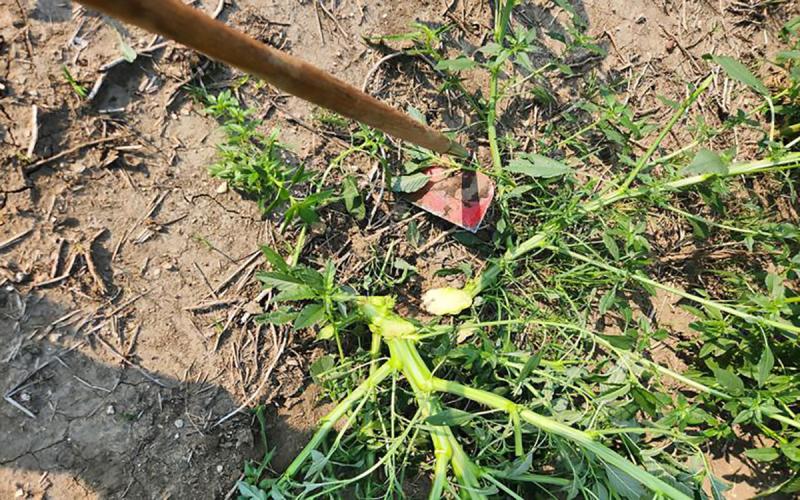
If weeds are still an issue in soybean after the cutoff date, other herbicides or tactics can be implemented to manage weeds. Refer to the most-recent South Dakota Pest Management Guide - Soybean and Weed Control Field Test Data for specific herbicides and the effectiveness on select weed species. While herbicides are usually a staple in weed management plans, nonchemical tactics (i.e., cultivation, hand weeding, mowing, etc.) can and should be implemented as well to increase the effectiveness of weed management plans within the growing season (Figure 1).


