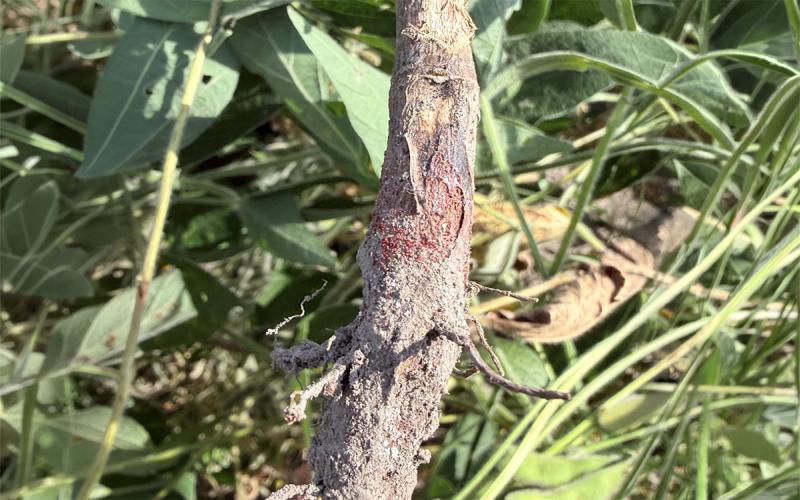
The incidence of volunteer corn in subsequent crops tends to be greater following periods of drought. Drought stress can weaken corn stalks, making them more prone to lodging and dropping ears. Dropped ears can potentially germinate and pose significant disease risk to subsequent crops, potentially attracting pests like corn rootworm beetles and serving as the source of inoculum. Utilizing livestock to graze corn residue following harvest is a strategic management practice to reduce volunteer corn in the following crop, while reducing the use of herbicides.
Benefits to Utilizing Livestock
For a diversified operation, grazing corn stalks can provide additional nutritive value to maintain body condition and preserve harvested feed inventory for a few additional days depending on the quality and amount of residue available. For farming operations that do not include a livestock enterprise, renting corn stalks for grazing can provide an additional stream of income and reduce production costs by reducing herbicide needs to combat volunteer corn.
Cattle are selective grazers and typically will consume corn grain first, followed by leaves and husk, then cob, and finally corn stalks. The preference and selectivity to grain makes them a useful management tool to for utilizing spilled grain or dropped ears and potentially reducing the amount of volunteer corn emergence.
Practical Considerations
When considering grazing corn stalks as a method to reduce volunteer corn populations, there are several infrastructure considerations to make. Water availability and fencing tend to be among the greatest concerns for livestock producers. Temporary water sources and hauling in water can be relatively quick and low-impact options for water management. However, hauling water tends to be labor and time intensive which producers will need to factor into when making economic considerations. Installing permanent water sources may make more sense if grazing corn stalks becomes an annual tradition. Temporary fencing solutions such as solar and electric fence can address fencing concerns. Virtual fencing technology would also serve as a low-labor method of strategic grazing management on corn residue and could potentially improve utilization and reduce labor inputs.
Soil Compaction and Residue Concerns
For farmers, among the biggest concerns of grazing corn residue are the potential of soil compaction and residual residue. The University of Nebraska conducted a 16-year long study on the effects of corn residue grazing on soil properties and yields of a corn-soybean rotation. They found that grazing residues had no detrimental impact on soil properties or crop yields. In fact, fall grazing of corn residue increased soybean yields by 3.4 bu/ac.
An increase in surface roughness of fields may be noted following residue grazing events. However, avoiding grazing when soil is wet or thawed can minimize surface disturbance. Avoiding high or extreme stocking densities can also reduce surface roughness. Fields with greater residue are at lesser risk of surface disturbance than those with little to no residue.
Determining Stocking Rate and Grazing Days
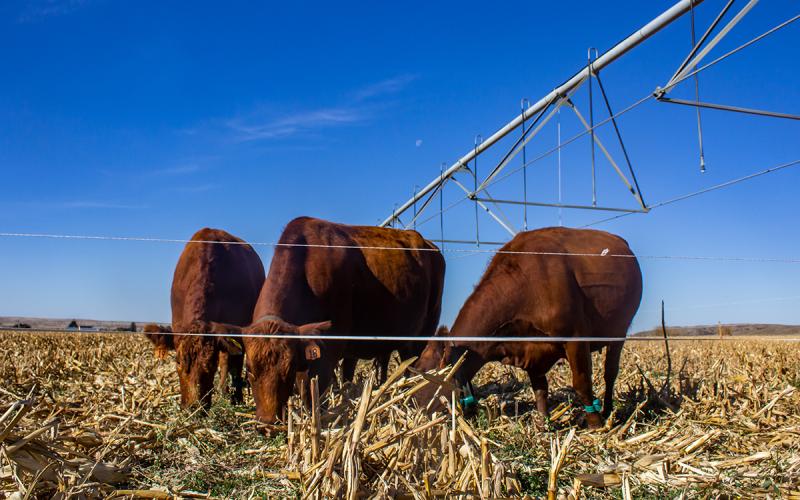
Stocking rates will vary by producer, field, and situation. When determining the stocking rate animal weight, corn yield, number of acres, and anticipated days on the field should be considered. A general rule of thumb is that corn produces roughly one pound of residue per pound of harvested grain. For instance, a 170-bu/ac corn crop at 56 lb/bu produces roughly 9,520 lb of grain/ac. Therefore, a rough estimate for this field would be about 9,520 lb of residue/ac.
However, not all residue is usable. Cattle are going to primarily select the grain, husks, leaves, and some cob material, leaving behind majority of the stalk. Additionally, leaving behind some residue is essential for soil protection and nutrient cycling. A typical starting point is to assume 25-30% of residue is grazeable material. In high-quality scenarios, up to 50% of total residue may be consumable material.
To calculate available forage, the following equation can be used:
- 170-bu corn × 56 lb. grain/bu = 9,520 lb residue/ac
If 25% is considered readily consumable:
- 9,520 × 0.25 = 2,380 lb. usable forage/ac
And we allow 30% of that usable forage to be consumed:
- 2,380 × 0.30 = 714 lb. of usable dry matter/ac
Now, we must match the usable forage to animal demand which is going to vary dependent on class of livestock (i.e. dry cow vs growing calf) and animal weight. In this example, we are going to utilize one animal unit (AU) or a 1,000 lb cow that consumes 26 lb of dry matter/day at 2.6% of body weight.
- 714 lb of usable dry matter/ac ÷ 26 lb. of dry matter/day = 27 cow-days/ac
This means that 1 AU could graze for about 27 days before accounting for nutrient requirement changes as a result of weather, trampling, selective grazing behavior, and the need to leave adequate residue. For scenarios where using the easy math of 1 AU may not be adequate, stocking rate can be calculated using: available grazeable dry matter / (animal dry matter intake x grazing days).
The Bottom Line
Ultimately, utilizing corn residue for grazing can have mutual benefits to both livestock, crop fields, and subsequent crop performance. Utilizing fall grazing to reduce volunteer corn populations can provide additional grazing days and nutritional value to livestock and reduce herbicide needs and potential pest and disease issues in following crops.