Written collaboratively by Eric Jones, Jill Alms, and David Vos.
Residual herbicides are often recommended to inhibit weed seed germination to minimize competition with the crop and heavy reliance on postemergence herbicides for weed management. Despite the importance of residual herbicides for weed management, environmental conditions affect the performance of these herbicides. Dry conditions at planting hinder the activity of residual herbicides as the herbicide is not moved into the soil profile where weed seeds are germinating. While wet conditions at planting prevent a timely application of residual herbicides, allowing weeds to germinate and cause early season competition with the crop.
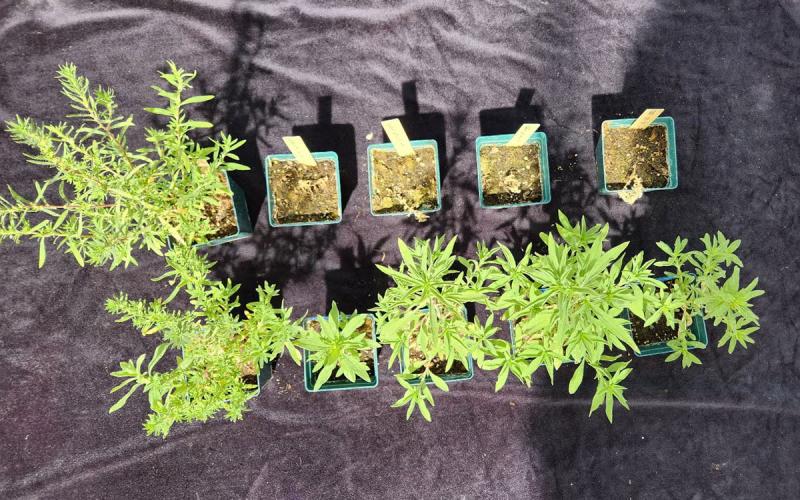
Fall-applied residual herbicides help manage early emerging weeds (such as kochia) by using snowmelt and early spring rainfall as activating precipitation to move the herbicide into the soil layer of emerging weed seedlings. While applying residual herbicide in the fall does not eliminate the need for all other herbicides during the growing season, the application timing reduces the risk of unfavorable conditions at planting.
Flumioxazin (e.g., Panther, Valor, others) is a commonly used herbicide for fall applications in South Dakota due to the lower solubility of the herbicide (does not breakdown easily with water) which results in extended residual activity and the effectiveness on many early emerging weeds. However, overreliance on this herbicide and other Group 14 herbicides (e.g., sulfentrazone [Spartan, component of Authority products] has selected for resistant kochia populations in Canada, North Dakota and South Dakota (Figure 1).
Investigating Herbicide Mixtures
Herbicide mixtures increase the effectiveness of weed managemen, while reducing selection pressure on herbicide-resistant weeds. As flumoxazin becomes less effective due to resistance, a common question is “What is as effective, and what other herbicides should be used as well?” A trial was conducted at The SDSU Southeast Research Farm in Beresford, South Dakota to determine the effectiveness of various fall applications of single herbicides and mixtures on kochia (Table 1). Herbicides were applied in the fall (11-4-2025) and kochia control was evaluated in the following spring (5-11-2026). Each herbicide treatment was replicated three times. While the focus of the study was to determine effective herbicide alternatives due to resistance, the kochia at the research farm is Group 14-susceptible.
| Tradename | Active ingredient | Herbicide Group(s) | Rate |
|---|---|---|---|
| Dual Magnum | S-metolachlor | 15 | 2 pt/acre |
| Prowl | pendimethalin | 3 | 3pt/acre |
| Tricor | metribuzin | 4 | 8 fl oz/acre |
| Valor | flumioxazion | 14 | 4 fl oz/acre |
| Zidua | pyroxasulfone | 15 | 6.5 fl oz/acre |
| Dimetric Charged | metribuzin + flumioxazin | 5 + 14 | 24 fl oz/acre |
| Dual Magnum + Zidua | S-metolachlor + pyroxasulfone | 15 | 2 pt + 6.5 fl oz/acre |
| Fierce EZ | flumioxazin + pyroxasulfone | 14 + 15 | 9 fl oz/acre |
| Tripzin | metribuzin + pendimethalin | 3 + 5 | 58 fl oz/acre |
| Fierce MTZ | metribuzin + flumioxazin + pyroxasulfone | 5 + 14 + 15 | 1.5 pt/acre |
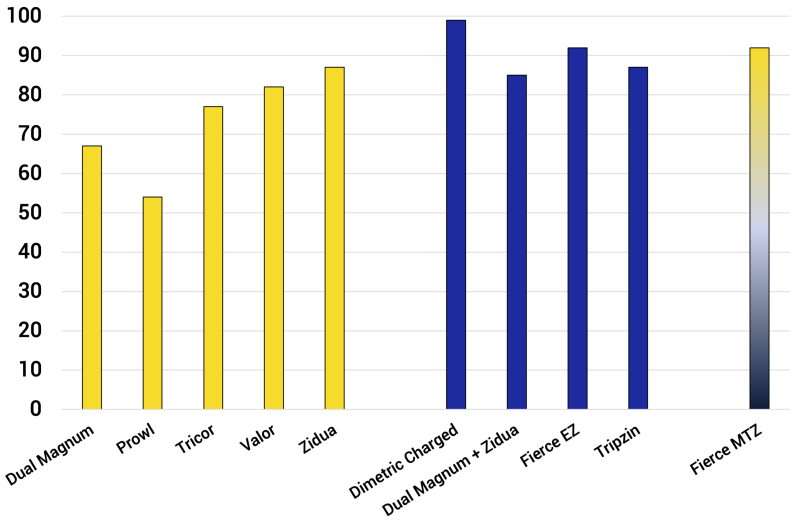
Valor and Zidua were the only single herbicide treatments to provide greater than 70% kochia control; kochia control from the other single herbicide treatments never exceeded 67% (Figure 2). All herbicide mixtures provided greater than 80% kochia control (Figure 2). Control was similar between the two herbicide mixtures and the three herbicide mixture (85 – 99% vs 92%) (Figure 2). Although these results are derived from a single year at one location and the kochia population was Group 14-susceptible, the trend of herbicides mixtures being more effective than a single herbicide holds true. Therefore, when fall-applied herbicides are used for kochia management, applying two or more herbicides from different herbicide groups can improve the likelihood of effective control and reduce reliance on a single herbicide site of action.
An important note of this study is that the herbicides were selected based on a soybean crop to be planted in the spring. While some of the herbicides can be applied to sunflowers, there are restrictions for corn (primarily with pendimethalin [Prowl H20]). The single herbicides were also applied at maximum labeled rates that would not allow additional applications of the herbicide in the crop season. Refer to the most-recent South Dakota Pest Management Guides and specific herbicide labels for more information regarding use rates, activity on weeds and planting restrictions.