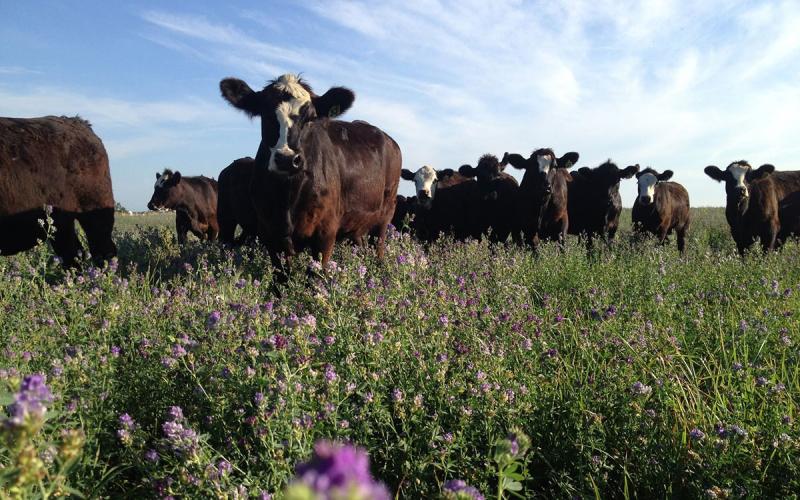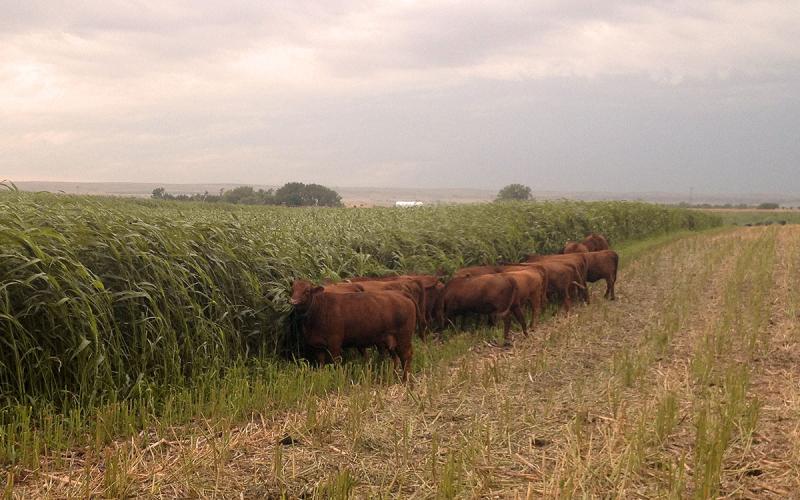
Prussic acid is a herbivory defense mechanism used by numerous plant species in the Northern Great Plains but is most associated with sorghum and sudangrass hybrids. For more information on prussic acid risks in sorghum species, see articles on Prussic Acid Poisoning on the SDSU Extension website.
While the risk of prussic acid poisoning is greatest in sorghum species, several additional species present across South Dakota can produce prussic acid at varying levels of concern. Producers should be aware of these plants, particularly when grazing pastures and rangelands following drought, frost or other conditions that damage plant tissue.
To begin, it is important to understand what “prussic acid” is and why it is not unique to sorghum species, despite most of the attention being placed on this group of plants. Prussic acid is the common agricultural term for hydrogen cyanide (HCN), a toxic compound released through a chain reaction involving cyanogenic compounds and plant enzymes. In healthy plants, the cyanogenic compounds remain stable and are stored separately from the enzymes that convert them into HCN. When plant cells rupture from freezing, wilting, trampling, grazing, chopping or other damage, the compounds mix and HCN is produced.
A simple way to visualize this reaction is to think of cracking a glow stick. Separately, the two chemicals do not produce light, but when the capsule keeping them apart is broken, the chemicals mix and the reaction becomes visible.
Put simply, plants that have this type of defense mechanism are called cyanogenic plants. Although the specific compounds and enzymes differ among species, the result of HCN production is the same. Fortunately, once free HCN develops, it does not persist. Sticking with the glow-stick analogy, the reaction is relatively short-lived and the HCN gradually dissipates as a gas, just as a glow stick becomes dimmer with time.
However, the cyanogenic compounds that can produce HCN may remain in living or harvested plant tissue after free HCN has dissipated. Rumen microorganisms can also release HCN from these compounds during digestion. Therefore, drying or waiting may reduce risk, but neither guarantees that questionable forage is safe. Laboratory testing for total HCN potential remains the most reliable option when conditions are uncertain.
Plant Species of Concern
Aside from sorghum and sudangrass hybrids, several other species found in South Dakota possess this defensive trick. Identifying these plants is particularly important in pasture and range grazing systems because many occur naturally or as weeds. Some may not normally be viewed as grazing species and can easily be overlooked.
Johnsongrass

Johnsongrass (Sorghum halepense) is a species of particular concern because it uses the same cyanogenic compound, dhurrin, to produce HCN as cultivated sorghum. Johnsongrass is not an ancestor of grain sorghum, but it belongs to the same genus and uses essentially the same cyanogenic system.
Johnsongrass is an introduced warm-season perennial that spreads by seed and underground rhizomes. It is less common in South Dakota than in states farther south but may occur along field margins, roadsides, drainageways and other disturbed areas. Risk is greatest in young plants and new growth following drought, mowing, grazing or a non-killing frost. Cattle, sheep and goats are all susceptible, with the greatest exposure occurring when hungry animals consume young, leafy growth rapidly. Apply the same grazing precautions used for sorghum: avoid frost-damaged plants and wait at least seven days after a complete killing freeze to graze standing forage.
Arrowgrass

Saltmarsh arrowgrass (Triglochin maritima) and marsh arrowgrass (Triglochin palustris) are grasslike perennial plants found in wet meadows, marshes, stream margins and saline or alkaline lowlands. Arrowgrass is not a true grass and can be identified by its narrow, fleshy basal leaves and small flowers or fruits arranged along a slender stalk.
Arrowgrass uses the cyanogenic compounds taxiphyllin and triglochinin rather than dhurrin, but plant damage releases HCN through a similar process. Stunted, drought-stressed, frost-damaged or recently cut plants present the greatest concern. Cattle and sheep are most commonly exposed while grazing wet meadows or consuming contaminated hay, although goats and horses can also be poisoned. Risk increases when drought lowers water levels, limits alternative forage or makes arrowgrass more accessible. Pastures or hay containing substantial amounts of arrowgrass should be tested when plants have been stressed.
Reed Canarygrass

Reed canarygrass (Phalaris arundinacea) is a tall, cool-season perennial commonly found along wetland margins, streams, drainageways and saturated or low-lying soils. It often forms dense stands and may provide much of the available green forage during early spring or late fall.
Prussic acid production in reed canarygrass is poorly understood and appears to be less consistent than in sorghum, Johnsongrass, arrowgrass or cherry species. An SDSU Extension case study documented detectable HCN in frost-exposed reed canarygrass, but the concentrations were below levels normally associated with acute poisoning and HCN could not be confirmed as the cause of death. Reed canarygrass is more clearly associated with tryptamine alkaloids that can cause neurological signs, “Phalaris staggers” or sudden death. When illness occurs, testing should consider HCN, alkaloids, nitrate, water quality and other possible causes.
Flax

Cultivated flax (Linum usitatissimum) contains several cyanogenic compounds, including linustatin, neolinustatin, linamarin and lotaustralin. Livestock exposure is most likely when immature, drought-stressed or frost-damaged flax is grazed, or when failed crops, volunteer flax, screenings or flax-processing products are used as feed.
Ruminants are at greatest risk because rumen microorganisms can release HCN from the cyanogenic compounds. Horses and other nonruminants are generally less efficient at releasing HCN from intact cyanogenic glycosides but can still be poisoned by forage or feed containing free HCN. Mature flax is not commonly grazed in South Dakota, so the greatest concern is likely to occur when a failed or stressed crop is considered for emergency forage. Suspect flax should be tested before grazing or feeding.
Cherry Species

Chokecherry (Prunus virginiana) is common across South Dakota and is frequently found in shelterbelts, draws, woodland edges, creek corridors and brushy areas. Wild black cherry (Prunus serotina), pin cherry (Prunus pensylvanica), American plum (Prunus americana) and planted fruit or ornamental Prunus species may present similar concerns.
Cherry species contain cyanogenic compounds such as prunasin and amygdalin. Young leaves and shoots generally have the greatest cyanogenic potential, but wilted leaves create the most common livestock hazard. Frost, drought, herbicide injury, pruning and storm-damaged branches can all make wilted foliage suddenly available to animals. Cattle can be poisoned after consuming fallen branches, while goats and sheep may face greater exposure because they browse shrubs and woody vegetation more readily. Cut or fallen branches should be removed from livestock areas rather than left for animals to consume. For more information, visit Poisonous Plants on Rangelands: Woody Species.
Serviceberry

Serviceberry (Amelanchier alnifolia) is a native shrub found primarily in western South Dakota, including the Black Hills, wooded draws, slopes and stream corridors. Its leaves and young shoots contain cyanogenic compounds that can release HCN following frost, wilting or mechanical damage.
Documented livestock poisoning from serviceberry is less common than poisoning from chokecherry. Cattle may be exposed where broken or cut branches fall into a pasture, while browsing animals such as goats and sheep are more likely to consume the living shrub. Risk is greatest when alternative forage is limited or animals gain concentrated access to wilted branches and young growth.
Conclusion
The presence of a cyanogenic plant does not necessarily make an entire pasture unsafe. Risk depends on the species, environmental stress, plant maturity, amount available, degree of tissue damage and how rapidly it is consumed. Hungry animals introduced into a new pasture are at greater risk because rapid consumption can overwhelm their ability to detoxify cyanide. When cyanogenic plants are abundant or growing conditions have increased concern, laboratory testing is the most dependable way to determine whether the forage can be safely grazed or fed.
Declaration of Generative AI and AI-Assisted Technologies in the Writing Process
During the preparation of this work, the authors used artificial intelligence to make minor editorial corrections. After using this tool/service, the authors reviewed and edited the content as needed and take full responsibility for the article’s content.
References
- Bachler, J., & Ehlert, K. (2025, March 4). Poisonous plants on rangelands: Woody species. South Dakota State University Extension.
- Bauder, S. (2025, September 8). Prussic acid poisoning. South Dakota State University Extension.
- Bauman, P. (2021, June 28). Reed canary grass: Possible prussic acid & alkaloid issues. South Dakota State University Extension.
- Binder, E. M., Blodgett, D. J., Currin, J. F., Caudell, D., Cherney, J. H., & LeRoith, T. (2010). Phalaris arundinacea (reed canarygrass) grass staggers in beef cattle. Journal of Veterinary Diagnostic Investigation, 22(5), 802–805.
- Gleadow, R. M., Møldrup, M. E., O’Donnell, N. H., & Stuart, P. N. (2012). Drying and processing protocols affect the quantification of cyanogenic glucosides in forage sorghum. Journal of the Science of Food and Agriculture, 92(11), 2234–2238.
- Great Basin Seed. (n.d.). Utah serviceberry (Amelanchier utahensis). Retrieved October 21, 2026.
- Gruss, S. M., Johnson, K. D., Johnson, S. K., Holman, J. D., Obour, A. K., Aiken, R. M., & Tuinstra, M. R. (2022, July). Managing the prussic acid hazard in sorghum (AY-378-W). Purdue University Extension.
- Gruss, S. M., Johnson, K., Ghaste, M., Widhalm, J. R., Johnson, S. K., Holman, J. D., Obour, A. K., Aiken, R. M., & Tuinstra, M. R. (2023). Dhurrin stability and hydrogen cyanide release in dried sorghum samples. Field Crops Research, 291, Article 108764.
- Haskins, F. A., Gorz, H. J., Hill, R. M., & Youngquist, J. B. (1984). Effect of freezing on the hydrocyanic acid potential of field-grown sorghum tillers. Crop Science, 24(6), 1183–1186.
- Millborn Seeds. (n.d.). Flax. Retrieved October 21, 2026.
- Mohler, C. L., Teasdale, J. R., & DiTommaso, A. (2021). Johnsongrass. In Manage weeds on your farm: A guide to ecological strategies. Sustainable Agriculture Research and Education.
- Morton Arboretum. (n.d.). Reed canary grass. Retrieved October 21, 2026.
- Native Plant Trust. (n.d.). Triglochin maritima L.: Saltmarsh arrow-grass, seaside arrow-grass. Go Botany. Retrieved October 21, 2026.
- Nielsen, J. S., & Møller, B. L. (1999). Biosynthesis of cyanogenic glucosides in Triglochin maritima and the involvement of cytochrome P450 enzymes. Archives of Biochemistry and Biophysics, 368(1), 121–130.
- Oomah, B. D., Mazza, G., & Kenaschuk, E. O. (1992). Cyanogenic compounds in flaxseed. Journal of Agricultural and Food Chemistry, 40(8), 1346–1348.
- Panter, K. E., Ralphs, M. H., Pfister, J. A., Gardner, D. R., Stegelmeier, B. L., Lee, S. T., Welch, K. D., Green, B. T., Davis, T. Z., & Cook, D. (2011). Plants poisonous to livestock in the Western States (Agriculture Information Bulletin No. 415, rev. ed.). U.S. Department of Agriculture, Agricultural Research Service.
- Radke, S. (2026, June). Cyanide poisoning in animals. Merck Veterinary Manual.
- South Dakota State University Extension. (2022, September 9). Prussic acid precautions.
- U.S. Department of Agriculture, Agricultural Research Service. (n.d.). Arrowgrass (Triglochin maritima and T. palustris).
- Waggoner, J. W., & Holman, J. D. (2013). Effects of sample handling method on prussic acid (hydrocyanic acid) content of forage sorghum. In Roundup 2013. Kansas State University Agricultural Experiment Station and Cooperative Extension Service.