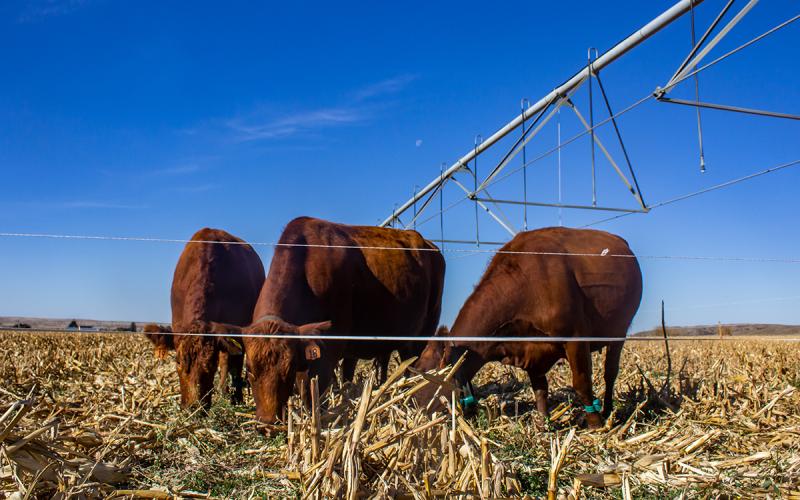
The combine leaves the field, the grain is in the bin, and for most people, the corn crop is finished. However, for livestock producers, the harvest may only be entering its second phase. A field still produces something of value after the grain has been harvested. Husks, leaves, cobs, stalks, and some amount of grain and ears are scattered across the field. For the cow, it simply isn’t residue, it’s another source of feed.
Traditionally, we might discuss grazing corn residue in simple terms: 200 acres, 100 cows, 40 days of additional grazing. While those numbers help shape the big picture, they don’t necessarily tell us what the grazing accomplished.
How much feed did the cattle harvest? How much stored feed did those additional grazing days replace? How much value did the cattle capture from a crop that had been previously harvested? And how much residue remained in the field to continue doing its job for the soil? Instead, maybe we should look at the entire flow of value:
Corn produced → residue left behind → feed harvested by livestock → nutrients returned to the soil and stored feed replaced.
Measuring More Than Grazing Days
Grazing days are easy to understand, but they only serve as representative of what we truly want to know. Factors such as livestock size and class, stocking density, weather, residue availability, amount of grain, and grazing management can all influence how much feed cattle actually consume. Perhaps a better question is: How much of the available residue did the livestock harvest?
Cattle are selective grazers, meaning they tend to naturally select more palatable and easier digestible portions first. In the case of corn residue, this is the husks and leaves, leaving stalk and cob material for last. As grazing continues, the quality and quantity of the residue that remains decreases over time, meaning that residue is not simply how long cattle remain in the field, but how much usable feed they harvested during that time.
Another way to evaluate the value of grazing crop residue is to factor in the value of grazing compared to conventional feeding. The time spent grazing residue likely means those cattle were not consuming feed that otherwise might have been supplied form hay, silage, or other stored sources. Therefore, the value of grazing corn residue should include the feed that was harvested, stored, transported, and delivered.
Capturing Value From a Previously Harvested Crop
For the farmer, the primary product may be corn grain. For the livestock producer, the remaining plant material represents an opportunity to capture added value and reduce stored feed costs. In a system that utilizes both crop and livestock enterprises, the same acre can contribute to both.
Rather than mechanically harvesting every pound of remaining plant material, bailing it, and hauling it to livestock, turning cattle out on residue allows them to harvest much of the available feed themselves. Grazing crop residues can reduce the need for machinery, fuel, labor, storage, and hauling associated with harvesting a secondary feed resource. It can also help feed the nutrient cycle back to the soil by placing manure and urine directly back on the field, returning nutrients for the next crop.
Residue Still Has a Job
However, when grazing crop residue, the goal should not be to remove every usable pound from the field. Instead, good residue grazing should be about finding the point where livestock are able to capture meaningful feed value while leaving behind enough residue to continue serving the soil.
Crop residue plays a significant role in healthy soil management. It helps protect the soil from wind and rain, reduce erosion, and it also contributes organic matter back into the soil and can improve water infiltration capacity and soil moisture. All of which are important for long-term productivity and sustainability.
The appropriate amount of residue to harvest and leave behind varies from field to field and is influenced by factors such as soil type, slope, climate, tillage system, yield, weather, and other management factors. A field that can support significant grazing without compromising productivity and soil health has a different grazing capacity compared to a field that has little residue and a greater risk of erosion.
Looking at the Whole System
Each step of harvest creates value, but the value is easiest to determine when the entire system is considered. The corn grain serves purpose to people and livestock. The remaining plant material can be harvested by cattle creating added value. Cattle are then able to convert that residue into beef while returning nutrients to the field. These additional grazing days can replace a portion of stored feed while reducing some of the expense associated with harvesting and feeding that forage. Simultaneously, remaining crop residue continues to protect and build the soil.
As corn harvest wraps up, remember that the value of the crop doesn’t have to end when the grain leaves the field. With intentional grazing management, the post-harvest residue can become part of another production cycle that connects crops, cattle, economics, and soil.