Overview
When we start the year out with limited soil moisture and limited precipitation, you hopefully started thinking about ways to be flexible with your management decisions, such as destocking, finding additional pasture to run on, early weaning, or other adaptive management strategies. Planning for drought can quickly be replaced with a false sense of security when precipitation does arrive in the middle of the growing and grazing seasons. It is easy to feel safe when precipitation seems plentiful, but there are still management decisions to make that can influence the outcomes you experience from the latter half of the grazing season and early fall.
At this juncture, it’s important to implement management strategies that continue to maximize your pasture and herd-health during a year where the precipitation we receive is helpful – but not as much as you might think. When spring moisture is delayed or limited, and the following moisture received doesn’t help your operation reach “normal” precipitation or production levels, there are a few things to consider.
How did spring precipitation stack up? Understanding timely precipitation and amount from normal.
The precipitation we receive in April, May, and June is the most advantageous for growth in the Northern Great Plains. The reason for this is that we are largely dominated by cool-season grasses in South Dakota and approximately 75% of forage growth is complete by the end of June. While rains in late June and July may alleviate some stress, you may still be below normal precipitation for year to date, and most growth in cool-season grasses is complete for the year. These mid-year and later rains benefit warm-season grasses or opportunities annuals – not the cool-season species that drive early forage production. Examples of this are the following South Dakota Mesonet stations that did receive timely precipitation in May and June, in particular (Figures 1-4).
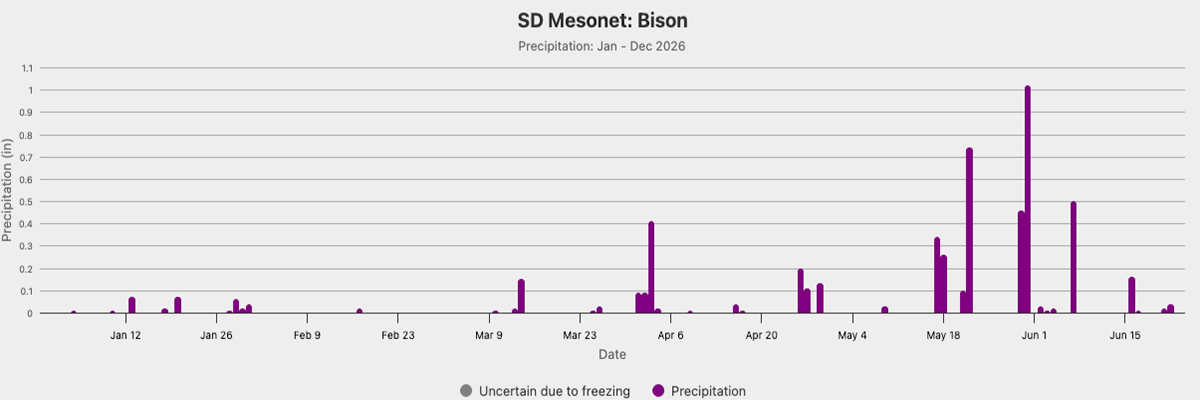
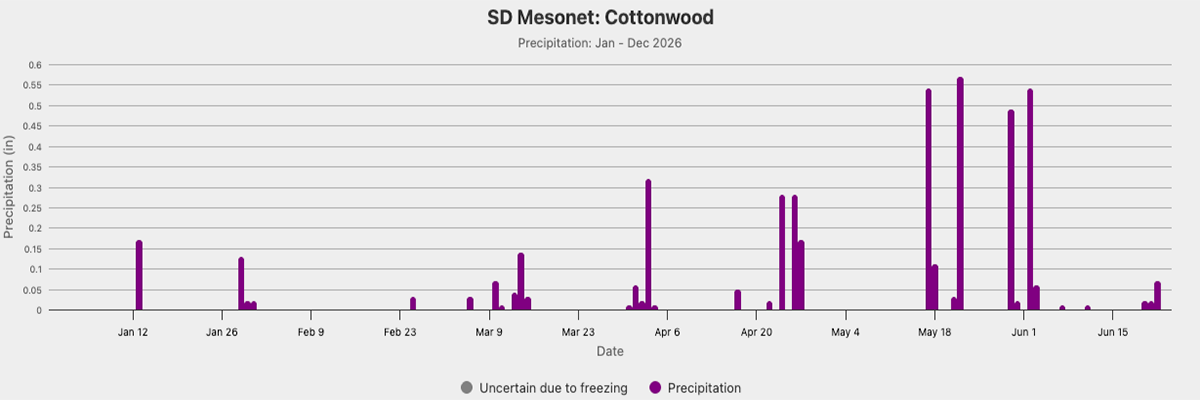
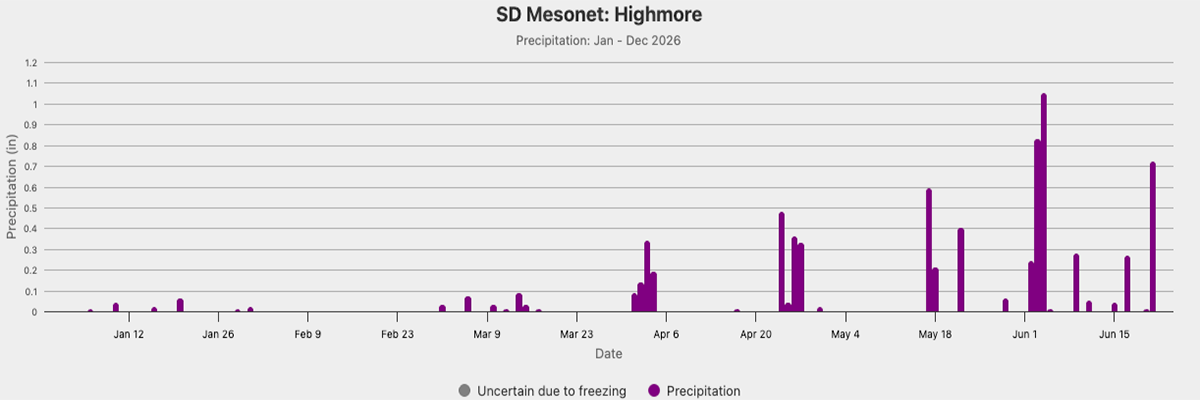
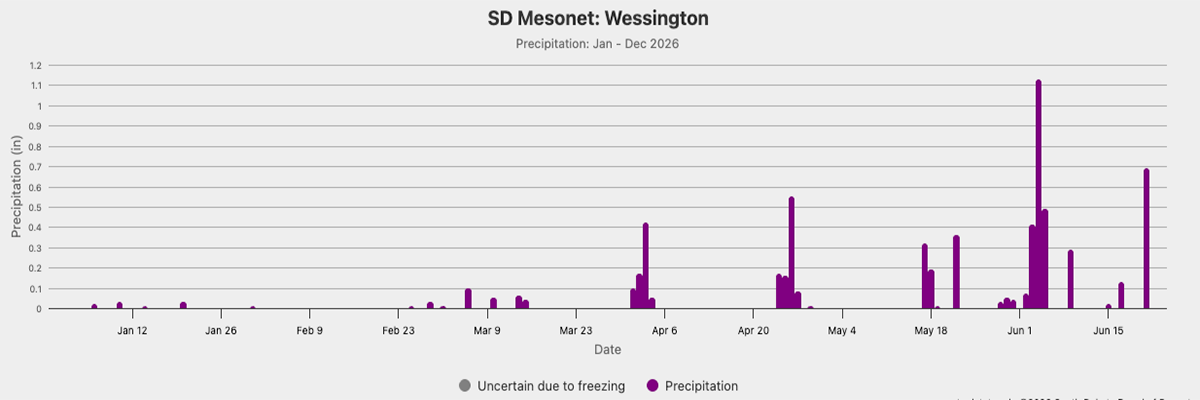
While these figures appear promising, when you further digest how much precipitation has been received to date compared to what normal precipitation is to date – it lags quite a bit (Table 1). Precipitation received mid to late growing season will not make up your deficit. Additionally, significant rainfall events may look great in the rain gauge, but the amount of that rain that infiltrates into the soil can be far less than what was received.
| Station | Precipitation (1/1/26 to 6/22/26) | Amount From Normal |
|---|---|---|
| Bison | 5.4 in | -3.8 in |
| Cottonwood | 4.4 in | -5.1 in |
| Highmore | 7.2 in | -3.8 in |
| Wessington | 6.3 in | -4.83 |
In addition to mixed-precipitation, growing conditions and how grasses respond can be compounded by mixed-temperatures early in the growing season. For example, in a year where we have limited moisture, but it was warm, followed by cold temperatures, again followed by limited moisture and high temperatures – grasses are going to equate those conditions to stress. Consequently, grasses may mature earlier in the season and be stunted in growth (e.g., western wheatgrass matures and heads out late May and only reaches 6 inches tall).
Soil moisture: The hidden reserve and driving factor.
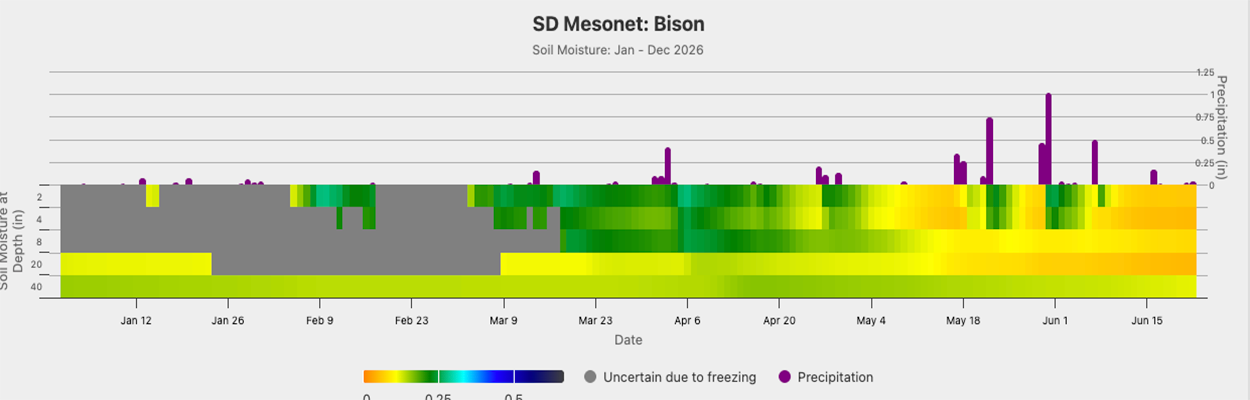
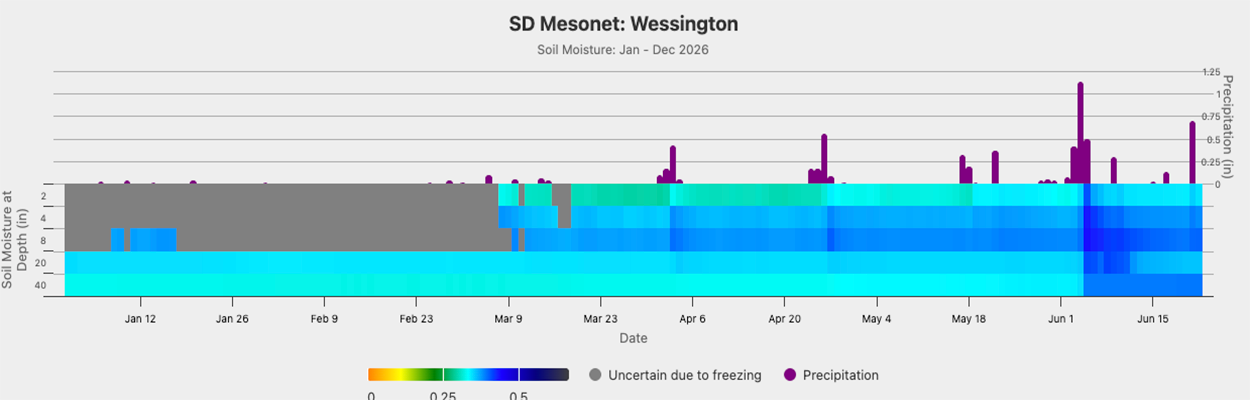
Adequate soil moisture serves as a temporary insurance policy when rainfall is below average. It is important to note that dormant season precipitation is especially valuable for recharging this soil moisture while plants are not actively growing and using that moisture. A lack of dormant precipitation is indicative of a delayed spring green up. When early spring moisture is lacking, plants will tap into this reserve moisture to initiate their growth. However, without sufficient rainfall to recharge the soil profile (Figures 5-6), that buffer will quickly disappear. This leaves pastures vulnerable to stress and reduces regrowth potential.
Key indicators of low soil moisture include:
- Cracking soil or hard-packed surfaces (i.e., the soil doesn’t “spring back” when you walk on it)
- Wilting or stunted forage
- Unusual bare patches or early dormancy
- Soil moisture probe readings that show dryness in the upper and mid-profile layers
What are pastures telling you now?
Ranchers should continue to monitor their pasture conditions throughout the season. Consider these range assessment tips:
- Use grazing exclosures to compare grazed vs ungrazed areas
- Track forage height and density to compare among years
- Evaluate plant species composition – note the presence of stress indicators (increase in annuals or undesirable forage)
- Look for signs of overgrazing – especially if recovery between grazing events is limited
Pay attention to these signs of the trajectory of your pastures as you move into the late grazing season and early fall.
- Stunted regrowth after grazing or clipping
- Unusual browning, heading out, or early dormancy
- Increase in bare ground or invasive species
- Cattle grazing closer to the ground or ignoring their typical “ice cream” plants
If pastures are lagging despite some summer rainfall, that indicates that spring soil moisture and rainfall wasn’t sufficient to support strong growth – and the system is now under stress.
Early weaning as a strategy to reduce stress on your pastures
Consider early weaning as a drought management strategy for your operation. Early weaning – at 90-150 days of age – is an effective way to reduce forage demand during drought or forage shortages. Simply removing the calf and stopping the cow’s lactation can reduce the cow’s nutritional needs by 25-30%. This strategy can help maintain or improve her body condition as she heads into the dormant season without increasing feed costs.
Consider early weaning if:
- Pasture production is well below normal
- Cows are beginning to lose condition
- You want to extend the grazing season or avoid overgrazing
- You’re looking to maintain pasture heath going into fall and winter
Summary
Every year is different, but the long-term sustainability of your pastures and herd depends on timely, flexible management. Mid-season is not too late to course-correct – but it is the time for a clear-eyed assessment. Rain that falls now can help, but it won’t replace what didn’t grow in the spring. Steps to take going forward include evaluating the precipitation received to date, and how close you are to normal precipitation to date, adjusting your grazing rotations to protect weakened pastures, implement early weaning or partially destock if needed, consider supplemental feeding to reduce pressure on dry rangeland, and finally, start planning early for the fall and winter.