Written collaboratively by Tong Wang, Airish Lou Yago, and Wajdi Belgacem.
South Dakota agriculture has always been shaped by weather, but recent decades have brought a noticeable increase in climate variability. Producers are now facing more frequent swings between severe drought and excessive wetness—sometimes within the same growing season. These rapid shifts create new challenges for crop production, soil management, and long‑term planning. Understanding these trends and adopting adaptive management practices can help producers strengthen the resilience of their operations.
Weather Extremes are Becoming More Common
Over the past three decades, South Dakota has experienced increasing climate variability, characterized by both severe droughts and more frequent excessively wet conditions. In 2012, an intense drought prevented the planting of more than one million acres nationwide, including approximately 130,000 acres in South Dakota (USDA‑FSA, n.d.). Similarly, widespread flooding in 2019 resulted in over 19 million unplanted acres across the United States, with South Dakota experiencing the most severe impacts—nearly four million acres remained unplanted (USDA‑FSA, n.d.; Lawal et al., 2021). These events underscore the growing sensitivity of agricultural systems to climate variability and highlight the need for farmers to understand long‑term weather patterns and adopt effective adaptation strategies.
A widely used metric for monitoring these shifts is the Standardized Precipitation Evapotranspiration Index (SPEI), which captures the balance between water supply (precipitation) and water demand (potential evapotranspiration) (National Integrated Drought Information System [NIDIS], n.d.). Evapotranspiration is influenced by temperature, solar radiation, wind, and humidity; for example, rising temperatures accelerate evapotranspiration and can intensify drought severity. By integrating these factors, SPEI provides a comprehensive measure of water availability, making it particularly valuable for agricultural assessments. SPEI values typically range from extreme drought (≤ −2.0, D4) to extreme wetness (≥ 2.0, W4), offering a standardized framework for evaluating climatic conditions.
Classification of Drought and Wetness based on SPEI Values
Drought Categories
- D0: −0.7 to −0.5 (abnormally dry)
- D1: −1.2 to −0.8 (moderate drought)
- D2: −1.5 to −1.3 (severe drought)
- D3: −1.9 to −1.6 (extreme drought)
- D4: ≤ −2.0 (exceptional drought)
Wet Categories
- W0: 0.5 to 0.7 (abnormally wet)
- W1: 0.8 to 1.2 (moderate wet)
- W2: 1.3 to 1.5 (severe wet)
- W3: 1.6 to 1.9 (extreme wet)
- W4: >= 2.0 (exceptional wet)
Exceptional Drought and Wet Trends in South Dakota: 1996-2025
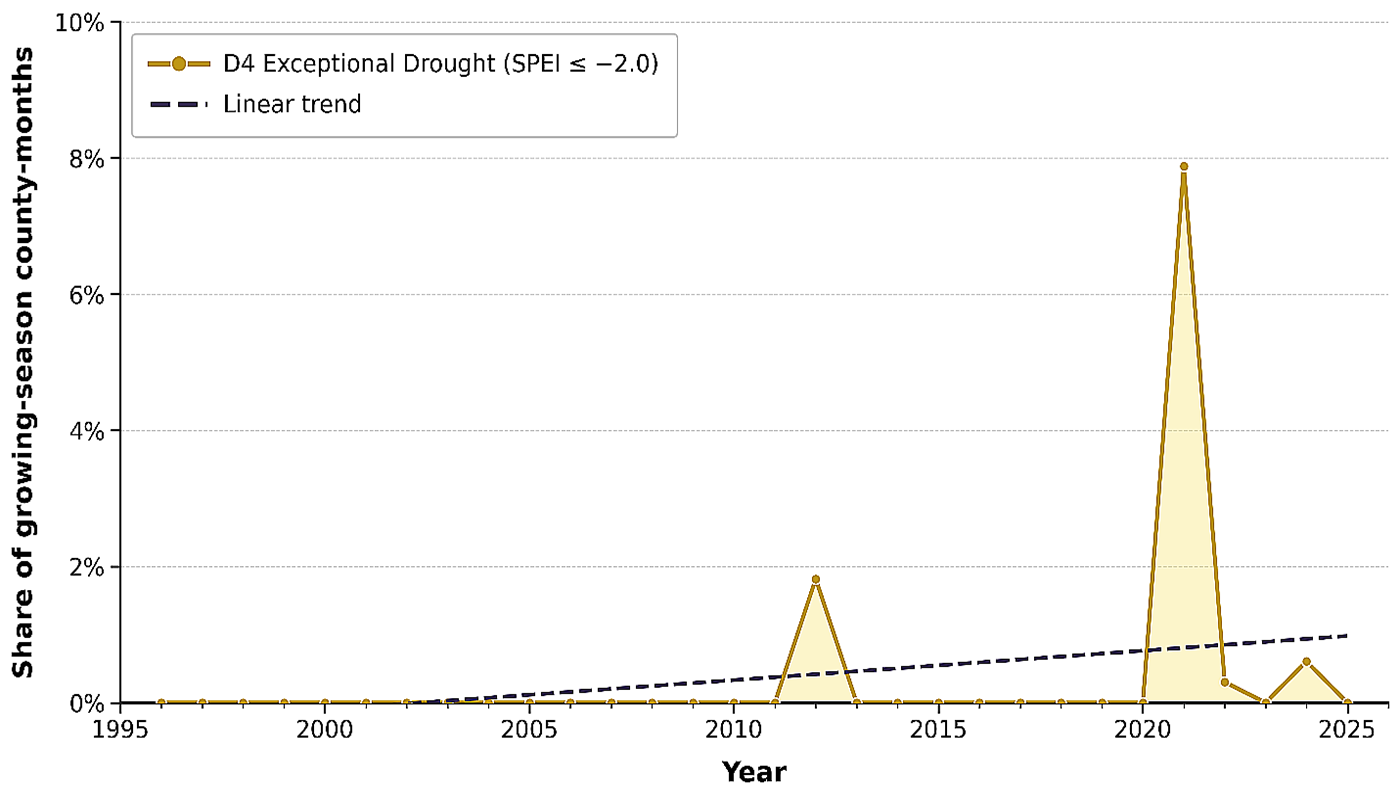
An analysis of SPEI-based data from 1996 to 2025 reveals an increasing trend in exceptional drought conditions. Although exceptional drought events are relatively rare, the figure above shows notable spikes during major drought years, particularly in 2012 and 2021. In contrast, exceptionally wet conditions occur more regularly throughout the record. The figure displays distinct peaks in 2010, 2014, and 2019, indicating that extreme moisture surpluses have become a recurring feature in South Dakota. Together, these patterns reveal a broadening range of hydroclimatic extremes, emphasizing the need for producers to adopt more resilient and adaptive strategies.
Exceptional Drought
Exceptionally Wet
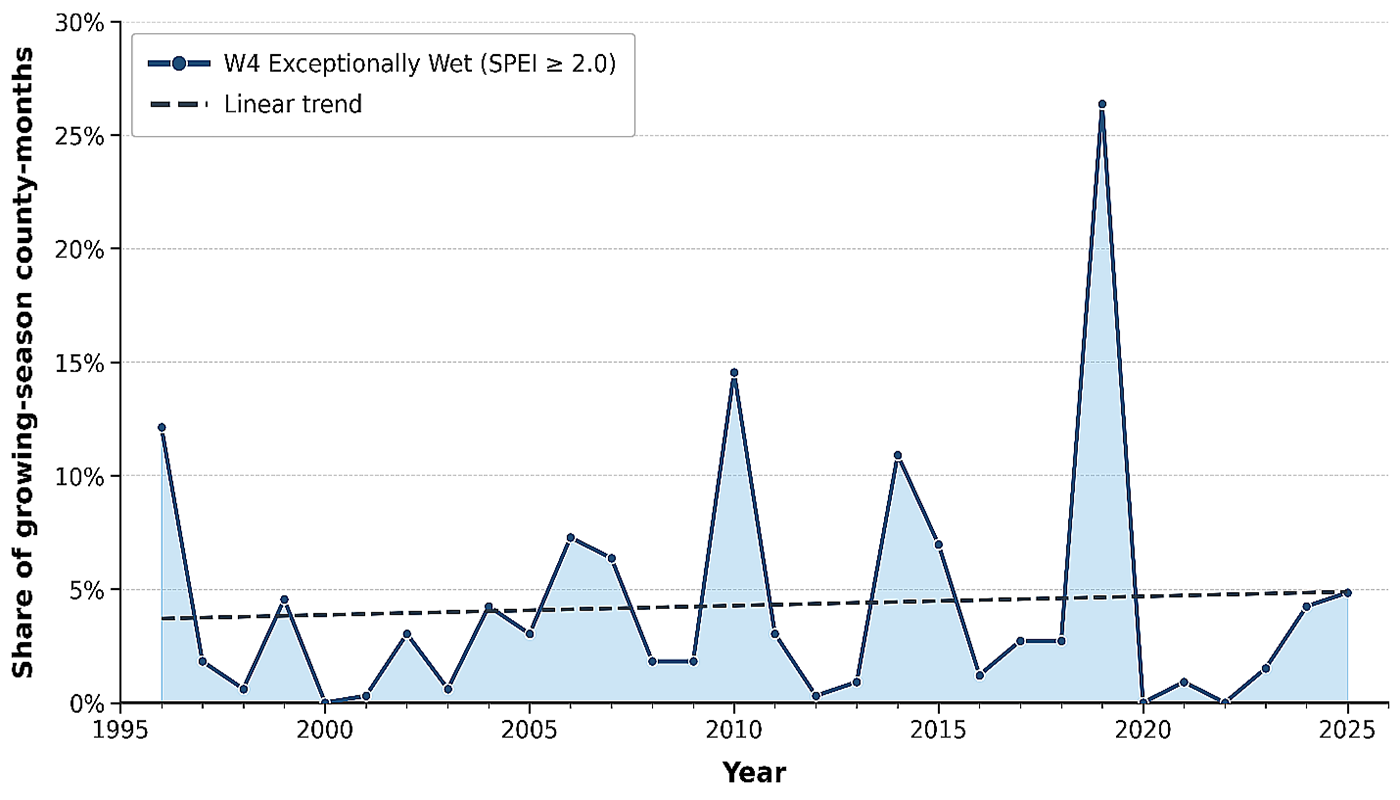
Note: The growing season in South Dakota is defined as May through September (Wang et al., 2026). Share of county- months is calculated by summing up the total number of drought-affected months across all South Dakota counties during the growing season, then dividing by the total number of county‑months in the state for that same period.
From an agricultural risk perspective, this pattern over the years is especially concerning. Rising drought intensity increases the risk of soil moisture deficits, reduced pasture productivity, and crop yield losses. Simultaneously, the increasing frequency of exceptionally wet conditions heightens the challenges of planting delays, nutrient leaching, soil compaction, and prevented planting. The coexistence of these contrasting risks complicates farm management, requiring producers to carefully plan for both moisture shortages and surpluses within limited timeframes.
Adaptation Strategies for Resilient Farming Systems
Given these trends, adaptation strategies that strengthen farming system resilience have become increasingly important. Several practices—no‑till farming, diversified crop rotations, cover cropping, and controlled or slow‑release fertilizers—are widely recognized for improving soil health and buffering crops against extreme weather.
No‑Till Farming
No‑till systems minimize soil disturbance, helping preserve soil structure and organic matter. Under drought conditions, improved soil aggregation enhances water infiltration and retention, allowing crops to access moisture more efficiently (USDA, 2024). No‑till also reduces evaporation losses from the soil surface (Samantha et al., 2025).
Economically, no‑till can reduce fuel and labor costs by eliminating multiple tillage operations. In 2018, 36% of South Dakota farmers reported cost savings associated with no‑till adoption (Wang and Ristau, 2021a). While transitioning to no‑till may require adjustments in equipment and weed management, long‑term improvements in soil health can enhance yield stability and contribute to more consistent farm income.
Resilient Crop Rotation Systems
Including small grains, legumes, or forage crops in a rotation helps build healthier soils. These rotations reduce soil compaction, improve aggregation, and increase pore space, allowing roots to grow more effectively and water to move through the soil more efficiently (Iheshiulo et al., 2023).
Incorporating a wider range of crops to crop rotations can strengthen the bottom line by improving yields and reducing input needs (Wang and Ristau, 2021b). However, the profitability of different cropping systems depends on local market opportunities, input prices, and individual farm conditions, making adoption decisions highly context dependent.
Cover cropping
Cover crops are especially valuable under excessively wet conditions. They protect the soil surface, improve water infiltration, and help reduce erosion during heavy rainfall events (Yoder et al., 2021). Their root systems also help maintain soil structure, lowering the risk of compaction and surface runoff. Although cover cropping requires additional investment, many South Dakota farmers report long‑term gains in soil health and water infiltration that often justify the added costs (Wang and Ristau, 2021c).
Controlled or slow-release fertilizer
Controlled or slow‑release fertilizers provide another useful adaptation strategy for wetter environments. Because they release nutrients gradually, they help reduce losses from leaching and runoff during heavy rainfall events (Clark, n.d.). Although these products come with higher costs, they can improve nutrient efficiency, reduce the need for multiple applications, and support more stable yields under variable weather conditions.
Take-Away Message
By understanding emerging climate trends and adopting adaptive practices (e.g., no‑till farming, resilient crop rotation systems, cover cropping, and controlled or slow‑release fertilizer), producers can strengthen the resilience of their operations. These strategies not only help buffer crops and soils against moisture extremes but also support more stable yields and long‑term profitability. Continued collaboration among producers, Extension professionals, and researchers will be essential for developing and sharing tools that help farms remain productive and resilient in an increasingly variable climate.
References
- Clark, C.A. n.d. What happens to your crops in flooded fields?. University of Wisconsin-Madison Division of Extension. [Accessed March 16, 2026]
- Iheshiulo, E. M. A., Larney, F. J., Hernandez-Ramirez, G., Luce, M. S., Liu, K., & Chau, H. W. (2023). Do diversified crop rotations influence soil physical health? A meta-analysis. Soil and Tillage Research, 233, 105781.
- Lawal, A., Kerner, H., Becker-Reshef, I., & Meyer, S. (2021). Mapping the location and extent of 2019 prevent planting acres in South Dakota using remote sensing techniques. Remote Sensing, 13(13), 2430.
- National Integrated Drought Information System. n.d. U.S. Gridded Standardized Precipitation Evapotranspiration Index (SPEI) from nClimGrid-Daily. [Accessed April 28, 2026].
- Samanta, S., Ale, S., & Morgan, C. L. (2025). Evaluating the potential of no-tillage in enhancing resilience of agricultural watersheds to extreme climatic conditions. Science of The Total Environment, 1001, 180495.
- USDA Farm Service Agency (FSA). n.d. Crop Acreage Data. [Accessed April 28, 2026].
- USDA. 2024. Northwest No-Till Farming for Climate Resilience. USDA Climate Hubs. [Accessed April 28, 2026]
- Wang, T. and Ristau, J., South Dakota Farmers’ Usage of Conservation Tillage. (2021a). South Dakota Farm Survey. 7.
- Wang, T. and Ristau, J., South Dakota Farmers’ Usage of Diversified Crop Rotations. (2021b). South Dakota Farm Survey. 6.
- Wang, T. and Ristau, J., South Dakota Farmers’ Usage of Cover Crops. (2021c). South Dakota Farm Survey. 8.
- Wang, T., Yago, A. L., & Belgacem, W. (2026). Farmer Perceived Climate Trends and Conservation Practice Adoption. Choices, 41(1), 1-12.