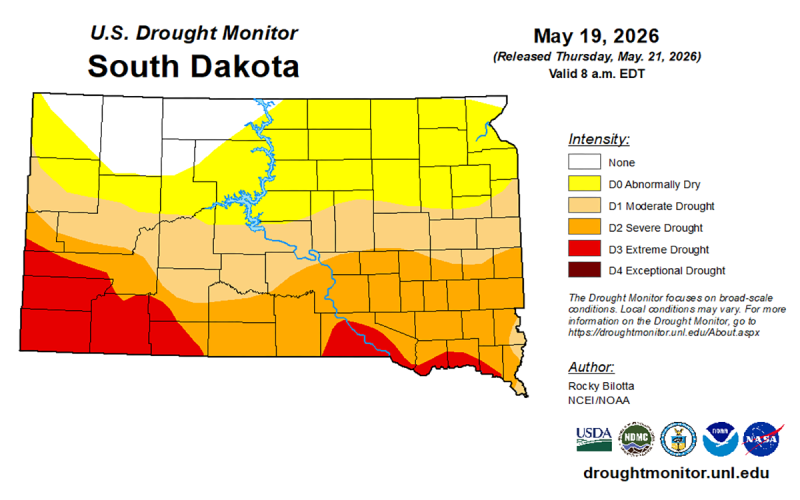
Despite the technological advances, weather factors still play a major role in crop production, especially precipitation. The current U.S. Drought Monitor shows that almost all of South Dakota is under abnormally dry or moderately to severe drought conditions (Figure 1). Even though crop producers with established irrigation systems are usually able to manage crop water needs more effectively, some agronomic considerations may prevent the situation from getting worse for producers under dryland management systems.
Weed Control
Weeds under drought conditions tend to show more tolerance to applied herbicides that those growing under optimal conditions because plants may develop thicker wax layer on the leaf surface to conserve moisture which can obstruct the herbicide absorption. Herbicides applied during highly stressful environmental conditions may cause unwanted injuries to already stressed crops and not affect weeds as intended. Systemic herbicides such as Roundup and SU herbicides are known to have reduced effects during hot and dry conditions.
Insects
Weather factors can influence insect populations quite dramatically, both in favor of and against the growing crops. One of the insects to lookout for during hot and dry conditions is grasshoppers. Warmer winter and springs like the one in 2025-26 usually favor early hatch and subsequent growths of grasshoppers. Under hot and dry conditions, a small grasshopper population can do as much damage as a large population under cool, wet conditions. Another important insect that can thrive during dry conditions is thrips. Crops, especially soybean is susceptible to thrips early in the season and conditions may worsen during hot and dry weather. Soybean aphids, considered one of the major pests of soybean also tend to have more pronounced effects on plants that are stressed by hot and dry weather conditions.
Nutrient Deficiency Symptoms
Under dry conditions, plants may show moderate to severe nutrient deficiency symptoms even when the soil contains adequate amount of nutrients needed for normal growth and development. These symptoms could be in the whole field or on a small area in the field. One of the major nutrients that could be harder for plants to extract during moisture deficit situations is potassium. When the field shows deficiency symptoms, a good practice would be sample soil and plant tissues from good and bad portion of the field and conduct nutrient analyses on both sets of samples to confirm the presence (or absence) of these nutrients. Further, if the dry (granular) nitrogen fertilizer is applied late, it may stay on the soil surface for prolonged period of time and not be readily available to the plant as roots are penetrating deeper in the soil for resources. This will cause plants to show N-deficiency symptoms.
Nitrates in Forages
Nitrates in forage crops when converted to nitrites can cause toxicity to livestock at higher amounts. Under drought conditions plants cannot effectively metabolize nitrates into protein and amino acids. These nitrates can build up in the plant tissues and cause toxicity when fed to livestock. As grass forages are more likely to be fertilized with nitrogen, it is recommended to test for nitrates when these crops are grown under drought conditions.


