Written collaboratively by Hector Menendez [Matt Beck, Jordan Adams, Julia Travassos da Silva, and Luis O. Tedeschi.
Why Consider Fat in Cattle Diets?
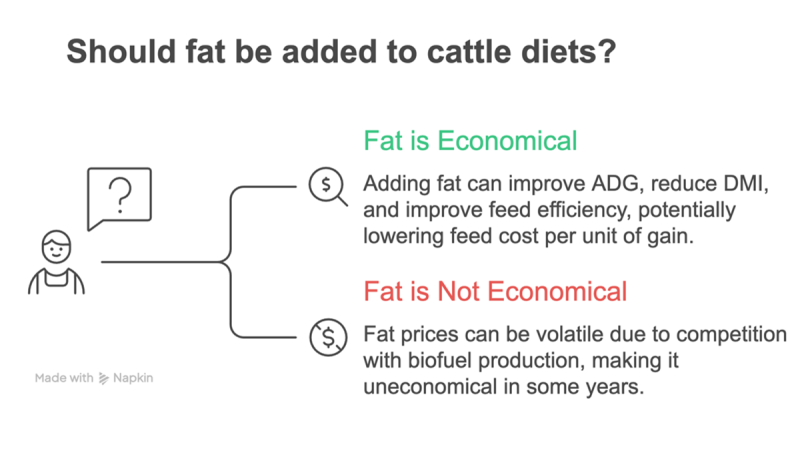
Adding fat to cattle diets is a common strategy in confinement systems to increase dietary energy density. Higher-energy diets often improve average daily gain (ADG), reduce dry matter intake (DMI), and improve feed efficiency (feed-to-gain; Zinn & Jorquera, 2007). When fat is economical, these changes can lower the feed cost per unit of gain, which is a key driver in profitability. However, fat prices have become more volatile in recent years. This volatility is largely driven by competition between livestock feed use and biofuel production (Ajanovic, 2011; Oláh et al., 2017). As a result, fat that was economical one year may not be the next. Because of this uncertainty, producers and conservation planners need a simple way to evaluate when fat inclusion makes economic sense (breakeven cost) for a specific diet type and what ingredient they plan to replace with supplemental fat.
This article introduces a feed-to-gain breakeven calculator developed by the National Animal Nutrition Program (NANP) Feed Management Committee to support informed decisions.
The Key Question: Does Fat Reduce the Cost of Gain?
The most practical way to evaluate fat inclusion is to focus on feed cost of gain, not just ration cost or energy concentration. If ration cost and feed-to-gain ratio are known, one can calculate the feed-only cost of gain (ration cost × feed-to-gain ratio). For example, a ration that costs $7.00 per 100 lb of dry matter and yields a feed-to-gain ratio of 6.3 (i.e., 6.3 lbs. of feed required for 1 lb. of gain) would have a feed-only cost of gain of $44.10 per 100-lbs of gain. A ration that improves feed efficiency may still be uneconomical if ingredient costs increase too much. Conversely, a more expensive ration can be profitable if it substantially improves feed-to-gain.
Why Breakeven Matters
Rather than looking at fat price alone, it would be better to determine the maximum price you can pay for fat and still breakeven. The breakeven price depends on the ingredient fat replaces [e.g., corn or dried distillers’ grains (DDG)], the price of that ingredient, and the change in feed-to-gain when fat is added. Because these factors vary across operations and over time, a one-size-fits-all recommendation does not work.
Feed-to-Gain Calculator: Fat Inclusion
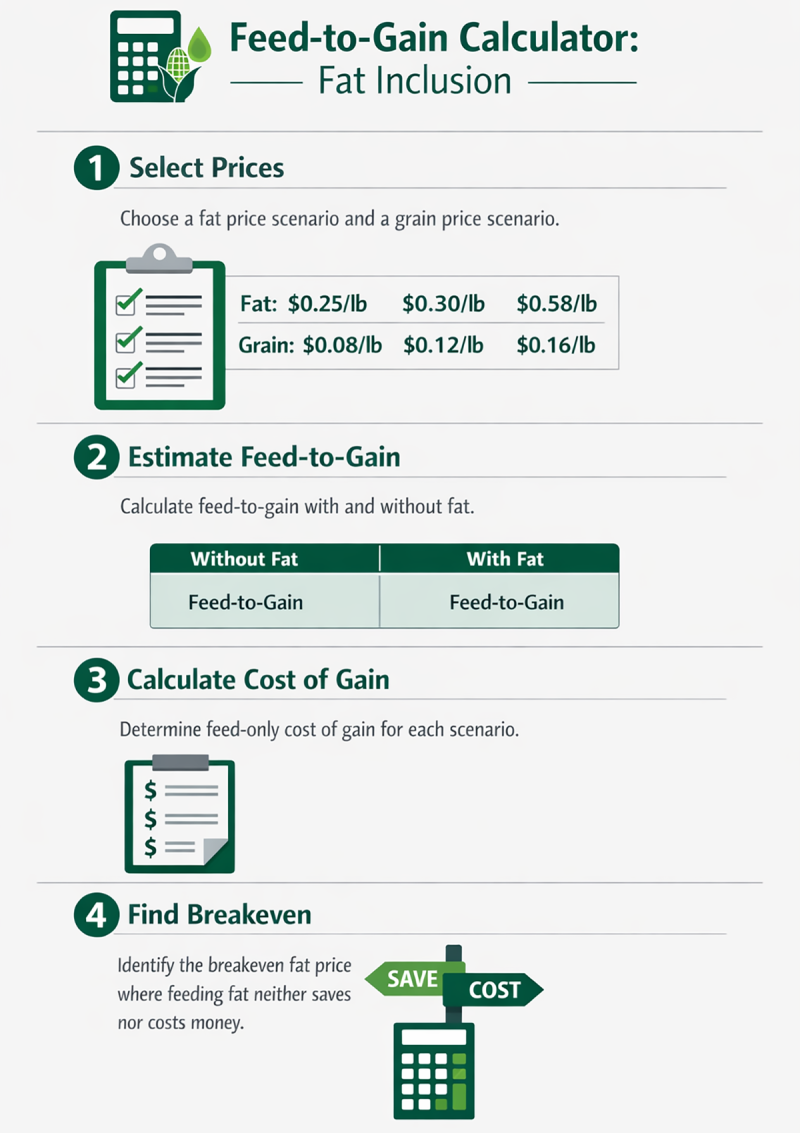
To address this need, the NANP Feed Management Committee (Dr. Matt Beck) developed a breakeven fat calculator hosted as a web-based decision-support tool.
The calculator uses predicted ration costs and animal performance from the Oklahoma State University Cowculator program (Gross, Lalman, & Paul, 2025) to estimate feed-to-gain for rations with and without fat.
What the User Selects
The calculator asks the user to select a fat price scenario (low, $0.25/lb; medium, $0.30/lb; high, $0.58/lb) and a grain (corn or DDG) price scenario (low, $0.08/lb; medium, $0.12/lb; high, $0.16/lb). All other ration ingredients are held constant, so the analysis focuses only on the economic trade-off between fat and the ingredient it replaces.
What the Calculator Does
Once inputs are selected, the calculator:
- Estimates feed-to-gain with and without fat,
- Calculates feed-only cost of gain for each scenario,
- Determines the difference in feed-only cost of gain,
- Identifies the breakeven fat price (the price where feeding fat neither saves nor costs money).
The output is an easy-to-interpret breakeven value that can be compared directly to current market prices.
A Key Takeaway
The breakeven value of fat is not based only on energy content ($/Mcal). Fat may be economical even when it appears more expensive per unit of energy because it can reduce DMI, improve feed efficiency, and shorten days on feed.
Where to Access the Tool?
The feed-to-gain fat breakeven calculator is hosted on the NANP website as a Shiny web application.
Need Help Interpreting Results?
Producers and planners are encouraged to work with local extension specialists, consulting nutritionists, and conservation planners from the U.S. Department of Agriculture’s Natural Resources Conservation Service (NRCS). For additional support, contact Dr. Matthew Beck.
References
- Ajanovic, A. (2011). Biofuels versus food production: Does biofuels production increase food prices?. Energy, 36(4), 2070–2076.
- Gross, M., Lalman, D., & Paul, B. (2025, June 27). Cowculator, Oklahoma State University. Retrieved March 25, 2026.
- Oláh, J., Lengyel, P., University of Debrecen, Faculty of Economics and Business, Balogh, P., University of Debrecen, Faculty of Economics and Business, Harangi-Rákos, M., University of Debrecen, Faculty of Economics and Business. (2017). The Role of Biofuels in Food Commodity Prices Volatility and Land Use. Journal of Competitiveness, 9(4), 81–93.
- Zinn, R. A., & Jorquera, A. P. (2007). Feed value of supplemental fats used in feedlot cattle diets. The Veterinary Clinics of North America. Food Animal Practice, 23(2), 247–268, vi–vii.