Written collaboratively by Adam Varenhorst, Amanda Bachmann, Philip Rozeboom, Patrick Wagner, and Bradley McManus.
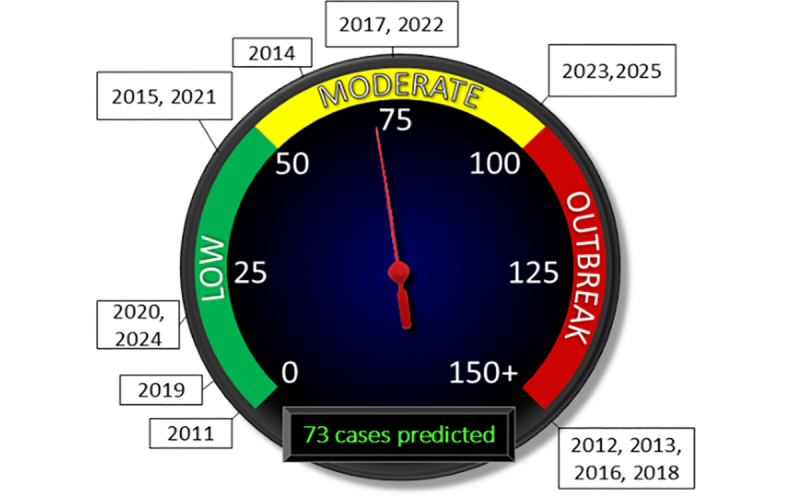
As of July 30, 2026, the South Dakota Department of Health (SD DOH) indicated that West Nile Virus positive mosquito pools have been detected in Brown, Codington, Hughes, Lincoln, and Minnehaha counties in South Dakota. So far, there have been two reported human cases of West Nile virus from Jerauld and Pennington counties. The current human cases in South Dakota are considered at a low level, and the last update to the SD DOH prediction model is estimating 73 cases for 2026 (Figure 1).
There are two mosquito species that account for most of the human bites and the risk associated with contracting the West Nile virus. Another previous article discusses practices that can reduce mosquito bites.
If you are outside after dark, make sure to cover as much of your skin as possible by wearing long sleeves and pants. We also recommend using insect repellants that contain DEET or similar active ingredients to provide further protection. This U.S. Environmental Protection Agency provides a helpful tool for choosing a repellant that will provide the best protection based on the desired activities.
Mosquitos may become more of an issue depending on forecasted precipitation. Scattered rain events can create small pools of water where mosquitos can breed, so make sure to check and clear out gutters, watering cans, plant pots, and other yard furniture or debris that can hold water. Water features and rain barrels should be treated with mosquito dunks (Bti products) to kill mosquito larva.