
Written collaboratively by Clarence Winter, Eric Jones, and Sunish Sehgal.
Over the last several years, South Dakota crop producers have had an emerging problem that commands significant attention and resources to combat: herbicide resistant weeds. Two of these weed species, Palmer amaranth and waterhemp, are broadleaf weeds that thrive in annual cropping systems, while developing resistance traits from reliance on herbicide for management. The challenges associated with managing these resistant populations have been studied and discussed extensively. Several herbicide groups are now ineffective against certain resistant populations, increasing the importance of alternative and integrated management strategies. One such opportunity is the incorporation of cool-season crops.
The success of Palmer amaranth and waterhemp inhabiting row crop rotations can be attributed to continuous emergence patterns and increased growth rate under warmer temperatures. Warmer soil temperatures favor germination and emergence, and both species have a prolonged emergence period that can extend through much of the growing season. These environmental conditions closely resemble the needs of warm-season crops such as corn, soybean, and sunflower, allowing Palmer amaranth and waterhemp to emerge and grow while the crop canopy is still developing. Later-emerging plants may contribute less to crop yield loss but can still produce seed and replenish the soil seedbank. Incorporating cool-season crops such as wheat, rye, oats, or canola can disrupt the lifecycle of these weed species. Cool-season crops establish earlier in the spring or the previous fall, allowing for substantial crop cover before peak Palmer amaranth and waterhemp emergence, increasing competition for light, water, and other resources (Figure 1). Perennial forage systems, such as alfalfa or perennial grasses, can provide similar benefits by maintaining established competition and creating repeated opportunities to prevent weed seed production.
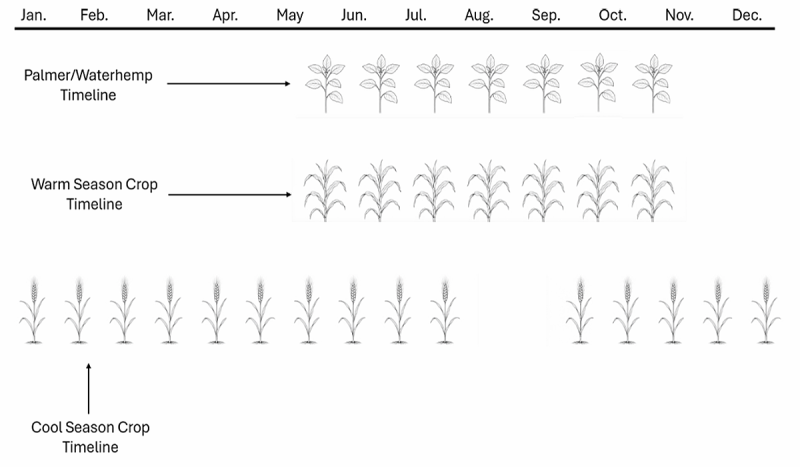
For producers facing increasing challenges from herbicide-resistant Palmer amaranth and/or waterhemp, incorporating a cool-season crop can provide another tool for diversifying weed management. However, adding a new crop to a farm’s enterprise is not always straightforward. Producers may have limited experience growing small grains, lack access to necessary equipment or markets, or be hesitant to dedicate acres to a crop that may offer different economic returns than their existing crop selection. These barriers can make crop diversification difficult, even when the agronomic benefits are recognized.
Dual-purpose winter wheat may provide flexibility for producers interested in adding a cool-season crop into their rotation. SD Sundog, a newly released awnless hard red winter wheat variety from SDSU, was developed for dual-purpose grain and forage production. The variety combines good forage yield potential with high grain yield potential, good test weight, excellent grain protein content, and strong end-use quality. This early maturity variety provides producers with greater flexibility to respond to growing conditions and forage needs while maintaining the opportunity to produce bread-quality grain. An early forage harvest may also provide additional cropping flexibility. Depending on harvest timing, available soil moisture, herbicide rotation restrictions, and the remaining growing season, producers may have opportunities to establish another crop later in the year, opening the possibility of a double crop. In some environments, this could include a later-planted warm-season crop such as sunflower. SD Sundog is SDSU’s first dual-purpose winter wheat variety developed for haylage and bread-quality grain production.
From a weed management perspective, the value of a dual-purpose crop extends beyond how it is ultimately harvested. Regardless of whether the crop is managed for forage or grain, winter wheat establishes well before the primary emergence period of Palmer amaranth and waterhemp and extends to other warm-season weeds as well. This allows for the crop to occupy growing space and capture sunlight, water, and nutrients before these warm-season weeds being their most active period of emergence. For producers who also have livestock, forage needs, or a haying enterprise, a variety such as SD Sundog may therefore provide an opportunity to address multiple objectives with the same cropping system.


