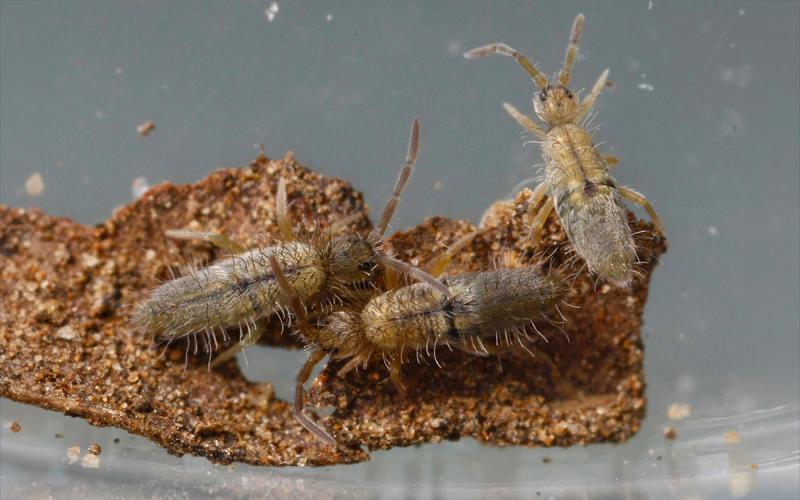
Recent reports of seemingly millions of very small insects moving around on driveways and around homes was the result of a springtail population boom (Figure 1). Although we don’t often notice them, our yards host quite a few different species of these very tiny hexapods. Several studies have determined that there can be upwards of 10,000 springtails present in a square foot. In North America, there are approximately 700 different species that can vary in size, body structure, and color. The reason we don’t regularly observe springtails is because they are typically quite content in the soil. However, when soil conditions are not ideal, they begin seeking new habitat. Springtails typically become a nuisance or home invader during drought conditions or saturating rains. This is because they require high humidity conditions to survive, but too much rain also poses risks to their survival. Many springtail species are detritovores, meaning they eat decaying organic material, so they play an important role in the ecosystem. In some instances, the springtail populations will seem to disappear after moderate rainfall, likely because they returned to the soil.
Most of the time, springtail populations will not persist once indoors, and their numbers will slowly decrease over time. Persistent populations may indicate that they are present in the soil of house plants or that there is a reliable point of entry or moisture issue that needs to be addressed.
Identification and Biology
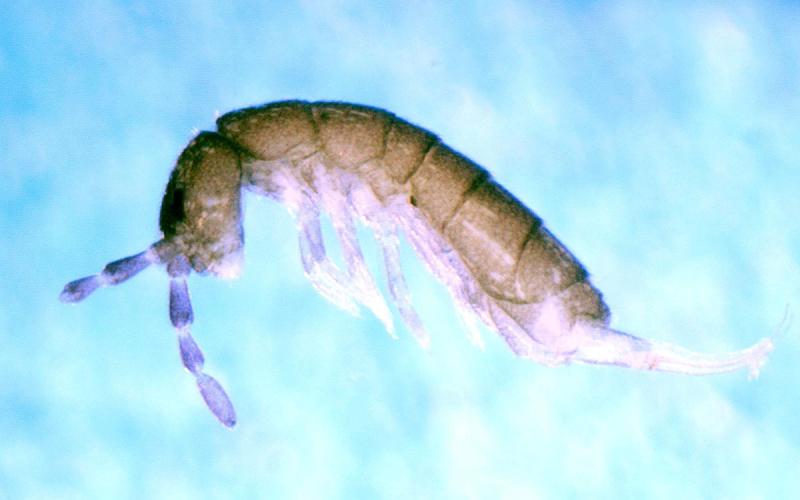
Depending on the species, springtails can vary in size from 0.2 mm to 10 mm. Color also varies greatly based on species. The most observed species are typically 1-2 mm in size. Springtails get their names due to the presence of a tail-like appendage that is called the furcula. The furcula is a forked appendage and connects to the underside of the abdomen (Figure 2). When the furcula is folded underneath the abdomen, the springtails can release it to propel themselves forward.
Management
If springtails are observed indoors, the first step in removing them is to determine if there are easy entry points for them. Because springtails are so small, they can enter through window screens and very small gaps. Reducing the humidity in homes can also reduce springtail populations, especially in basements and bathrooms. Springtails are often attracted to these rooms because of the presence of moisture and potentially mildew or mold. As mentioned, potted house plants can become a home for springtails. If they are observed leaving the potted plant soil, water the soil and allow it to dry completely before rewatering.
It is important to remember that springtails are not a threat to human health, and outside of the aforementioned houseplants, they do not generally feed or reproduce indoors.
For any insect, an exterior perimeter spray around the home may reduce the movement of the insects into the home. During the summer, such an application can also be beneficial to keep out crickets and many other accidental home invading insects.