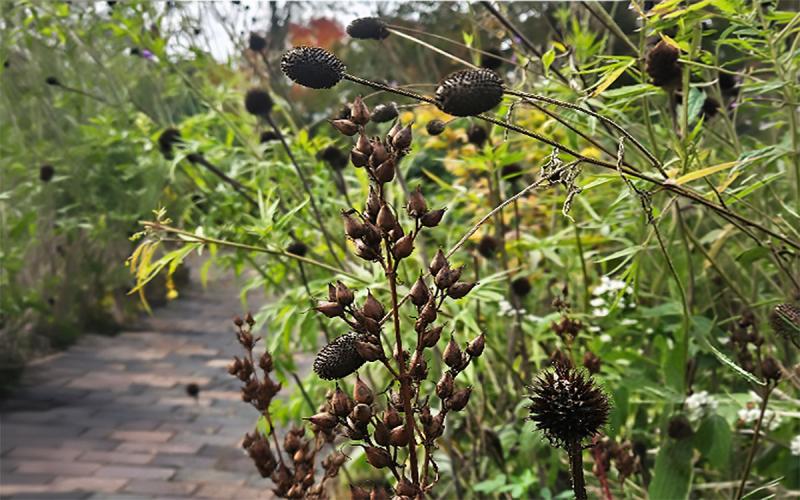
In addition to the multitude of services native perennials provide during the growing season, many offer specific benefits during winter. “Winter interest” is a term used to describe plants with features valuable to wildlife, people, or the overall landscape in winter. Native perennials with winter interest provide either colorful stems, colorful foliage or structure for aesthetic value, wildlife habitat, or food for wildlife when resources are low in winter.
South Dakota winters can be harsh for wildlife. Many bird species must shift from a summer diet of abundant berries, worms, and insects to grains and seeds. Numerous native perennials hold onto their seed heads throughout winter providing a crucial food source for wildlife. Native perennials also provide habitat for a variety of animals and pollinators in winter. For example, some native bees overwinter in the stems of certain native plants.
Special Note: Leaving any species of plants standing over winter rather than cutting or mowing them down provides habitat for wildlife while decreasing maintenance!
Native perennials with winter interest also provide aesthetic value to a landscape. Against the dull-brown or stark-white backdrop of winter, bright red, orange, and evergreen stems or foliage add beauty and variety, which is often lacking this time of year.
Incorporating native species for winter interest in landscaping or prairies will add ecological value and visual appeal.
Trees and Shrubs

Blooms: April-May
Height: 50-70 ft.
Description: Hackberry is a native deciduous tree that can tolerate a wide range of soil and moisture conditions. It blooms in spring and produces berries that can remain on the tree through winter providing a food source for many bird species. Its uniquely textured bark also provides visual interest year-round.

Blooms: May-August
Height: 3-8 ft.
Description: Red-osier dogwood, or red-twig dogwood, is a fast-growing deciduous shrub. It blooms in early to mid-summer and produces berries that birds and other wildlife consume. Its stems have a bright red hue in fall and winter providing a pop of color on an otherwise white and brown landscape.

Blooms: May-June
Height: 4-8 in.
Description: Arctostaphylos uva-ursi, commonly known as bearberry or kinnikinnick, is a low-growing subshrub that does well in dry, sandy, rocky, and acidic soils. Its leaves turn from dark green in summer to reddish-purple in winter making it a great species for adding color and texture to a landscape in winter.
Grasses

Blooms: August-September
Height: 3-7 ft.
Description: Indiangrass is a common species in the tallgrass prairie that tolerates a wide range of soil and moisture conditions. Its reddish-brown plumes provide both color and structure for winter interest, and the seed heads offer food for wildlife.

Blooms: August-October
Height: 1-3 ft.
Description: Prairie dropseed is a grass species that thrives in a variety of soil and moisture conditions. This bunchgrass grows in rounded, cascading clumps and has fine leaves that turn reddish-brown in the winter making it very popular in landscaping. The seed heads float above the foliage and can remain throughout winter.

Blooms: July-September
Height: 3-6 ft.
Description: Switchgrass tolerates a wide variety of growing conditions and provides habitat, food for wildlife, and aesthetic value to any landscape. In dense clusters, its branched, lacy panicles create a purple haze in mid-summer to early fall. Its delicate seed heads can also resemble little fireworks against the sky or another neutral backdrop.

Blooms: July-September
Height: 8-28 in.
Description: Blue grama is a drought-tolerant grass that grows well in drier soils. The densely packed spikelets atop its stems turn from a deep blue-red color in summer to tan in fall and winter. Blue grama’s fine leaves and unique, eyebrow-shaped seed heads make it a popular landscaping choice.

Blooms: August-September
Height: 1-3 ft.
Description: Little bluestem is an attractive structural grass that helps support surrounding plants. This warm-season, clump-forming grass has a bluish hue during summer and turns a reddish-orange in fall providing aesthetic appeal along with seeds for songbirds.
Forbs

Blooms: June-July
Height: 1-2 ft.
Description: Narrow-leaved coneflower is the only Echinacea (coneflower) species native to South Dakota. It usually has one to a few flowering stems and its blooms are a pale purple to pink color. Its common name comes from the conical seed head in the center of the flower that remains throughout winter providing food for wildlife. The spiky, globular seed heads stand out in sharp contrast to lighter grasses on a snow-covered landscape.

Blooms: August-September
Height: 1-4 ft.
Description: Meadow blazingstar or Rocky Mountain blazingstar is a mid to late summer bloomer popular among butterflies and other pollinators. This species prefers moist to average soil and full sunlight. Its stalked, round flower heads have bright purple-pink flowers that first open at the top and continue down. The seeds remain through winter for wildlife as long as they aren’t blown away in the winter wind.

Blooms: July-August
Height: 2-5 ft.
Description: Rattlesnake master is a unique-looking species and easy to recognize in eastern South Dakota prairies. Its small, white florets are densely packed on globular heads that remain through winter providing food for wildlife. Along with its spiky flower heads, rattlesnake master has long, spiny yucca-like leaves that also add interest in the off-season.

Blooms: June-September
Height: 3-7 ft.
Description: Gray-headed coneflower tolerates a wide range of soil and moisture conditions. The species typically has one to a dozen flowering stems. The conical seed heads that grow in the center of its yellow, drooping flowers in the summer remain into winter providing food for wildlife.

Blooms: July-September
Height: 2-5 ft.
Description: Round-headed bushclover is a late-season bloomer that thrives in drier, sunnier locations. Delicate, white flowers with magenta centers bloom in late summer. Its unique-looking seed heads form atop rigid, upright stems and offer food for birds and other wildlife in winter.

Blooms: July-October
Height: 2-10 ft.
Description: Maximilian sunflower tolerates a wide variety of soil and moisture conditions but can also spread easily in yards or landscaping. In late summer, its bright yellow blooms attract pollinators when few other species are still blooming. Maximilian sunflower is one of several sunflowers native to South Dakota that offer food for birds in winter. Leaving the dried seed heads on the standing stems will attract a variety of small birds like finches, chickadees, nuthatches and sparrows to yards or prairies.

Blooms: August-September
Height: 1-5 ft.
Description: Stiff goldenrod is one of several goldenrod species native to South Dakota. It can be distinguished from other species by its flat-topped flowering head and rough, oval-shaped leaves. Stiff goldenrod blooms later in the growing season when few species are still blooming for pollinators. In late fall and winter, seeds are attached to white, cottony fluffs that add visual appeal to any landscape.

Blooms: June-October
Height: 2-4 ft.
Description: Anise hyssop, or blue giant hyssop, tolerates a range of soils as long as they are well-drained. Lavender to dark purple flowers are arranged on spikes atop its stems, and its foliage releases a licorice fragrance. The branching, upright seed heads that remain through winter provide vertical interest and offer food for wildlife, especially birds.
References
- Native Plant Research at South Dakota State University, South Dakota State University Open Prairie.
- Minesota Wildflowers Website, MinnesotaWildflowers.info.
- USDA Plants Database, U.S. Department of Agriculture.
- Lady Bird Johnson Wildflower Center, University of Texas at Austin.
- Common Hackberry, University of Minnesota Extension.
- Redosier Dogwood, University of Minnesota Extension.
- Turn Your Yard Into a Winter Refueling Spot for Birds, National Audubon Society.
- Nesting & Overwintering Habitat for Pollinators & Other Beneficial Insects, Xerces Society.
- Rattlesnake Master (Eryngium yuccifolium L.), U.S. Forest Service.
- Growing Into the Winter Garden, Izel Native Plants.
- Consider Plants With Winter Interest in Landscapes, University of Illinois Extension.