Written collaboratively by Hector Menendez, Jordan M. Adams, Julia T. Silva, Karun Kaniyamattam, and Luis O. Tedeschi.
Supporting Conservation Through Precision Feed Management
Feed management is more than a livestock nutrition strategy; it is a conservation practice designed to optimize production efficiency and minimize use of natural resources. Through improved ration formulation, nutrient utilization, and feeding strategies, producers can optimize productive efficiency by reducing feed costs while minimizing nutrient losses to water resources, reducing air emissions, and improving feed and forage balance. The USDA Natural Resources Conservation Service (NRCS) recognizes feed management (Conservation Practice Standard 592) as a conservation practice that can help address resource concerns related to water quality, air quality, livestock production, and energy use.
Agricultural professionals with expertise in livestock nutrition and feeding systems may become certified USDA-NRCS Technical Service Providers (TSP) to assist producers with developing and implementing feed management conservation plans. TSPs provide technical expertise to help producers meet NRCS conservation standards while improving operational efficiency.
What is the NRCS Feed Management Practice?
The NRCS Feed Management Conservation Practice Standard 592 focuses on adjusting livestock diets and feeding strategies to:
- Optimize productive efficiency
- Improve nutrient use efficiency
- Reduce nitrogen and phosphorus excretion
- Lower methane emissions
- Improve feed conversion efficiency
- Reduce feed waste and nutrient runoff risks
Feed management plans include precision ration balancing, phase and/or group feeding, amino acid balancing, forage testing, and feed bunk management which improves feed efficiency and nutrient digestibility.
How Feed Management Addresses Resource Concerns
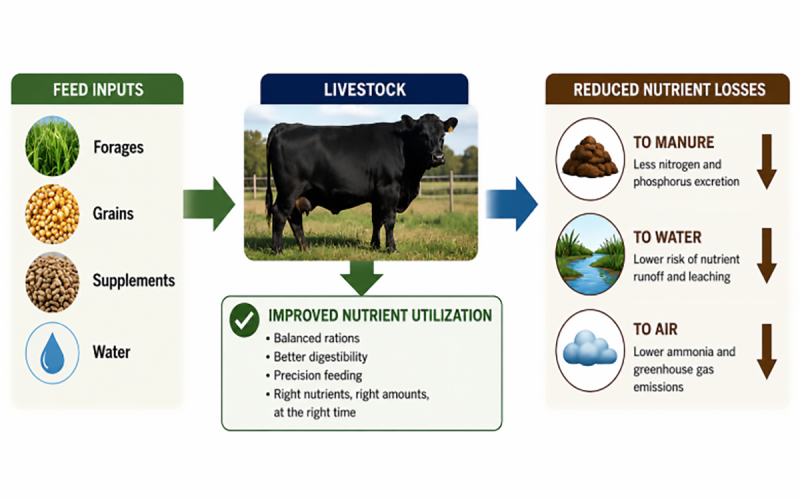
Conservation planning is built around addressing specific natural resource concerns in different regions and for a variety of animal operations. Feed management is a unique conservation practice because it can influence multiple concerns through a single management practice.
Water Quality Concerns
Feed management can reduce the amount of excess nitrogen and phosphorus excreted by livestock. By better matching nutrient supply with animal requirements, producers can increase productive efficiency, decrease the risk of nutrients transported to surface and ground water, nutrient accumulation in manure storage systems, and nutrient losses from land-applied manure.
Air Quality Concerns
Improved nutrient utilization can reduce environmental emissions associated with livestock production, including greenhouse gas emissions, airborne reactive nitrogen emissions, and objectionable odors associated from manure and urine.
Livestock Production Concerns
Feed management directly addresses the NRCS resource concern of feed and forage balance by helping producers match diets to animal requirements, improve feed efficiency, optimize use of available forage resources, and improve animal performance and productivity.
Energy Efficiency Concerns
Because feed production, harvesting, transportation, and manure management require energy inputs, improving feed efficiency can reduce the overall energy required to produce a pound of milk or meat.
Why Become a Feed Management TSP?

Certified feed management TSPs can assist producers participating in conservation programs such as the Environmental Quality Incentives Program (EQIP). Producers may hire approved TSPs to develop feed management plans that meet NRCS requirements.
This creates opportunities for:
- Nutrition consultants
- Animal scientists
- Feed industry professionals
- Extension personnel
- Veterinarians
- Experienced livestock producers
As livestock producers face increasing expectations related to nutrient stewardship, greenhouse gas reduction, and sustainability reporting, demand for qualified feed management specialists capable of developing conservation-based feeding strategies is expected to increase.
Who Can Become a TSP?
According to NRCS, eligible TSP applicants include:
- Individuals
- Private businesses
- Nonprofit organizations
- Public agencies
- Tribal organizations
Successful TSPs often have backgrounds in agriculture, natural resources, engineering, agronomy, animal science, forestry, or environmental management. Professional certifications, licenses, or field experience may also be required depending on the services offered and state-specific requirements.
Step-by-Step Roadmap to Becoming a Feed Management TSP

Step 1. Develop Technical Expertise
Successful feed management TSPs typically have experience in:
- Beef cattle nutrition
- Dairy nutrition
- Swine or poultry feeding systems
- Forage evaluation
- Nutrient management
- Ration formulation software
- Precision feeding technologies
Educational backgrounds in animal science, nutrition, or related agricultural fields are often beneficial.
Step 2. Review NRCS Feed Management Standards
Applicants should become familiar with NRCS Conservation Practice Standard 592 (Feed Management) and understand the criteria and documentation requirements necessary for conservation planning and implementation.
Step 3. Create a Login.gov Account
Applicants must establish a verified Login.gov account to access USDA systems and the NRCS TSP Registry. Identity verification and multi-factor authentication are required.
Step 4. Register in the NRCS TSP Registry
The NRCS TSP Registry is used to:
- Submit certification applications
- Upload credentials and documentation
- Complete required agreements
- Maintain certification records
Applicants select "Feed Management” as their technical service category and document their qualifications.
Step 5. Complete Required Training
NRCS may require applicants to complete specific conservation planning or technical training modules. Training requirements can vary by state and technical service category.
Applicants should also develop familiarity with:
- NRCS conservation planning procedures
- Feed management documentation requirements
- Nutrient management planning
- Livestock production systems within their region
Step 6. Submit Application and Maintain Certification
Once documentation and training are complete, applicants submit their certification package through the TSP Registry. Approved applicants become listed in the national NRCS TSP directory and may begin providing technical services to producers.
Maintaining certification may require continuing education, updated credentials, or periodic renewal.
Benefits of Feed Management Conservation Planning
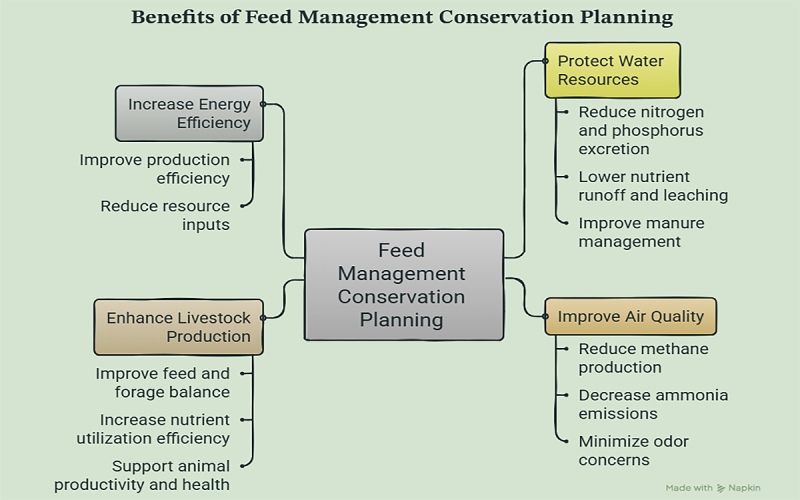
The feed management conservation practice is capable of addressing multiple NRCS conservation concerns simultaneously. Properly designed feed management plans can protect water resources, improve air quality, enhance livestock production, and increase energy efficiency.
By addressing these resource concerns, feed management strategies help producers balance profitability with environmental stewardship while supporting long-term sustainability goals.
Additional Resources
- How to Become a TSP, USDA Natural Resources Conservation Service.
- Conservation Practice Standard Feed Management (Code 592), USDA Natural Resources Conservation Service.
- Natural Resource Concerns Fact Sheet, USDA Natural Resources Conservation Service.
- Connecting Nutrition and Conservation: The Importance of CPS 592, SDSU Extension.
Learn More and Get Involved

Explore the NANP Feed Management Committee and access factsheets, reports, and decision support tools at the NANP website. Whether you're a producer, extension agent, planner, or researcher, your voice is critical in building the future of sustainable livestock production—starting with what we feed and how we manage it.
Funding Acknowledgement
This work was supported by the U.S. Department of Agriculture, Natural Resources Conservation Service (USDA-NRCS) under Grant Agreement NR233A750008C011, titled “Increasing Awareness and Use of Livestock Feeding Management through the National Animal Nutrition Program (NANP).” The views and conclusions contained herein are those of the authors and should not be interpreted as representing the official policies or endorsements of USDA-NRCS.