Written collaboratively by Hector Menendez, Jordan M. Adams, Julia T. Silva, Karun Kaniyamattam, and Luis O. Tedeschi.
Feed is the single largest cost in most livestock operations, often accounting for 50-70% of total production expenses. At the same time, how feed is sourced, stored, mixed, delivered, and managed has direct implications for animal performance, environmental stewardship, and long-term operation viability. Recognizing this, the U.S. Department of Agriculture’s Natural Resources Conservation Service (NRCS) established the Conservation Practice Standard (CPS) 592 – Feed Management as a practical framework to help producers improve feed efficiency while reducing nutrient losses to the environment.
The National Animal Nutrition Program (NANP) Feed Management Committee is built around CPS 592, using the standard as a bridge between advanced animal nutrition research and on-the-ground decision making. This article explains why CPS 592 is important, how it applies to real-world livestock systems, and how producers, extension professionals, and NRCS personnel can use it as a flexible, science-based guide rather than a prescriptive set of rules.
What is NRCS Conservation Practice Standard 592?
CPS 592 (Feed Management) is designed to help livestock producers:
- Improve feed efficiency and nutrient utilization.
- Reduce excess nutrient excretion (nitrogen, phosphorus, and others).
- Minimize feed waste and shrink.
- Support whole-farm conservation goals.
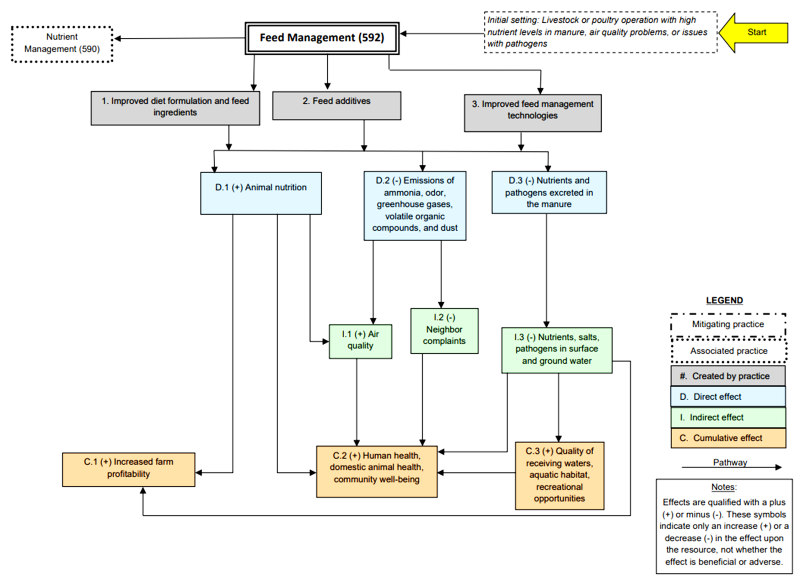
Rather than focusing on a single practice, CPS 592 emphasizes management decisions across the entire feeding system. This includes feed formulation, ingredient selection, storage, delivery, and monitoring animal performance. Importantly, CPS 592 is adaptable across livestock species (beef, dairy, sheep, goats, swine, poultry) and production stages. At its core, CPS 592 recognizes that better nutrition management is both an economic and environmental solution.
Why CPS 592 Matters to the Livestock Industry
Feed Efficiency Drives Profitability
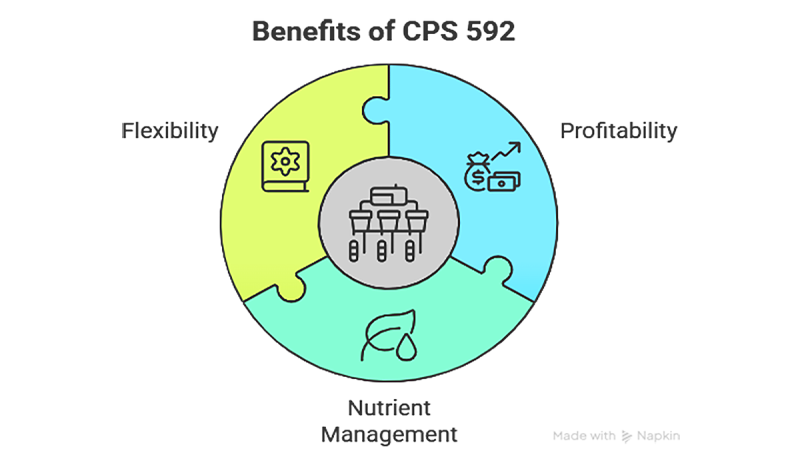
Even small improvements in feed efficiency can have large economic impacts. Overfeeding nutrients such as crude protein increases feed costs without improving animal performance. CPS 592 encourages:
- Matching diets to animal requirements.
- Adjusting rations by production stage.
- Using laboratory feed analysis rather than book values alone.
These concepts are well supported by animal nutrition research and directly align with producer goals of lowering cost per unit of gain or milk.
Nutrient Management Starts at the Feed Bunk
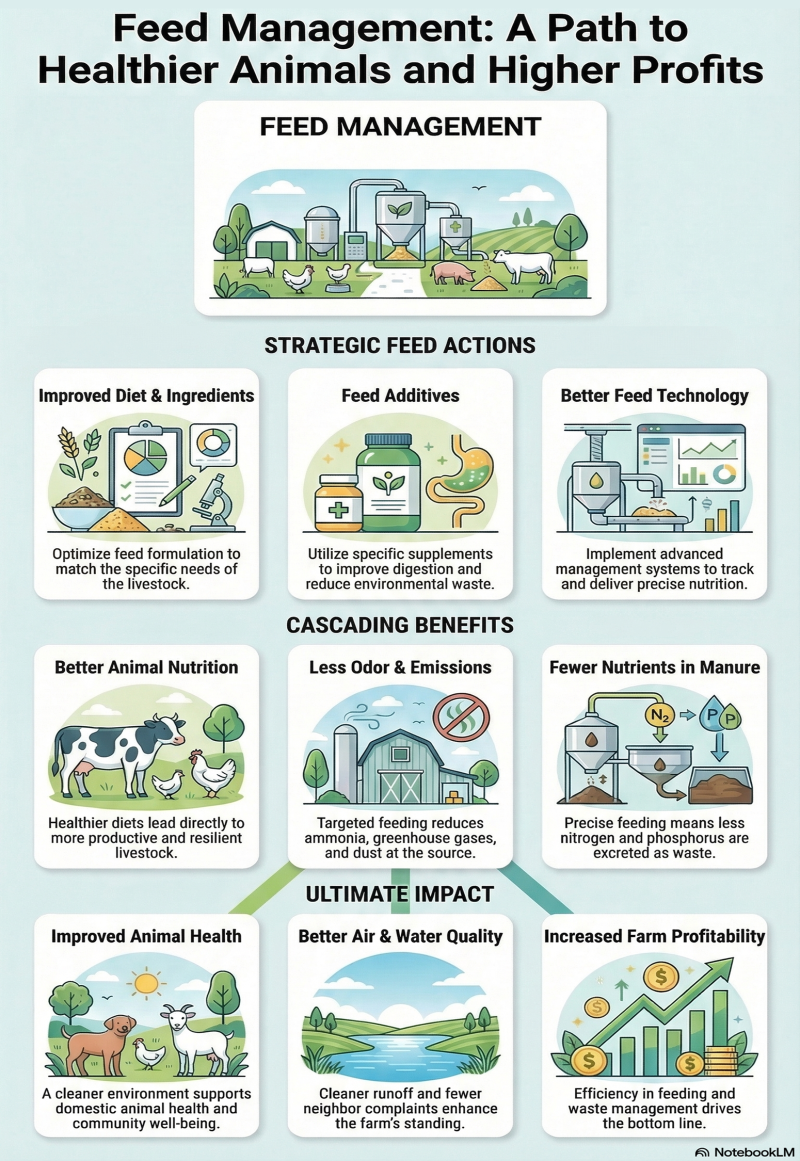
A key strength of CPS 592 is that it addresses nutrient losses before manure is excreted. Excess nutrients in manure are often the result of imprecise feeding. By improving diet formulation and feed delivery accuracy, CPS 592 helps:
- Reduce nitrogen and phosphorus excretion.
- Lower the risk of nutrient runoff or leaching.
- Complement existing Nutrient Management Plans (CPS 590).
In practice, feed management and manure management are inseparable. CPS 592 provides the upstream solution.
Flexibility Across Production Systems
CPS 592 is intentionally non-prescriptive. It does not require a single feeding strategy or ration type. Instead, it allows for:
- Conventional, byproduct-based, or alternative feeding systems.
- Grazing-based and confined operations.
- Operations of varying size and complexity.
This flexibility makes CPS 592 especially useful for extension and NRCS personnel working with diverse operations.
The Role of NANP Feed Management Resources
The NANP Feed Management Committee builds on CPS 592 by translating research into:
- Decision-support tools
- Extension publications and factsheets
- Training materials for NRCS and extension professionals
These resources help ensure that CPS 592 can be implemented consistently and effectively across regions and production systems.
The NRCS CPS 592 recognizes a simple truth: what and how we feed livestock matters. By aligning animal requirements, feed resources, and management practices, CPS 592 helps the livestock industry move forward toward greater profitability, accountability, and sustainability without sacrificing performance.
As the foundation of the NANP Feed Management Committee, CPS 592 is not just a conservation standard; it is a practical tool for better decision-making across the livestock industry.
Learn More and Get Involved

Explore the NANP Feed Management Committee and access factsheets, reports, and decision support tools at the NANP website. Whether you're a producer, extension agent, planner, or researcher, your voice is critical in building the future of sustainable livestock production—starting with what we feed and how we manage it.