Written collaboratively by Hector M. Menendez, Julia T. Silva, Jordan M. Adams, Luis O. Tedeschi, and Karun Kaniyamattam.

Livestock feeding systems are generating more data than ever before. From routine feed analysis and body weight records to automated feed intake monitoring, sensor technologies, and cloud-based platforms, producers today operate in a rapidly expanding data environment. However, more data does not automatically translate into better decisions.
Recent work presented through the National Animal Nutrition Program (NANP) highlights that livestock systems differ not only in how much data they generate, but in their ability to integrate that data into nutrition models and management decisions (Menendez et al., 2026).
These differences influence how effectively feed management supports performance, nutrient efficiency, and long-term system stability.
Not All Data Environments Are the Same
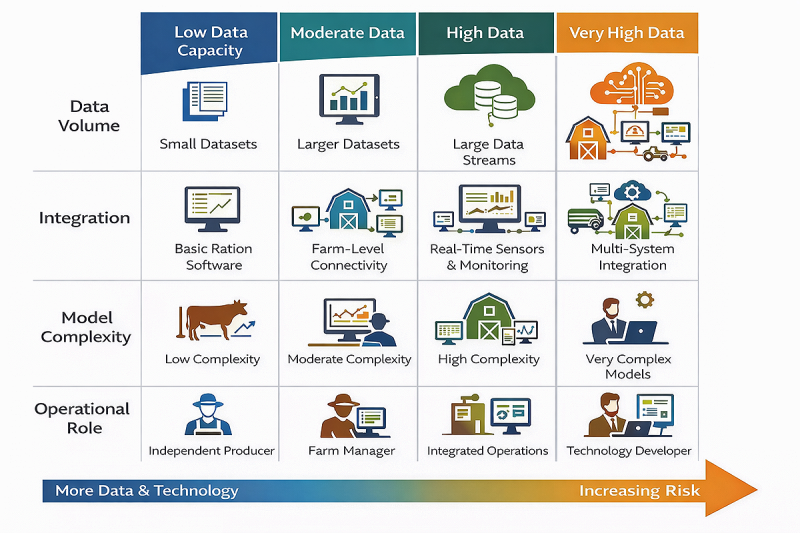
Across the livestock industry, operations can be viewed along a spectrum of data capacity.
Some systems rely primarily on feed analysis, ration formulation software, and periodic performance records. Others operate with automated feeders, real-time feed intake monitoring, connected dashboards, and multi-system integration.
Menendez et al. (2026) describe four interconnected dimensions that evolve together:
- Data volume.
- Integration capacity.
- Model adequacy requirements.
- Operational risk.
As data volume increases, the demand for information integration grows. As integration expands, model complexity grows. And as systems become more complex, operational risk also increases. The issue is not whether technology is good or bad. The issue is alignment.
Does your nutrition model match your data environment?
When Data Capacity Increases
As livestock systems adopt more data-intensive technologies, three changes typically occur:
- Greater potential for precision.
- Higher integration demands.
- Increased management complexity.
Additional data can improve feed intake estimation, refine nutrient supply, and strengthen monitoring. But the nutrition model must evolve accordingly.
Menendez (2026) emphasizes that when new data streams or revised parameter conditions emerge, model recalibration may be necessary. Without recalibration, additional data may increase bias or variability rather than improve accuracy. In these situations, simply collecting more information does not necessarily lead to better predictions.
Why Model Alignment Matters
Many nutrition models were developed under specific research conditions. When applied to new feeding systems, different genetics, feed intake variability, or automated monitoring environments, original assumptions may no longer hold.
High-data systems introduce:
- Greater variability.
- Sensor noise.
- Missing or inconsistent data.
- Increased reliance on digital infrastructure.
If the system generating data expands faster than the system interpreting it, decision quality may decline. Under these conditions, feed management is no longer defined solely by ration formulation but by the alignment between data collection, model structure, and management capacity.
Practical Questions for Producers and NRCS Advisors
As feeding systems become more data-intensive, consider:
- Are new data streams being incorporated into your nutrition model appropriately?
- Has your model been evaluated under your current production conditions?
- Who is responsible for validating automated outputs?
- Does your integration capacity match your level of technological adoption?
Systems that maintain alignment between data, models, and decisions are better positioned to improve nutrient matching and reduce inefficiencies.
Moving Forward
Precision livestock technologies will continue to expand. Data volume, velocity, and variety are increasing across production systems (Menendez et al., 2026). The operations that benefit most will not necessarily be those generating the largest datasets, but those ensuring that integration capacity and model adequacy evolve alongside technological adoption.
In modern feed management, success depends less on how much data is collected and more on how effectively that data is translated into biologically sound decisions.
Learn More and Get Involved

Explore the NANP Feed Management Committee and access factsheets, reports, and decision support tools at the NANP website.
Whether you're a producer, extension agent, planner, or researcher, your voice is critical in building the future of sustainable livestock production—starting with what we feed and how we manage it.
Reference
Menendez, H. M., Chang, Y., Palmer, E., La Manna, F., Moreno, E. R. V., Parsons, I., Turner, B. L., Moradi Rekabdarkolaee, H., Husmann, A. L., & Tedeschi, L. O. (2026). ASAS-NANP SYMPOSIUM: Mathematical modeling in animal nutrition: the importance of animal science flight simulators to enhance the competitiveness and sustainability of livestock production. Journal of Animal Science, 104, skaf440.
Funding Acknowledgement
This work was supported by the U.S. Department of Agriculture, Natural Resources Conservation Service (USDA-NRCS) under Grant Agreement NR233A750008C011, titled “Increasing Awareness and Use of Livestock Feeding Management through the National Animal Nutrition Program (NANP).” The views and conclusions contained herein are those of the authors and should not be interpreted as representing the official policies or endorsements of USDA-NRCS.


