Written by Madison Zercher under the direction and review of Cody Molnar, Kristine Lang, Amanda Bachmann, and Madalyn Shires.
Background
A 2025 trial in Brookings, South Dakota aimed to detect the influences of various warm-season cover crop living mulches on pest pressure in tomatoes and cucumbers and the interactions between both grafted and nongrafted tomatoes and cucumbers and the living mulch. A living mulch is a cover crop that is left to grow as a ground cover under a cash crop instead of being terminated prior to planting vegetables. Marketable yield, disease susceptibility, foliar disease ratings, and the presence of insects in the field and/or plots were assessed over one growing season. This project aimed to provide insight on decisions about plant health, growth, and crop yields to minimize the negative attributes of crop production for farmers when implementing a living mulch system.
Methods
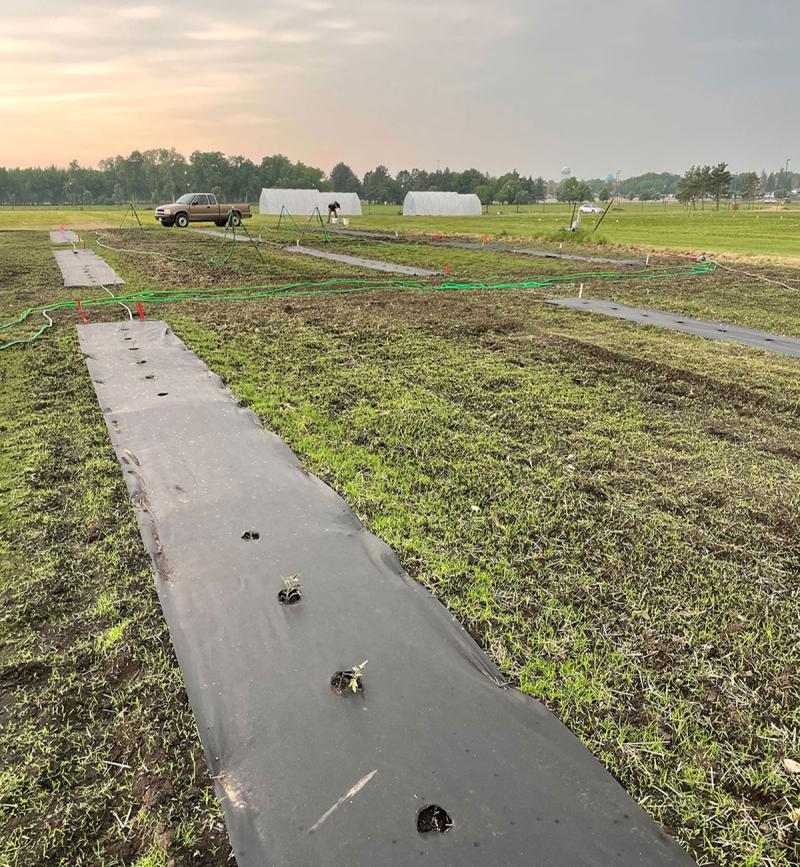
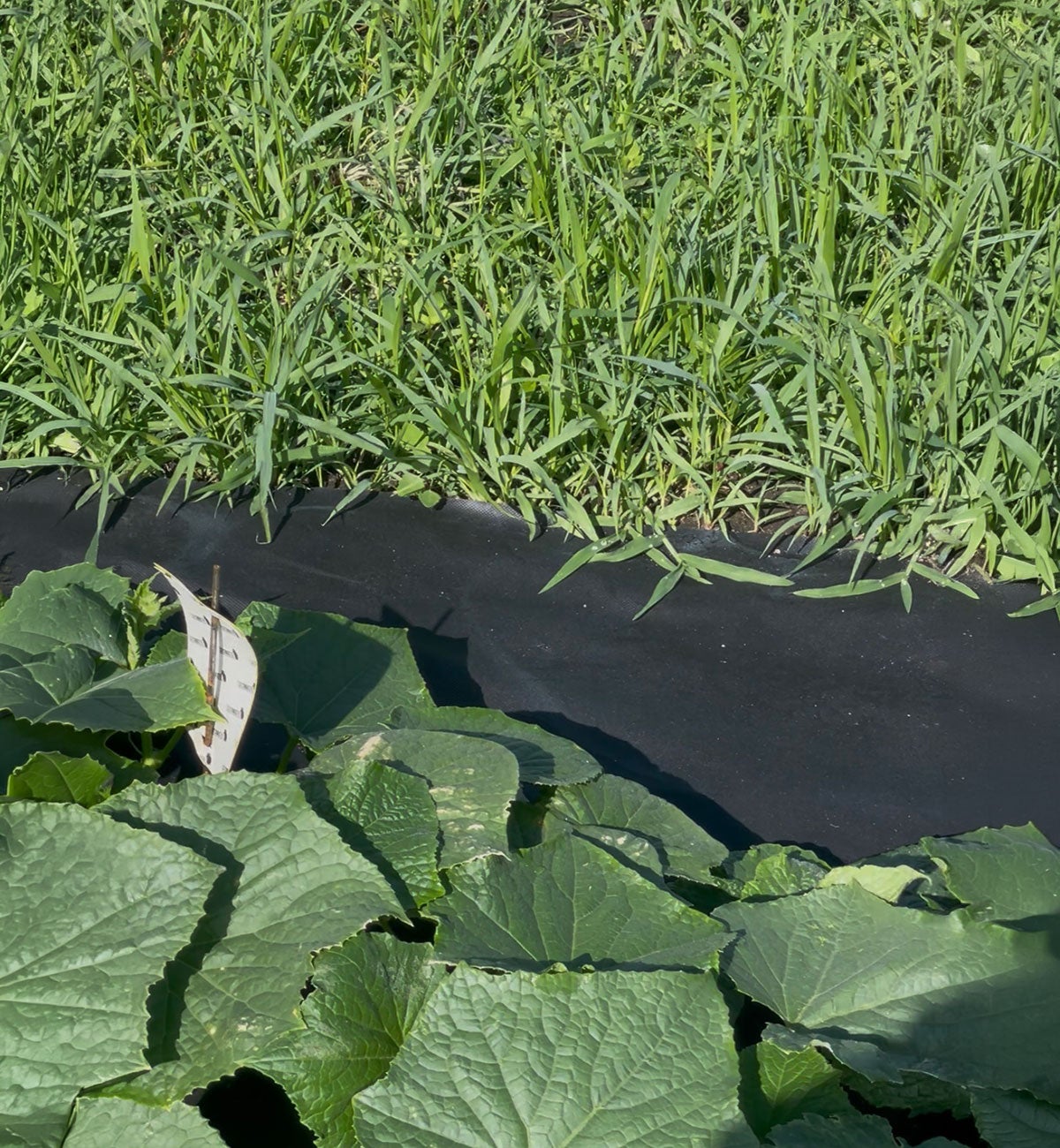
Both grafted and non-grafted tomatoes and cucumbers were planted within randomized, blocked plots in early June 2025 (Figure 1). Three different cover crops were seeded between vegetable crop rows and compared to bare ground conditions. The vegetables were planted into three-foot wide black, woven landscape fabric. The landscape fabric strips acted as a weed suppressant and aided in preventing yield impacts from the neighboring living mulch (Figure 2). The warm season cover crops were sudangrass (Sorghum × drummondii, SS), teff (Eragrostis tef, TF), and burseem clover (Trifolium alexandrinum, BE). There were also an equal number of control plots (no cover crop planted), which were treated with herbicide to further suppress the presence of weeds throughout the plots. Yield data was collected twice weekly on the producing cucumbers, including weight, diameter, and width. Those with irregular growth patterns or insect damage were labeled as “culls”, and only the weight was recorded due to inconsistencies and marketability of the produce. This weight was collected two times in the experiment, from six to seven plants in each plot (based on stand counts).
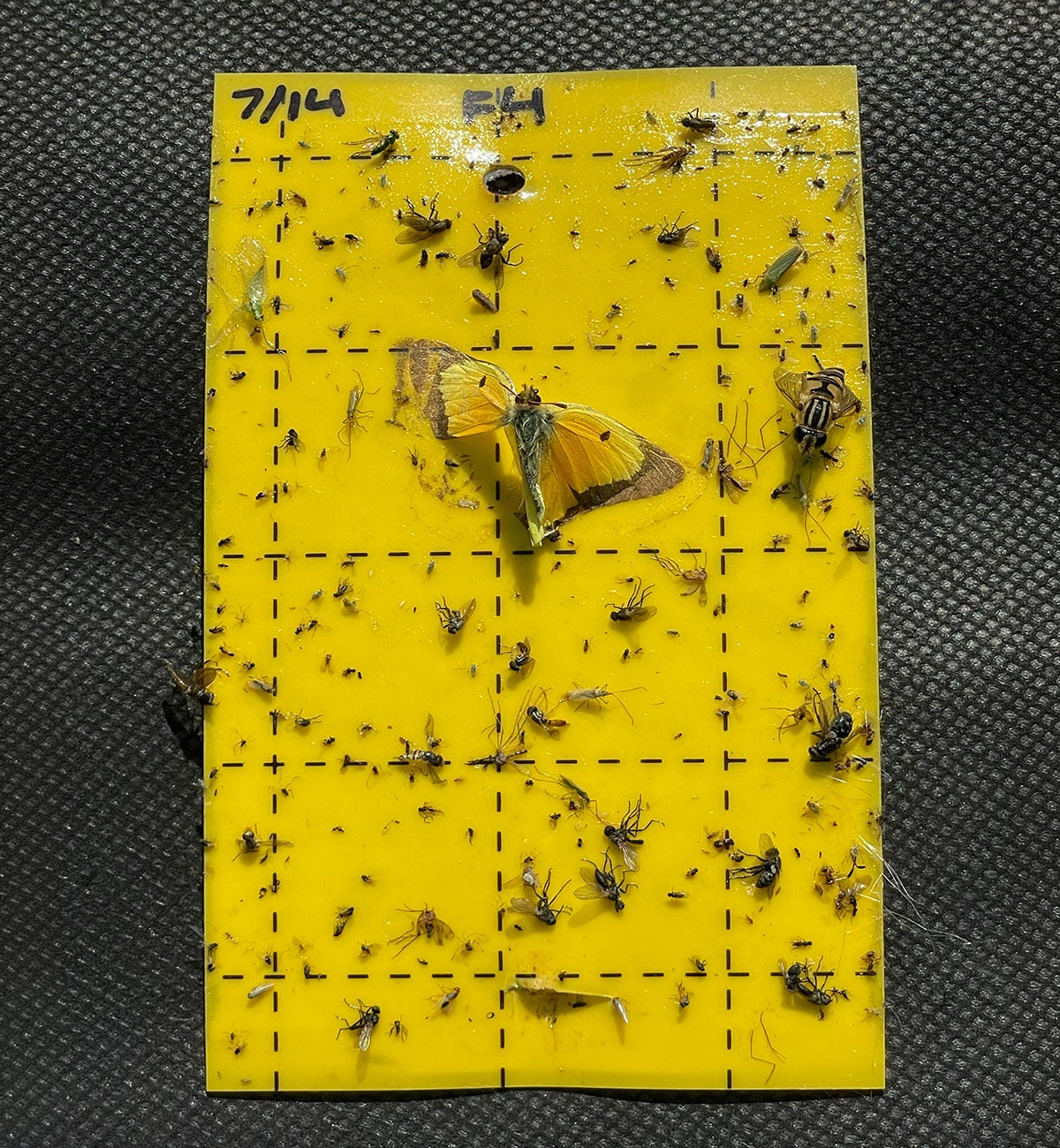
Thirty-two yellow sticky traps were also deployed within the sixteen plots and were changed weekly. These sticky traps were utilized for monitoring insect presence within the plot. Insects of interest were cucumber beetles (Acalymma vittatum and Diabrotica undecimpunctata howardi) and other known insect hosts of cucurbit diseases. The cards were inspected at the end of the season, and insects were identified and counted if present (Figure 3).
Results
No cucumber beetles were identified within the plots utilizing yellow sticky cards through the weeks of data collection. Foliar disease ratings for the tomato plots were never accounted for, as herbicide damage was too prevalent within the early stages of their development to reliably discern any diseases.
Very few foliar diseases were observed in either cropping system. Cucumbers were observed to be more adaptable to cover crop settings and responded better to the various treatments when compared to the tomatoes. While cucumber foliar disease levels were low overall during the season, when comparing all living mulch systems, there did appear to be slightly less disease incidence in the sorghum-sudangrass treatments. Due to the issues mentioned above, tomato data collection was limited and no conclusions could be made.
When evaluating yield between grafted and non-grafted cucumber, the sorghum-sudangrass and teff treatments displayed the largest range in weights. On average, grafted and non-grafted cucumbers surrounded by teff weighed 0.58 lbs and 0.62 lbs. In comparison, for sudangrass treatments, weights averaged 1.0 lbs for grafted cucumbers and 0.9 lbs in non-grafted plants (Table 1).
| Cucumber Weight (lb) | BG | SS | TF | BE |
|---|---|---|---|---|
| Non-grafted | 0.604 | 0.902 | 0.622 | 0.758 |
| Grafted | 0.758 | 1.008 | 0.589 | 0.622 |
Conclusion
Given the difficulties with data collection and the fact that we only collected data over a single growing season, few conclusions about the effect of cover crops can be made. Of the data collected, we were able to determine that the use of sudangrass as a cover crop may improve cucumber weights and may be a beneficial method to use in commercial operations. The addition of any cover crop did not seem to increase or decrease either insect or disease abundance. Using grafted or non-grafted crops did not seem to have any notable effects on disease, pest, or yield. No conclusive findings on tomatoes could be gathered due to the herbicide injury that occurred earlier in the season. While we can see some trends, we urge producers to utilize this information as a baseline dataset as much more data would be needed to make real-world recommendations and applications.
If we were to repeat this experiment, we would implement the following changes/improvements: application of herbicide through a low pressure sprayer for more precise placement, suitable grafting techniques for plant growth and compatibility, and proper separation of cover crop seeding by utilizing a push seed spreader as opposed tractor tilling which can result in mixed seeds within the plots.
Acknowledgements
Portions of this research were completed by Dr. Sean Toporek, Janani Perera, and Keigo Imai. We would also like to thank Denise, Mark, and Leah of Venner Farms for their participation in this research study. Funding was provided by USDA-NRCS Conservation Innovation Grants, South Dakota State Program, NR236740XXXXG003.