Written collaboratively by Krista Ehlert and Victoria Dungey.
Red Fescue Identification
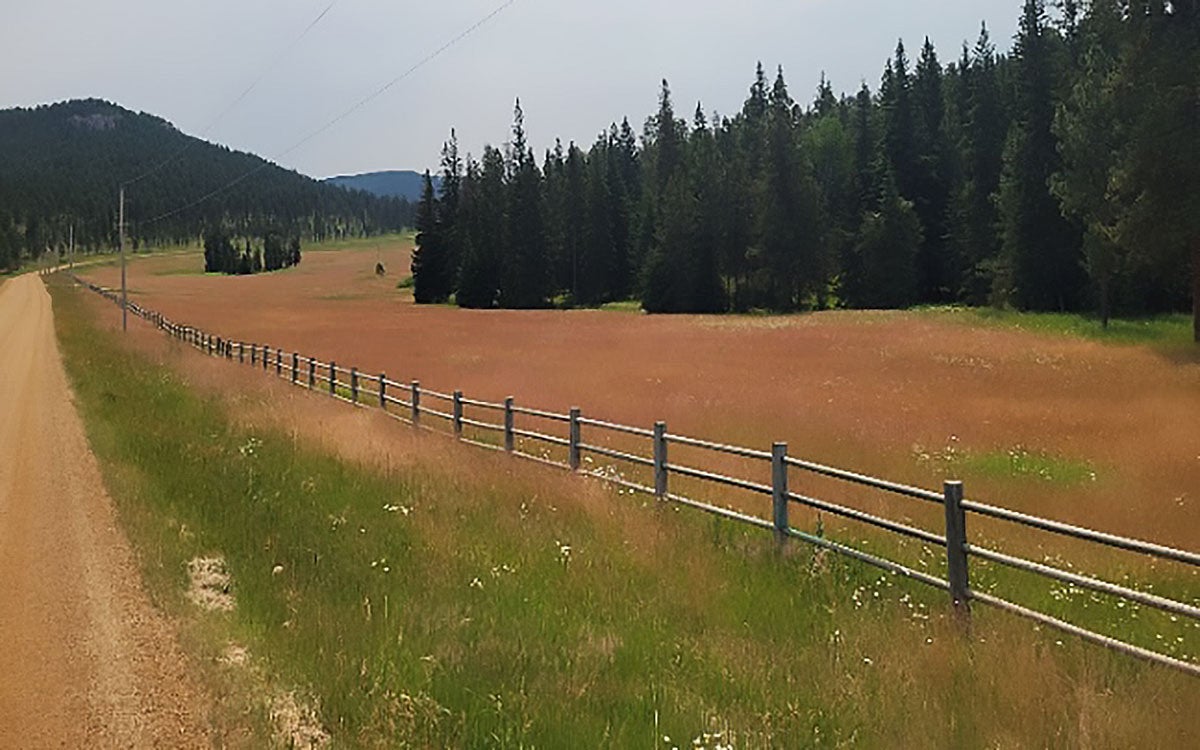
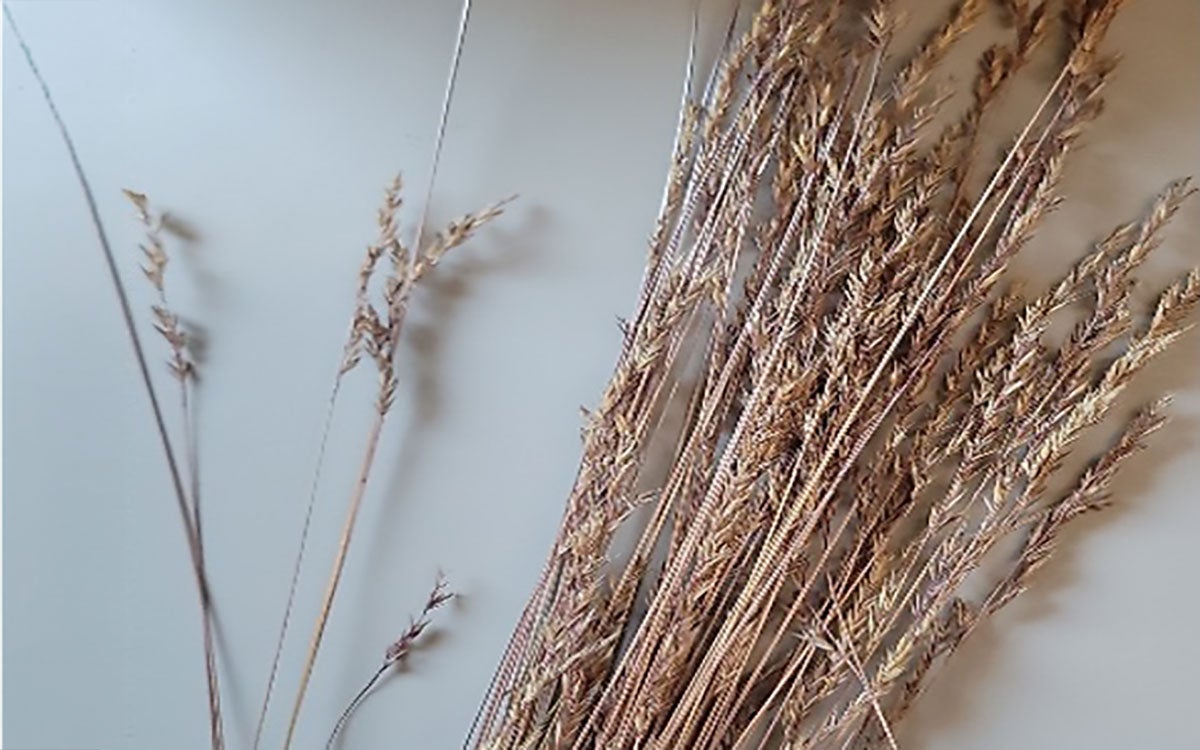
Red fescue (Festuca rubra) (Figures 1 and 2), a cool-season, dominate rhizomatous grass, has started showing up more frequently in meadows and forest in South Dakota - especially on disturbed ground. It is identifiable by the following characteristics:
Leaves
- Narrow, fine-textured blades that are folded or rolled (not flat), giving them a wiry, bristle-like appearance.
- Blades are typically 1–2 mm wide.
- The leaves of the rhizomatous shoots are distinctly involute (rolled inward).
Auricles and Ligule
- No auricles (ear-like projections at the leaf base).
- Ligule is very short and membranous, almost truncate (squared off).
Inflorescence
- Panicle is erect and somewhat narrow, 5 to 15 centimeters long.
- Branches are short and they tend to droop slightly after flowering.
Sheaths
- Basal sheaths are reddish to purplish at the base — this is one of the most reliable identification features and the source of its common name.
- Sheaths are closed (fused) for most of their length, distinguishing it from many other fescues.
Rhizomes
- Produces short, creeping rhizomes.
- Forms loose, spreading mats rather than tight clumps.
Habitat
- Commonly found in cool, moist environments — roadsides, meadows, forest edges, and lawns (Figure 1).
- Tolerates shade, drought, and poor soils well.
- Common in northern and high-elevation rangelands across the Western U.S.
Grazing Impacts
A New Player
While red fescue is not on the state noxious weed list (as of publication), its spread has raised questions from producers such as: Will cattle eat it? Is it safe to graze? Should it be managed before it takes over? To help address these questions, we sampled red fescue to determine forage quality, and we also observed how cattle responded when turned out on red fescue-dominated pastures within the Black Hills National Forest.
Observed Grazing Behavior
When the red fescue was first discovered, we noticed that the cattle chose to avoid grazing it, if they had access to other forage. In mixed plant community pastures, they grazed around it, particularly during the summer and fall. After forage analysis was complete (Table 1), cows were ‘pushed’ onto a red fescue stand in the early spring, and they grazed it without issue. In addition, body conditions remained stable, and there were no signs of toxicosis, stress, or poor intake. Therefore, while red fescue is not highly palatable by choice, cattle will graze it when it is the only forage choice or if it is in an early growth stage (Boland et al., 2011).
Testing Nutritional Value and Toxicity
Nutritional Test Results
Results from red fescue samples that were collected from three different locations where it was beginning to dominate indicate that red fescue is nutritionally sufficient and meets nutritional demands during most of the grazing season, especially in early growth stages.
| Parameter | Avg. Value | Notes |
|---|---|---|
| Crude Protein (CP) | 14.8% | High protein - good for early lactation or growing calves |
| Total Digestible Nutrients (TDN) | 55.4% | Moderate energy - typical of cool-season grasses |
| Relative Feed Value (RFV) | 107 | Comparable to early-bloom mixed pastures |
| Neutral Detergent Fiber (NDF) | 60.0% | Suggests decent digestibility, not stemmy |
| Acid Detergent Fiber (ADF) | 38.3% | Indicates moderate digestibility |
Endophyte Testing
Red fescue samples were also submitted for endophyte testing, as many fescue species, particularly tall fescue, are known to harbor toxic endophytes like Neotyphodium coenophialum, which produces ergovaline, a compound linked to fescue toxicosis(Bush & F, 2009). Results came back as negative for endophyte infection, suggesting that the red fescue present in our pastures was not currently producing toxic alkaloids. If cattle were experiencing signs of fescue toxicosis, there would have been signs of rough hair coat, poor gains, reduced intake, and/or stress.
Should You Worry About It?
Not necessarily but pay attention to pastures that contain red fescue. Red fescue seems to be safe to graze (low risk of toxicosis or poor performance) and is nutritionally sound. It is best grazed in the early spring; however, it is not a first-choice forage, which means it can become a problem over time if cattle avoid grazing it and it’s left to spread. If left unchecked, cattle will avoid and under graze the fescue, focus grazing on plant species that they prefer, and pasture diversity may decline overtime.
Management Recommendations
- Graze early and often. In the early growth stages, red fescue has better palatability and nutrient availably.
- Use rotational grazing. This prevents overgrazing of preferred plants and encourages animals to consume the fescue.
- Track ground cover. Dominance of low-palatable species can lead to decreased biodiversity and pasture productivity over time.
- Interseed legumes. If you have a private pasture, you can add legumes by seeding. Legumes can increase overall forage quality and help mitigate intake issues from endophyte-infected grasses (Roberts & Andrae, 2004).
- Watch for long term trends. If red fescue becomes dominant in a pasture overtime, it indicates insufficient grazing pressure or prolonged rest, which can potentially leading to a decrease in the diversity of other plant species.
Summary: Red Fescue Isn’t Bad, But It’s Bossy.
Red fescue is not toxic, and it’s not worthless; however, it’s not the best to graze. Producers can think of red fescue like that cow that calves a month behind the rest - she’s not hurting anything, but she keeps the whole system off rhythm. You don’t cull her right away, but you keep an eye on her. If you stay ahead of red fescue with smart grazing and pasture monitoring, you can keep it in check and make its presence work for your herd.
References
- Boland, T. M., Fadden, J., Doyle, E. M., O’Donovan, M. (2011). Grazing behavior and diet of beef steers grazing adjacent monocultures of tall fescue and alfalfa—I: Spatial allocation. Crop Science, 51(6), 2425-2434.
- Bush, L., & F, F. F. (2009). Alkaloids. In Tall Fescue for the Twenty‐first Century (p. 229249).
- Roberts, C.& Andrae, J. (2004). Tall fescue toxicosis and management. Crop Management.