Written collaboratively by Eric Jones, Graig Reicks, Jill Alms, and David Vos.
The 2026 growing season across South Dakota was prominently hot and dry. Under hot and dry conditions, weeds are stressed and herbicide activity decreases, leading to poor management of weeds. While the recent rain events in September have impeded row crop harvest, the moisture is welcomed to improve the activity of fall herbicide performance for noxious weeds in pastures and rangelands. Herbicides that are applied postemergence have language on the label stating, “Apply to actively growing weeds”. While weeds seem to thrive under adverse conditions compared with crops and forage, weeds still exhibit stress. Under drought conditions, weeds are not actively growing and the thickness of the cuticle (waxy layer on leaf surface) increases to retain water within the plant. When a herbicide is applied during these conditions, the droplets may not be absorbed through the thicker cuticle. Even if absorbed, the active ingredient contained in a herbicide may also struggle to inhibit the target site as the plant is not conducting normal processes. The recent rainfall events and forecasted mild temperatures across the state will likely allow weeds to grow more actively before a killing frost.
While some of the spring herbicide applications may not have been effective, fall herbicide applications should be considered for noxious weed management. Perennial weeds, such as Canada thistle and leafy spurge, begin to transport assimilates and nutrients down to the roots/rhizomes in the fall to survive the winter months. Herbicides applied in fall are also more likely to travel to roots/rhizomes than those applied during spring or summer. This is important, because the roots/rhizomes act as the “heart” of noxious weeds. There is often a rule of thumb that perennial weeds need to experience a light frost to trigger this downward flow of resources, but changes in day length and cooler temperatures also signal to the weed that winter is coming. Instead of waiting for a light frost to make fall herbicide applications, it’s more important to apply when there is adequate moisture and daily high temperatures have been 50 to 60°F for at least two days prior to the application and at least five days following the application. Once past mid-October, it is less likely to experience a long stretch of 50 to 60°F temperatures. If a hard freeze occurs before herbicide application, scout to see if the vegetative tissue of weeds becomes brown or discolored after 48 hours; if discoloration occurs, herbicides should not be applied as the plant tissue has been killed and the herbicide will not translocation through the weed. Watch the weather forecast to ensure a hard freeze does not occur immediately after application.
Scouting and Application Timing
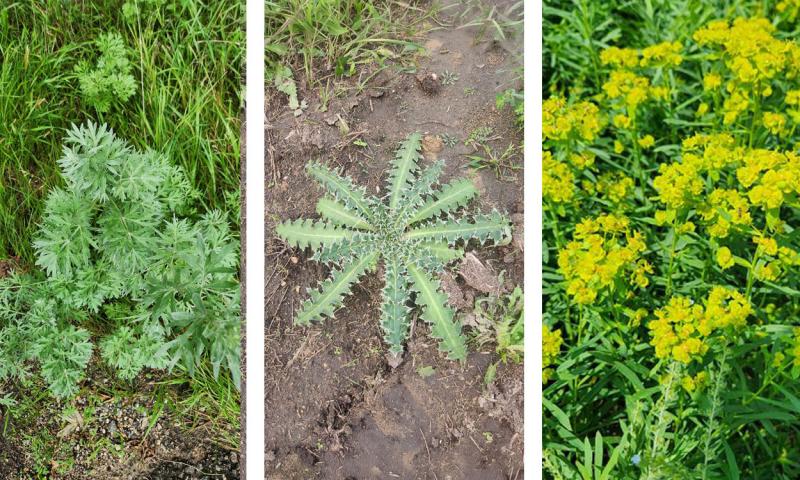
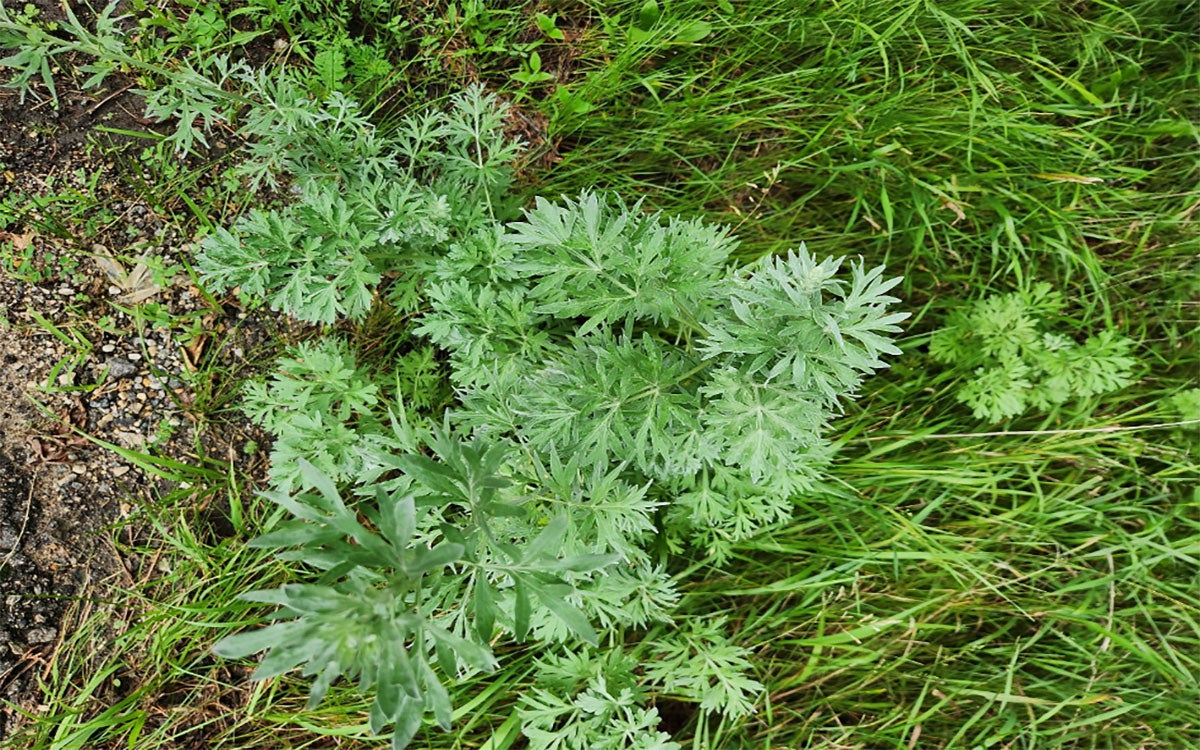
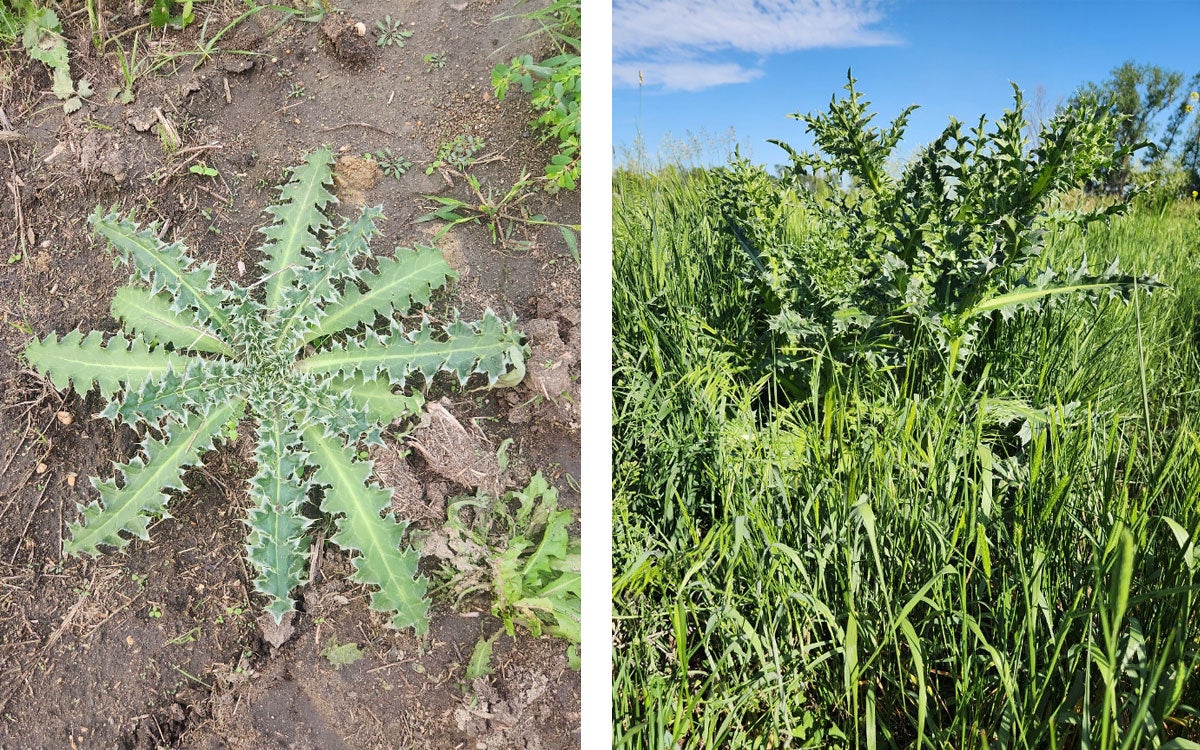
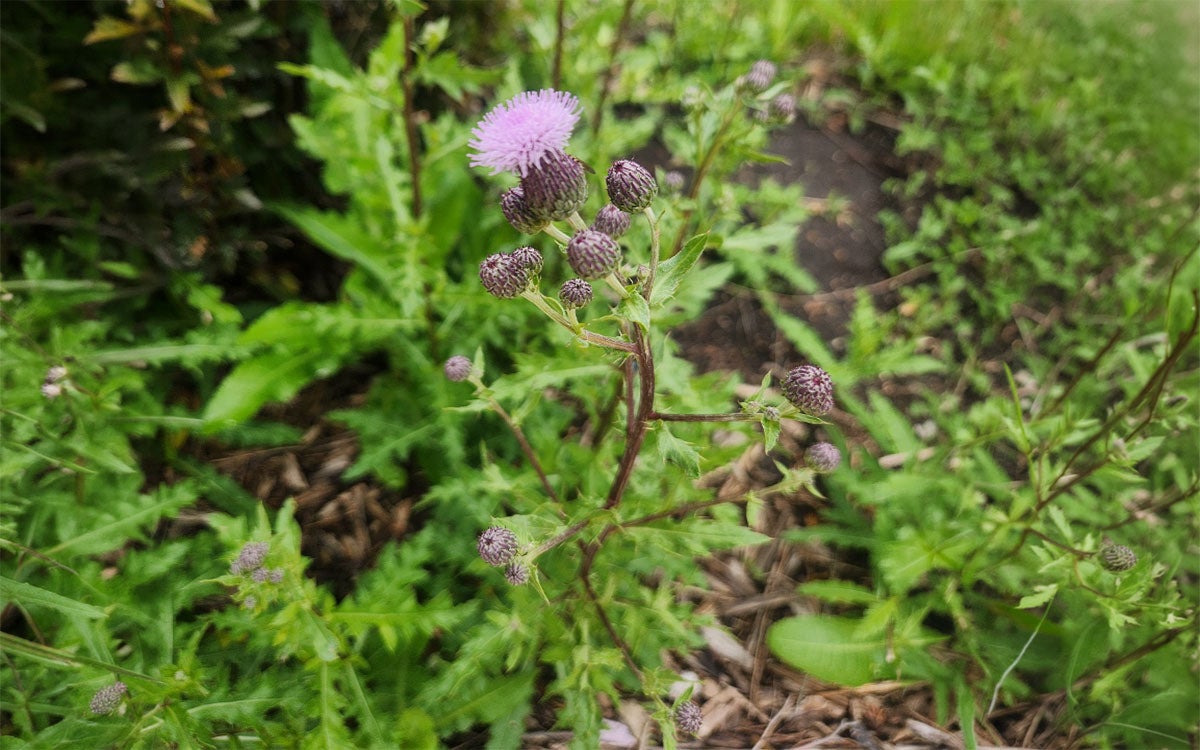
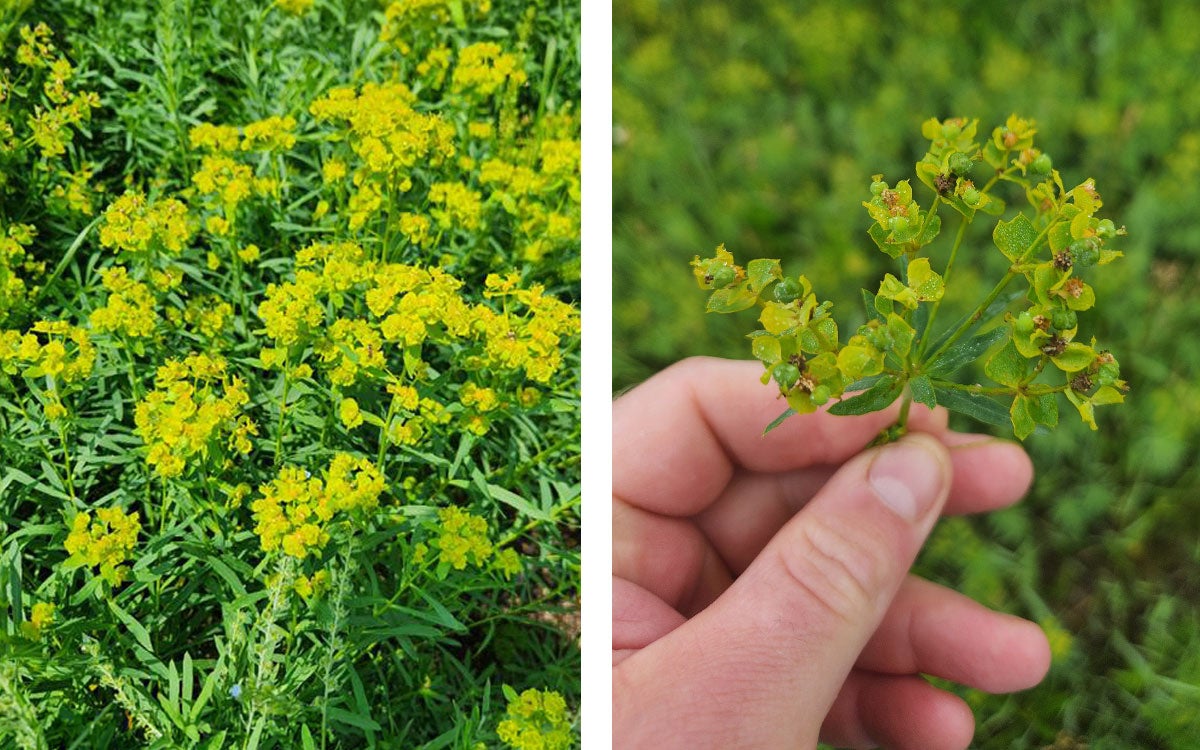
Fall herbicide applications can provide effective management of weeds, but the size and growth stage of the weeds can dictate the effectiveness of the application. Scouting should be conducted to determine plant stage prior to herbicide application. If weeds were clipped or mowed in the spring, new regrowth will likely be an appropriate growth stage. If no management tactic was implemented in the spring/summer, the weeds may be too mature for the herbicide application to be effective. A general guideline for appropriate growth stages: absinth wormwood (Figure 1): before leaves turn a grey-white hue, biennial (bull and musk) thistle – rosette or pre-budding (Figure 2); Canada thistle – pre-budding (Figure 3); leafy spurge – yellow bracts present (Figure 4). Continuous scouting should be conducted to determine if follow up tactics are needed or new areas have been infested. Nonchemical tactics such as mowing, releasing insects (e.g., leafy spurge beetle) and rotational grazing can and should be used to improve the overall effectiveness of weed management programs.
Absinth Wormwood
Biennial Thistles
Canada Thistle
Leafy Spurge
Refer to the most-recent SDSU Extension Weed Control: Noxious Weeds and Weed Control: Pasture and Range publications for more information on specifics of herbicides and weeds.