Written collaboratively by Hector Menendez, Jordan M. Adams, Julia T. Silva, Karun Kaniyamattam, and Luis O. Tedeschi.
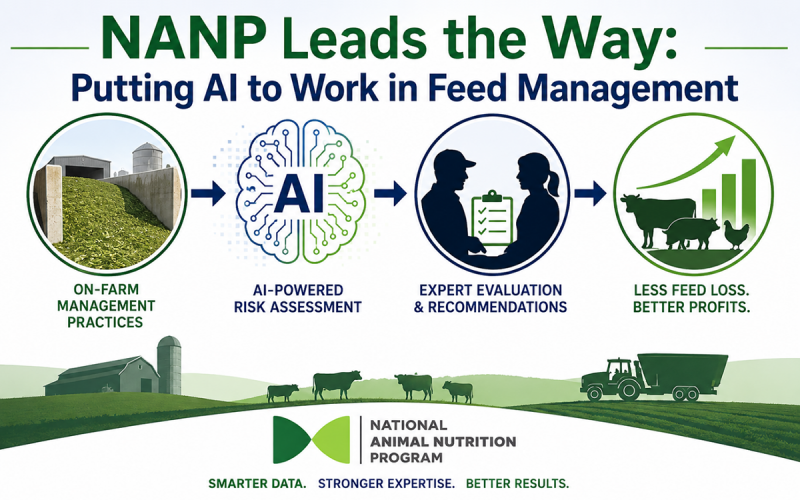
Artificial intelligence is rapidly changing agriculture, but its value on the farm ultimately depends on whether it can help producers make better decisions. At the National Animal Nutrition Program (NANP), a new feed management tool is on the way. Our team has been working to turn AI-based approaches into practical tools that can help livestock producers reduce feed losses, improve profitability, and take some of the headache out of day-to-day feed management.
One example of this work is the Feed Value Loss Risk Assessment Tool, an interactive decision-support application currently under development. The application integrates information on feed characteristics and management practices to estimate the relative risk of feed value loss under the selected management conditions. The underlying risk framework is informed by published research and expert knowledge, and a Random Forest machine-learning model integrates multiple management factors to generate an overall relative risk of feed value loss assessment (i.e., risk prediction). In this tool, feed value loss broadly refers to losses in feed quantity or usable nutritional value associated with harvest, storage, handling, mixing, delivery, and feed-out. It will help users identify management conditions associated with higher risk and recognize where changes may offer the greatest opportunity to protect feed value. Silage will serve as the first detailed application of the tool (shown below) while it is also capable of assessing risk for hay and grains.
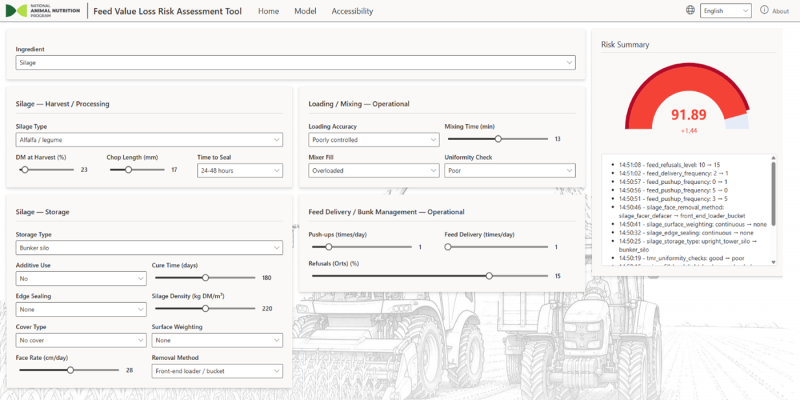
Users will be able to enter conditions related to harvest and processing, storage and feed out, loading and mixing, feed delivery, and bunk management. Rather than asking producers to interpret all of those factors individually, the tool is being designed to bring them together into an easy-to-use risk assessment. Users will be able to adjust management conditions and immediately see how the overall relative risk score changes. This will allow users to explore alternative management scenarios and identify potential areas for improvement. The resulting score will reflect relative risk and will not represent the percentage or quantity of feed lost. Higher scores indicate management conditions associated with greater relative risk of feed value loss and can be used to compare management scenarios and identify areas that may warrant greater attention.
The larger goal is not simply to put “AI” on the farm. It is to use AI and data-driven methods to organize complex information in a way that makes management decisions easier. Feed is one of the largest costs in livestock production, and even relatively small losses during storage, handling, mixing, or delivery can add up, ultimately impacting profit margins. Helping producers recognize those risks creates opportunities to preserve more feed value and potentially improve the bottom line.
The next step after using the tool is to review the results with a feed management expert. Members of the NANP Feed Management Committee and trained Extension, NRCS, nutrition, and other agricultural professionals can help producers evaluate identified risks, determine which are most important for their operation, and identify practical opportunities to reduce feed losses and improve profitability.
By helping producers identify potential risks and then connecting those results with expert evaluation, the Feed Value Loss Risk Assessment Tool represents the kind of practical application NANP is working toward—bringing together animal nutrition research, new technologies, and trusted agricultural expertise to address real-world challenges facing livestock producers. As the tool continues to be developed and evaluated, the goal remains straightforward: help farmers minimize losses, improve profitability, and make feed management a little less complicated.
Learn More and Get Involved

Explore the NANP Feed Management Committee and access factsheets, reports, and decision support tools at the NANP website. Whether you're a producer, extension agent, planner, or researcher, your voice is critical in building the future of sustainable livestock production—starting with what we feed and how we manage it.
Funding Acknowledgement
This work was supported by the U.S. Department of Agriculture, Natural Resources Conservation Service (USDA-NRCS) under Grant Agreement NR233A750008C011, titled “Increasing Awareness and Use of Livestock Feeding Management through the National Animal Nutrition Program (NANP).” The views and conclusions contained herein are those of the authors and should not be interpreted as representing the official policies or endorsements of USDA-NRCS.


