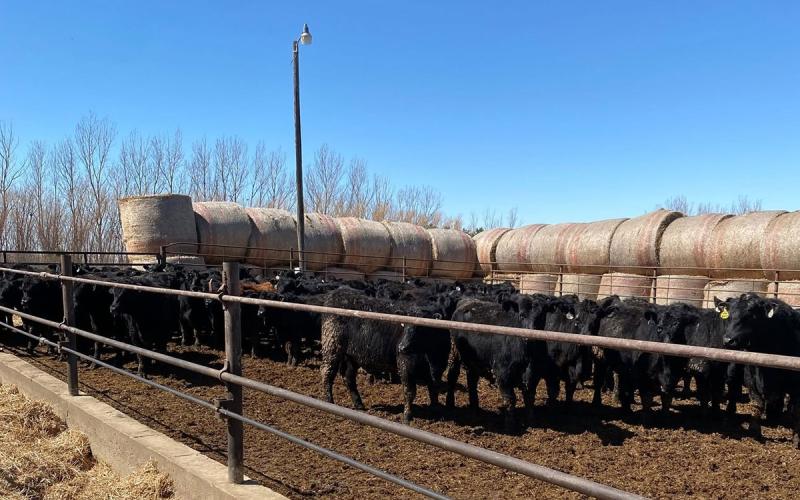
The mature weight of the U.S. cow herd has steadily increased over time. While larger cows are often perceived as more productive, this trend brings several economic challenges. This article focuses on how increasing mature cow size affects profitability in commercial cow-calf operations, particularly from a per-acre perspective. In an ideal system, the most efficient cow is one that remains productive under adverse conditions (e.g., drought), requires minimal inputs (e.g., feed and forage), maintains body condition, and consistently weans a calf each year.
Investigating Operational Impacts
Cow Efficiency
A common misconception is that larger cows are more productive because they wean heavier calves. However, research indicates that for every 100-pound increase in mature cow weight, calf weaning weight increases by only about ten pounds. To better evaluate productivity, we use a measure of efficiency: pounds of calf weaned per pound of cow body weight (lbs. calf/lbs. cow × 100). Higher percentages indicate greater efficiency. Ideally, cows should wean at least 50% of their body weight annually.
To illustrate this:
- A 1,500-lb. cow weaning a 550-lb. calf produces only 36% efficiency (550 ÷ 1,500 × 100)
- A 1,000-lb. cow weaning a 500-lb. calf achieves 50% efficiency (500 ÷ 1,000 × 100)
Although the larger cow weans a heavier calf, she is significantly less efficient. However, profitability in cow-calf systems is ultimately determined on a per-acre basis rather than per cow.
Forage Production
In addition to reduced efficiency, larger cows require substantially greater inputs, particularly forage. According to Dr. Dave Lalman (Oklahoma State University), a 1,500-pound cow consumes approximately eight more pounds of dry matter per day than a 1,000-pound cow. Over the course of a year, this difference adds up quickly and translates to roughly four additional acres required per cow annually, depending on forage productivity. While this may seem minor on a per-head basis, the impact at the herd level is significant. Increased forage demand from larger cows directly reduces stocking rate, meaning fewer cows can be supported on the same land base. For example, the same acreage can support approximately:
- 135 head of 1,000-lb. cows or
- 100 head of 1,500-lb. cows
This reduction of 35 cows per unit of land represents a major loss in production capacity. While larger cows may produce slightly heavier individual calves, fewer total calves are produced per acre.
Land Base
From a resource standpoint, pasture is often the most limiting and valuable asset in a cow-calf operation. As mature cow size increases, the operation becomes more land-intensive, requiring more acres per cow and reducing the total output per acre. Producers are forced to either:
- Reduce herd size
- Increase leased or owned pasture acreage, or
- Supplement with additional purchased or harvested feed
All three options reduce profitability on a per-acre basis. Larger cows also place more pressure on the land base, making operations more vulnerable during drought and periods of limited forage availability. In addition to reduced revenue per acre, larger cows increase production costs through higher annual feed requirements, greater winter supplementation needs, and potentially increased replacement female development costs.
Revenue Comparison
The following example offers a revenue comparison using the following assumptions:
- 1,000-lb. cow will wean a 500-lb. calf
- 1,500-lb. cow will wean a 550-lb. calf
- 90% calf crop weaned for both groups
- Value of $500/CWT based on the Ft. Pierre USDA Market Report (June 19, 2026)
Moderate Mature Size
Moderate Mature Size Herd (1,000-lb. cow):
- 135 cows x 90% calf crop = 121 calves
- 121 calves x 500-lb. weaning weight = 60,500 lbs. total weaning weight
- 60,500-lbs. of calf pay weight x $500/CWT = $302,500 total revenue generated
Large Mature Size
Large Mature Size Example (1,500-lb. cow):
- 100 cows x 90% calf crop = 90 calves
- 90 calves x 550-lb. weaning weight = 49,500 lbs. total weaning weight
- 49,500-lbs. of calf pay weight x $500/CWT = $247,500 total revenue generated
Results
When evaluated on the same land base, the moderate-sized herd produces 11,000 more pounds of calf per acre base and generates $55,000 more revenue annually, compared to the larger-sized cows. Despite weaning heavier individual calves, larger cows result in:
- Lower stocking rates
- Higher feed and forage requirements
- Reduced overall efficiency
Management Considerations
Producers can manage mature cow size over time through bull selection, particularly by placing emphasis on moderate frame size, mature weight EPDs, and overall cow efficiency rather than maximum growth traits alone.
Ultimately, the goal is not to simply select smaller cows, but to match cow size to available resources. Operations with abundant, high-quality forage may be able to support larger cows; however, in more resource-limited or variable environments, moderate-sized cows typically offer greater biological and economic efficiency. The size of mature cows is a critical factor in evaluating profitability within the commercial cow-calf enterprise. While larger cows produce slightly heavier calves, the gains are minimal compared to the increase in input costs and the reduction in herd size they require. Moderate-sized cows, on the other hand, tend to be more efficient, economically sustainable, and better suited to variable environmental conditions. For producers focused on long-term profitability, emphasizing efficiency, rather than size alone, should be a key management priority.