Cattle remain valuable. The national price received for steers and heifers from NASS was $245 per cwt in April 2026, which was $34 per cwt higher than a year earlier. Calves are even more valuable. The national price paid for feeder cattle and calves from NASS was $418 per cwt in April 2026, $97 per cwt higher than a year earlier. Those values indicate another increase in the value of cattle production at the state level for the year. The high price levels are also strong incentives to deliver pounds and calves to the market.
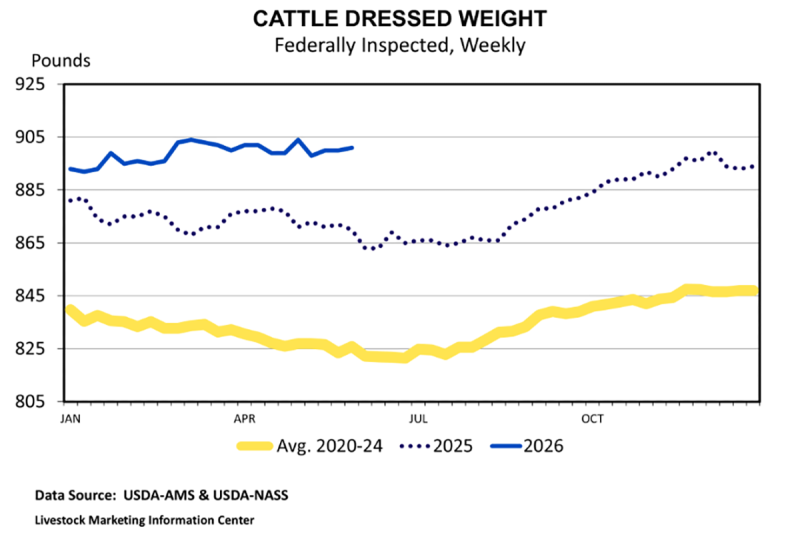
The pounds are coming from the continued higher slaughter weights. The average live weight of cattle slaughtered in Nebraska in April 2026 was 1,535 pounds, up from 1,494 a year earlier. Nationally, the dressed weight for cattle in 2026 has been steady and higher than last year and the longer-run average (see Figure 1). The average steer dressed weight is about 980 pounds and the heifer dressed weight is about 80 pounds lighter. Cow weights are the exception, about even with a year earlier.
Despite mostly higher weights, beef production is down in 2026, as the number of head slaughtered remains below 2025 levels. At a recent sale, steers weighing 1,372 pounds were sold to return to feed. There were also several instances of feeder cattle described as fleshy, or just another way to describe more pounds.
Some of the added weight is also because of lower feed costs. Some feed is less available than in recent years. The precipitation in early 2026 seemed more variable than normal. The pasture conditions in early June reveal what that means for forage supplies. The shares in South Dakota in the very poor, poor, fair, and good categories are all split equally. There is almost nothing in the excellent category. Pasture and feed are being utilized to ensure this year’s calf crop will get to market.
There were anecdotes about calves already being marketed. However, the totals for calves weighing 200-399 pounds show no difference from recent years. In addition, cow slaughter remains below last year’s low levels. If the volume at lighter weights starts to increase more dramatically, that would be a sign of early weaning and marketing. Summer months are often slow times for much feeder cattle movement across South Dakota. Nationally, if video sales and/or direct sales have more cattle at lighter weights and with earlier delivery times than normal, that too would indicate earlier weaning and movement of calves.
Forage supplies are also constrained by a slight reduction in ending hay stocks and fewer expected hay acres in South Dakota. May 1, 2026, hay stocks from NASS totaled 1.95 million tons, which was down from 2.24 million tons a year earlier. Thus, the residual stocks available to delay grazing or to supplement feeding programs until the new crop is harvested were lower, but not unusually so. Stocks on May 1, 2013, following the 2012 drought, were only 0.85 million tons. Hay production will likely be limited because, in the NASS Prospective Plantings report, producers only intended to harvest 2.55 million acres of hay in South Dakota, down from 2.64 million acres in 2025. The average hay yield in South Dakota over the past five years was 1.82 tons per acre. Using that yield as a forecast suggests hay production in 2026 of 4.64 million tons, which would be sharply lower than the 5.70 million tons in 2025 when acres were high, and yields were above average. The result would be a supply of only 6.59 million tons, the lowest since 2022. Tighter supplies and steady demand will put upward pressure on hay prices this year. In June, the Acreage report may show changes in acres. No yield estimates for hay are released until August.
Hay prices at the end of the 2025 marketing year reflect moisture problems across the western U.S. and sharply higher fuel or trucking costs. Hay prices are up sharply from a year ago in Montana, Wyoming, Colorado, Utah, and Idaho, all states with shortages of winter precipitation, and what had been a slight rebound in cattle inventory levels. Hay prices are lower in Missouri, Oklahoma, and Texas. High fuel prices are widening out hay price differences and driving up costs where feed supplies are tight.