Written collaboratively by Hector Menendez, Jordan M. Adams, Julia T. Silva, Karun Kaniyamattam, and Luis O. Tedeschi.
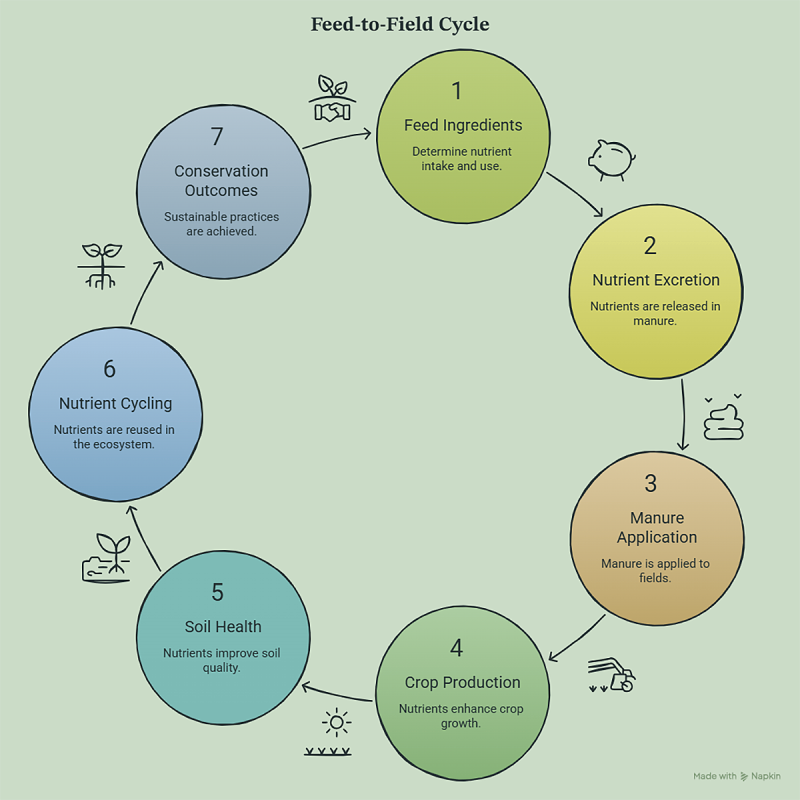
Feed management decisions influence much more than animal performance. They affect manure nutrient content, crop nutrient availability, soil health, and environmental outcomes. A review by Cruz et al. (2026) highlighted how feed production and manure management practices can improve nutrient use efficiency, help mitigate greenhouse gas (GHG) emissions, and support long-term sustainability. Although swine are not the largest contributors to livestock GHG emissions, feed production and manure management represent important opportunities for improvement within pork production systems. The review identified nutrient management, manure recycling, regenerative agriculture practices, and circular bioeconomy approaches as practical strategies for improving resource conservation and nutrient cycling.
For swine systems, the relationship between feed and manure is especially important. Feed ingredients and diet formulation influence nutrient intake, nutrient use efficiency, and ultimately the nutrients excreted in manure. Those nutrients then move into cropping systems where they affect crop production, soil health, nutrient cycling, and conservation outcomes. This feed-to-field connection is where the USDA-NRCS Feed Management Conservation Practice Standard (592) provides value by supporting more efficient nutrient use across the production system.
What can producers do?
Practical management practices can help reduce nutrient losses while improving resource use efficiency:
- Precision feeding: Match nutrient supply closer to animal requirements.
- Nutrient planning: Apply manure according to crop needs and soil test recommendations.
- Conservation practices: Use strategies such tillage/no tillage and cover crops to improve soil cover and nutrient retention.
- Manure placement: Incorporation or injection can reduce nutrient losses.
- Manure treatment technologies: Anaerobic digestion, composting, and biochar may recover nutrients and create additional value.
Thinking beyond individual practices

Regenerative agriculture and circular bioeconomy approaches focus on keeping nutrients moving through productive pathways. Feed management, manure recycling, and conservation practices can work together to improve nutrient use efficiency and support long-term soil function. These approaches are most effective when management decisions are integrated rather than applied independently.
Take-Home Messages
- Feed management influences manure nutrient output.
- Nutrient recycling is most effective when matched to crop needs.
- Conservation practices can support soil health and reduce nutrient losses.
Reference
Cruz, P., S. Menon, and C. Rice. 2026. Sustainable swine production: reducing environmental impacts through cropping systems and manure management. J. Anim. Sci. 104:1-19. doi:10.1093/jas/skaf428
Learn More and Get Involved

Explore the NANP Feed Management Committee and access factsheets, reports, and decision support tools at the NANP website. Whether you're a producer, extension agent, planner, or researcher, your voice is critical in building the future of sustainable livestock production—starting with what we feed and how we manage it.
Funding Acknowledgement
This work was supported by the U.S. Department of Agriculture, Natural Resources Conservation Service (USDA-NRCS) under Grant Agreement NR233A750008C011, titled “Increasing Awareness and Use of Livestock Feeding Management through the National Animal Nutrition Program (NANP).” The views and conclusions contained herein are those of the authors and should not be interpreted as representing the official policies or endorsements of USDA-NRCS.