Written collaboratively by Hector Menendez and Federica La Manna.
Think about eating a slice of watermelon on a hot day. It gives you water along with food. Now think about eating a dry piece of cake. You may want a glass of water with it. Cattle also get water from what they eat. On pasture, that water comes from grass.
Ranchers know that cattle need clean drinking water every day. But the water already inside grass is easy to overlook. As grass grows older and dries out during summer, cattle may need more water from tanks or other sources. We wanted to learn how these two sources of water are linked.
Two ways cattle get water

Water is classified in different ways. Generally, blue water is water that is removed from stored water sources like ponds, streams, rivers, and reservoirs. Green water is water that is available that did not have to be harvested by people such as rainfall or snowmelt on rangeland plants. Most of cattle water use is blue water from livestock tanks that is sourced from another location. However, cattle also get green water from the plants they eat. Grass in the early vegetative stages (tillering) often holds more water than mature, dry grass and can vary by times of peak growth and environmental conditions such as moderate temperatures and available soil moisture. Both water sources help meet an animal’s total daily water requirements.
What we studied in South Dakota
In the summer of 2025, we studied 127 yearling Angus steers grazing six native-grass pastures at South Dakota State University’s Cottonwood Field Station in western South Dakota. The study timeline was from June through August. Some pastures used continuous grazing, while others used rotational grazing with virtual fencing. Pastures also had different stocking rates (low, moderate, heavy) and plant community composition (for example, cool season grasses like Western Wheatgrass and warm season grasses such as Buffalo Grass).
We used water meters at drinking tanks to track how much water each herd used every day. About every two weeks, we collected grass samples and measured how much water they held. We then estimated how much water the cattle could get from eating that grass. The grass-water intake (proportion of water in forage) was an estimate (dry matter intake was estimated as 2.5% of full body weight), not a direct measurement of what each steer consumed.
What we found
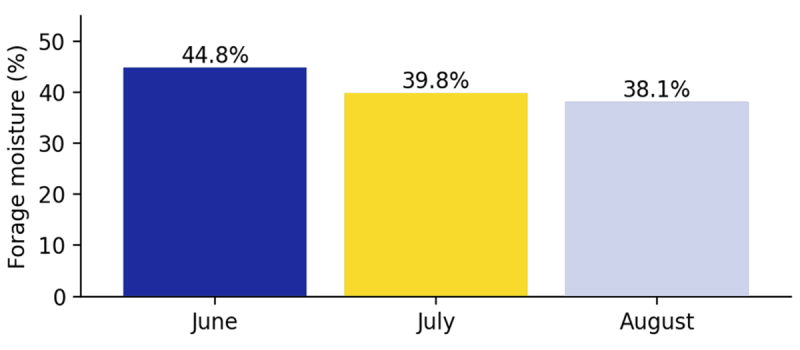
Grass moisture fell as summer went on. Across our samples, average moisture was about 45% in June, 40% in July, and 38% in August (Figure 1). This means cattle were grazing drier forage later in the season.
Our study also found a link between water from forage and water from drinking tanks. When estimated forage-water intake was higher, measured drinking-water use tended to be lower after adjusting for pasture area. This was a herd-level finding, so it does not tell us exactly how much less water any one steer would drink.
What does this mean for ranchers?
Water needs can change through the grazing season. Grass that looks green and tender in early summer may hold more water than grass that is dry and mature in late summer. Hot weather, animal size, feed intake, and other conditions also affect how much cattle drink. Our next step is to learn more about how weather, grazing practices, and forage moisture work together to affect cattle water use at a herd and individual level. This may provide some insight into cattle water use dynamics, available forage for dry matter intake corrected for seasonal water content, and phenotyping water efficient cattle. Knowing how grass moisture changes may help ranchers plan water supplies and manage grazing more confidently. For more information or to enroll your ranch in the SDSU water use program, contact Hector Menendez.


