Accurate prices are needed by buyers and sellers of cattle. With higher overall price levels, the price differences across cattle of different weights have also increased. As a result, producers may want to revisit some pricing rules reflected in price slides and in basis levels for lighter-weight feeder cattle.
The price slide has become steeper in recent years. To observe the change, consider USDA-AMS reported prices for feeder cattle steers at different weights as compiled by the Livestock Marketing Information Center (LMIC). The price slide from March 2026 is much steeper compared to the slide from March 2021 (Figure 1).
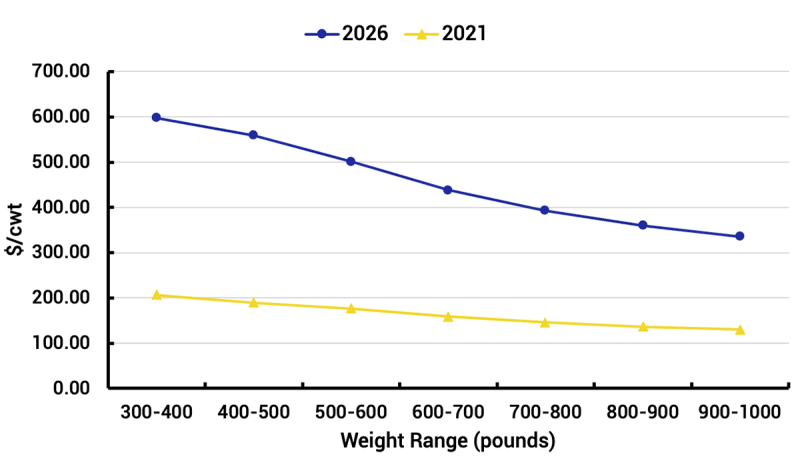
The slopes of those curves imply that the price slide increased from 13 cents per pound in 2021 to 46 cents per pound in 2026. Usually, price slides are used mainly for arriving at reasonable prices to complete contracts. However, the 2026 prices reflect large differences in per-head values across weights. Adjusting price slides may result in fairer prices for buyers and sellers.
Basis, generally defined as the difference between a specific cash price and a nearby futures price, can be measured and used for feeder cattle of different weights. The underlying futures contract reflects feeder steers weighing 700 to 899 pounds. When the cash price reflects similar weight feeder cattle, the basis is usually small, and for South Dakota it mainly reflects a small premium or positive basis level compared to other states. For planning purposes, an average of basis levels from recent prior years can be used to arrive at an expected basis. That convention does not work well for lighter-weight feeder cattle.
For light-weight feeder cattle, recent basis levels are much higher than historic averages. A primary reason for the wider basis is the higher feeder cattle futures price. As the underlying futures prices have moved higher during this cattle cycle, the relative price for lighter feeder cattle has also increased. Consider the monthly basis on 550-pound steers in South Dakota from January of 2021 through March of 2026. The basis is the cash price minus the nearby futures price. The futures data is from the CME Group as compiled by the LMIC. The basis averaged $61.00 per cwt. from 2021 through 2025. During the first quarter of 2026 it averaged $134.00 per cwt. The underlying futures prices have generally moved higher during that period, and the basis has become larger as well (Figure 2).
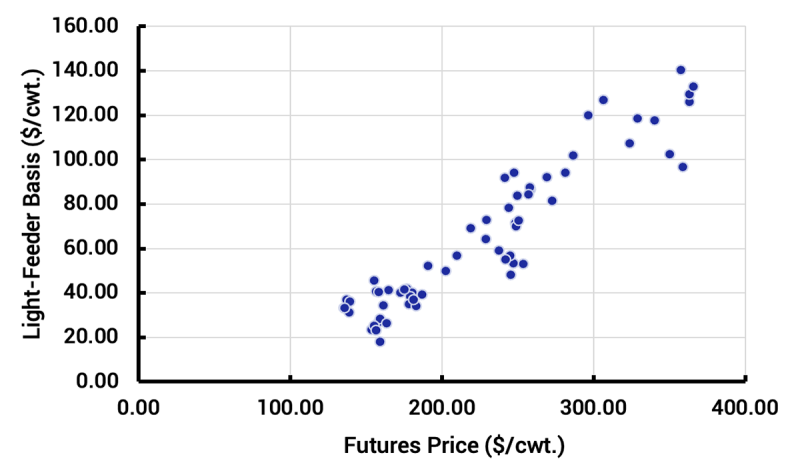
Almost 90 percent of the basis variability can be explained by fluctuating futures prices. For every $50.00 per cwt. change in the futures price level, the basis has changed by $23.00 per cwt. Feed prices and profitability are responsible for the variation observed around a given futures price level.
Using recent basis levels would be more indicative of expected basis levels compared to using historic averages. In March 2026 the cash price for 550-pound steers in South Dakota averaged $498.00 per cwt. The nearby (March 2026) feeder cattle futures price averaged $358.00 per cwt. during March. The basis was thus $140.00 per cwt. and reflected the feeding margin. The futures price reflected the value of an 800-pound steer worth $2,864.00 per head. The cash price for the 550-pound feeder reflected the value of $2,739.00 per head. The difference in those values, $125.00 per head, reflects the cost of feed, yardage, and profitability (or lack thereof), to add 250 pounds to the lighter feeder.
The price slide is much steeper than in prior years, as reflected in the basis on lighter-weight feeder cattle. For hedgers, using a more-recent basis on lighter-weight feeders should result in better price risk management. This would apply to both buyers and sellers.