Written collaboratively by Connie Strunk, Madalyn Shires, and Dalitso Yabwalo.
Fusarium Head Blight (FHB), commonly known as scab, is a major disease threat for wheat growers each year during the flowering growth stage when warm temperatures, humidity, and rainfall create ideal conditions for infection. Because the only in‑season management tool is a timely fungicide application, accurate disease forecasting is essential for protecting yield and grain quality.
Available Tools
To support growers in making informed fungicide decisions, two forecasting tools are available: the Fusarium Risk Tool and the Small Grains Disease Tool, hosted by South Dakota Mesonet.
oth tools use weather data to estimate the likelihood of FHB development, helping growers determine when the risk is high enough to justify a fungicide application or when conditions are low‑risk and a fungicide application may not be needed.
Fusarium Risk Tool
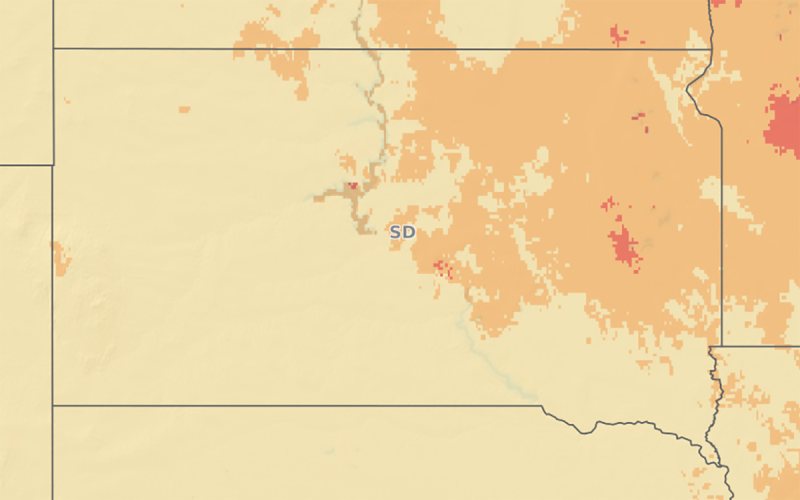
The Fusarium Risk Tool displays risk levels on a color-coded map. A yellow color indicates a low FHB risk, while orange/brown color indicates a medium risk, and the red color indicates a high risk (Figure 1).
Small Grains Disease Tool
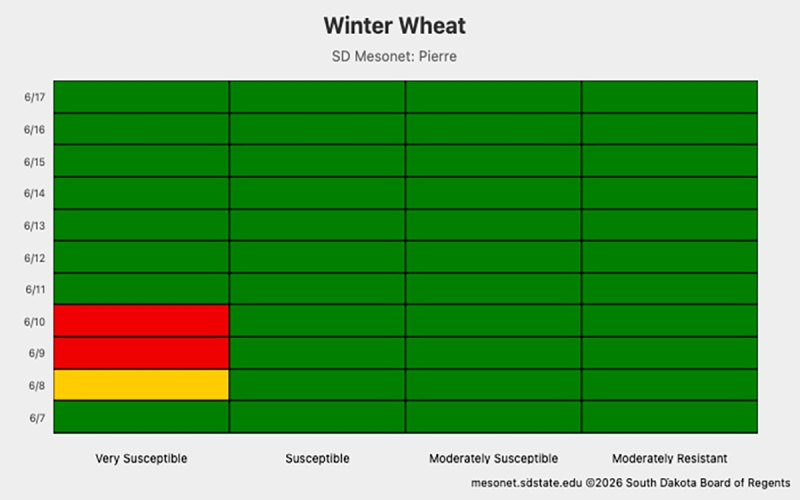
The Small Grains Disease Tool, hosted by the South Dakota Mesonet, provides a more localized, station‑specific assessment. Growers select:
- The nearest SD Mesonet station.
- The growth stage of the crop.
- The type of wheat (spring or winter).
The tool then displays an 11-day table showing scab risk across different cultivar susceptibility ratings (very susceptible to moderately resistant). The green color indicates that scab is unlikely, yellow indicates a moderate risk of scab, and the red color indicates scab is more likely than not to occur (Figure 2). This tool is valuable for growers who want field-specific guidance tied to local weather patterns and cultivar performance.
Why These Tools Matter
Using scab prediction tools helps growers by protecting their yield and grain quality by applying fungicides when infection risk is medium to high, avoiding dockage or rejection of grain at the elevator due to DON, and reducing unnecessary fungicide applications when risk is low, improving profitability and stewardship. By incorporating these forecasting tools into their management decisions, growers can better time fungicide applications and reduce their risk of scab.