About Spotted Spurge
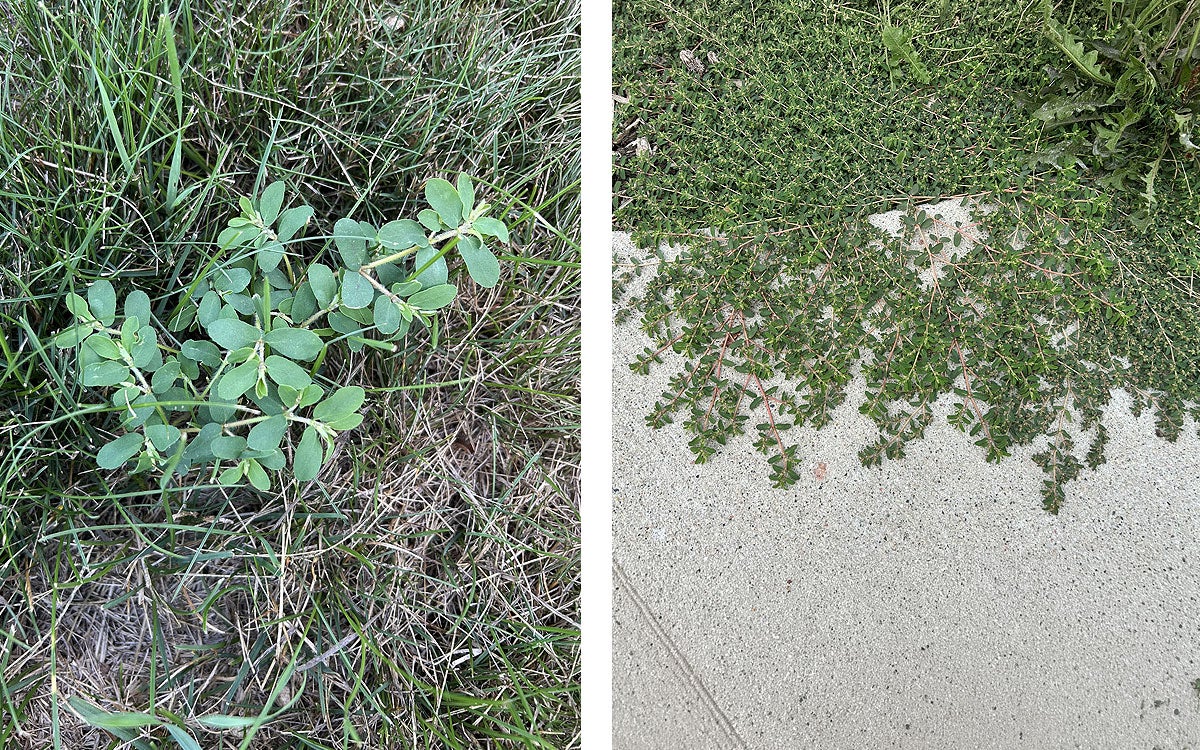
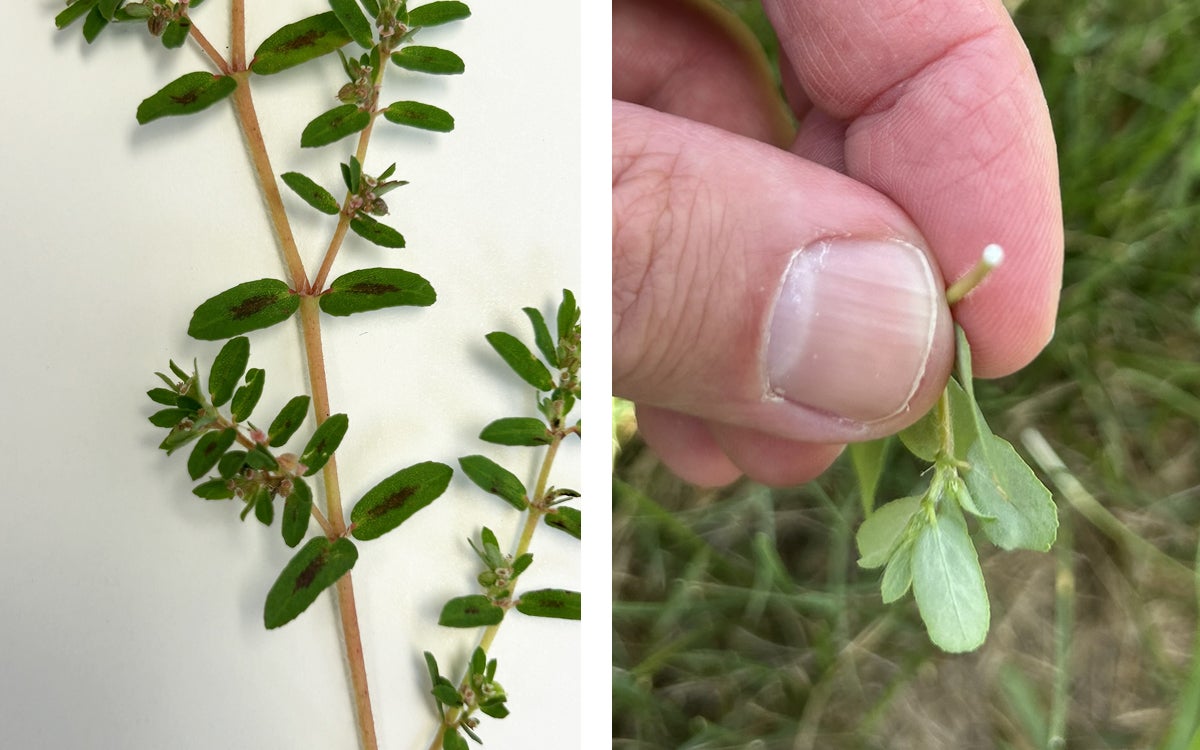
Spotted spurge (Euphorbia maculata) is a common weed known for its prostrate growth pattern, meaning it grows lying flat on the ground (Figure 1). For this reason, it’s often misidentified as prostrate spurge (Euphorbia prostrata), a very similar weed that’s less common to South Dakota. Spotted spurge often, but not always, has a maroon-colored spot on its leaves (Figure 2). This is one of the most-difficult weeds to control in lawns, gardens, and landscaping. Even when controlled, spurge can leave bare patches in lawns that may require reseeding. It’s also drought-tolerant, allowing it to outcompete thinner lawns, especially those under drought stress. To make matters worse, these weeds can produce thousands of seeds per plant.
Herbicide Control
When spurge is present in your yard, you’ll probably continue seeing it in the coming years. Crabgrass preventers, such as dithiopyr (Dimension®), pendimethalin (Pendulum®), and prodiamine (Barricade®, Lebanon®) provide good spurge control. Control improves when the active ingredient, isoxaben (Gallery® 75 DF), is added to the mixture. Gemini® 3.7 SC is a premixed product containing both isoxaben and prodiamine to provide excellent control of both crabgrass and spurge. It comes as a liquid concentrate that can be mixed with water and sprayed for approximately $170 per acre. The smallest quantity available for purchase is 0.5 gal, which covers about 1.5 acres. These products are not normally found on store shelves, so plan to order them online. Applying in the spring when soil temperatures consistently reach 50˚F, should provide ample time to receive the 0.5 inch of rain to incorporate herbicide into the soil prior to crabgrass and spurge emergence.
Postemergence options can be effective on smaller plants prior to the weed spreading out to form its characteristic mat (Figure 1). Look for the active ingredients of dicamba, sulfentrazone, and metsulfuron. Store shelves often contain products with dicamba and sulfentrazone. Metsulfuron is the most effective active ingredient against this weed, but products containing it are rarely found on store shelves and will likely need to be ordered online. Blindside® is a combination of metsulfuron and sulfentrazone which costs about $55 peracre. FarenheitTM is a combination of metsulfuron and dicamba which costs about $25 peracre.
Cultural Control
Hand-pulling is the best option for controlling full-grown weeds. Remove as much of the root as possible to prevent regrowth. Roots are easiest to pull when the soil is moist. Discard the weeds so their seeds don’t make the problem worse.
Wearing gloves is also a good idea if one is sensitive to the milky sap contained in the stems (Figure 2). Competition is your greatest control measure against most weed species, so keep lawns watered, fertilized, and mowed at taller heights (>3 in). Reseed or overseed thin areas, especially in late-August through early September.