The 2025 season began with wet and mild conditions, leading to an abundance of absinth wormwood, Canada thistle, and leafy spurge across the state. The end of the season was warm and dry, which extended opportunities to utilize fall herbicide applications. Most of South Dakota experienced first frosts that were delayed by at least one month, allowing for noxious weed growth to continue much later into the season. Now that winter is upon us, it’s time to plan for future noxious weed management with both spring and fall tactics. Consider asking yourself the following questions before creating your management plan for 2026.
Questions to Consider
How was my weed management plan this year?
Reflect on what worked well and what didn’t for weed management in 2025. If your management plan was less than desirable, improper herbicide selection may have been part of the problem. For example, Milestone® (aminopyrachlor) is effective against absinth wormwood and Canada thistle, but this product is not effective against leafy spurge. Since weed species often coexist in an area, herbicide tank mixtures will likely be needed to broaden the spectrum of control. Even if weed management has been excellent, the same tactics should not be continuously relied upon in future growing seasons. Overreliance on the same weed management plan will eventually select for weeds that can survive those tactics. Refer to the latest SDSU Extension Weed Control: Noxious Weeds and Weed Control: Pasture and Range publications for complete listings of herbicides and effectiveness on select weed species.
Where were the weedy areas?
Mapping weedy area(s), even those which your management plan provided excellent control, helps prioritize future scouting, making it easier to execute control tactics in a timely manner. Keeping weeds confined to small areas makes management doable with spot spraying, which potentially avoids expensive broadcast applications to larger areas. Noting the land features and topography of the infested areas is also important. Hilly areas may need treatment with an ATV sprayer, backpack sprayer or by an aerial application. Hilly areas and areas near water bodies are also good candidates for biocontrol releases if the insect(s) will feed on the weed species present. After treatment, follow-up scouting is necessary to evaluate control and assess if another application is needed.
What weed species were present?
As stated above, Milestone® can provide effective control on both absinth wormwood and Canada thistle. However, timing is critical if trying to control both species with the same application. It can be applied to Canada thistle up to the budding stage, which typically occurs in late-June. Absinth wormwood is best controlled before the plant turns a whitish color, which is often a month before Canada thistle’s budding stage. Therefore, making an application when Canada thistle is budding will likely result in subpar absinth wormwood control.
Correctly identifying weeds is also important for the success of nonchemical weed management. This is especially true for distinguishing biennial from perennial species. Since biennial weeds have a two-year life cycle, mowing them during their second year, but prior to them producing seed, can provide effective control without applying chemicals. This is not the case with perennial weeds. Mowing can complement chemical control tactics but will usually not replace them. Insects can also be effective for weed management, but they will only feed upon certain weed species (i.e., a leafy spurge beetle will not feed on hoary cress).
Can non-herbicide weed management easily be implemented?
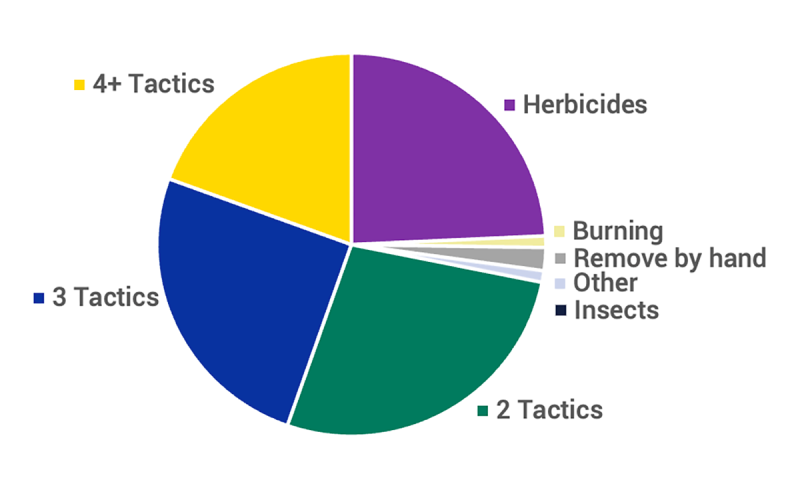
Many South Dakota land managers utilize multiple tactics to manage noxious weeds, which were revealed by a recently conducted survey (Figure 1). While herbicides remain the most effective weed management tool, non-herbicide tactics can be easily implemented. As previously mentioned, these include mowing, releasing appropriate insects for biocontrol, and/or hand weeding small, isolated patches. Utilizing multiple tactics is almost always preferred but should be done correctly. For example, if mowing and herbicide applications are used together, mowing should be performed either before (preferred) or several days after herbicide application. Delayed mowing gives the weeds time to translocate the herbicide throughout the plant. As another example, if releasing beneficial insects, allow plenty of time for weed regrowth after mowing, because insects will likely leave an area if there’s a lack of living weeds to feed upon.
While it is impossible to predict the growing conditions for 2026 at this time, planning now with a clear mind can help make better decisions, rather than waiting until the busy time of the growing season when there’s so many distractions. While making new changes can be worrisome, try implementing new management tactics on smaller areas and then expanding in future years if successful. Again, remember that weeds can adapt when the same management tactics are applied year-after-year. Diverse management plans can help improve long-term weed management. Weed management should be treated on an area-to-area basis, to ensure all weed species, land topography, and other special features are taken into consideration to ensure the correct tactics and implementation methods are selected.


