It may seem like major cities have the advantage on cutting-edge research, but for precision range and livestock research, look to South Dakota. The primary hub of that research is conducted at the Cottonwood Field Station, a 2,640-acre station in western South Dakota’s grasslands.
Part of the South Dakota Agricultural Experiment Station at SDSU, Cottonwood Field Station recently completed upgrades and renovations, including a dry lot monoslope barn, precision feeding bunks, new chutes, and a gathering space – all designed to advance precision livestock technology vetting and application for research and production.
One of the biggest challenges for producers adapting to new technologies is cost. Producers may be wary of investing in a new product without being sure of its return on investment.
“SDSU Extension is answering these practical questions for producers, providing objective, science-based evidence regarding technology and its return on investment,” said Hector Menendez, assistant professor and SDSU Extension Livestock Grazing Specialist.
According to U.S. Department of Agriculture, precision agriculture is defined as practices that “utilize technology to improve agricultural productivity or efficiency by connecting the practice to a digital environment for crop or livestock production.”
Some of those technologies include virtual fencing, GPS ear tags, calving cameras, emission monitoring systems, pasture-based weighing systems, drones, and water monitoring systems – all of which SDSU Extension is working with.
Menendez said people, businesses, and researchers from around the world, along with many U.S. companies, have visited Cottonwood to add support or request to be part of what SDSU is doing.

“This national and international reputation has propelled the Cottonwood Research Station as a leader in the field of precision ranching due to the synergistic activities of the team,” he said. “The facilities are at capacity, with plans to continue to fully utilize the new facilities to benefit producers and the agricultural industry.”
Despite the wide range of precision livestock technologies available, Cottonwood Field Station has tested and researched nearly all of them. While many technologies are still emerging and adapting, Menendez and Logan Vandermark, SDSU Extension Precision Livestock Field Specialist, said virtual fencing remains one of the hottest topics with livestock producers.
Virtual fencing is a GPS-based system that uses collar-mounted sensors and audio/electric cues to contain or move animals. By limiting physical fences, virtual fencing can improve grazing efficiency and reduce labor time and costs for producers by limiting the need to maintain physical fences.
“Virtual fencing is transformative across the world right now,” Menendez said. “It’s the most evolutionary precision livestock technology, hands-down.”
Evolutionary, and effective. Menendez and other faculty members have evaluated cattle all the way from grazing to slaughter, and their research determined that virtual fencing does not negatively impact animal welfare, performance or meat quality.
Another challenge of precision livestock technologies is that many pieces are presented as standalones. In answer to that, the team has built a whole ranching system that combines different technologies like forage monitoring, satellite systems, and virtual fencing.
By putting the pieces together, Menendez said they have compiled range livestock data that was unheard of just 5 years ago, which allows them to look at herd-level production all the way down to individual animals. Vandermark used that data and adapted an algorithm to help producers determine how much energy animals spend grazing. That’s important for producers to track because grazing animals in large pastures use a lot of energy to meet nutrient requirements, especially compared to confined animals.
“The value of what we do at Cottonwood is we can say ‘this management style can work well toward certain goals and may not for others’. The producer doesn’t necessarily need these technologies to manage their operations but hopefully can benefit from them,” Vandermark said. “Hopefully, research is going to drive industry and change. SDSU Extension plays a vital role for South Dakota producers in meeting those needs specifically.”
They have also researched how virtual fencing can be used in a community-minded way – some collars allow users to share access so others within their operation can know if their cattle get out. Others can be used to help automatically herd livestock to safety during emergency or disaster situations, such as blizzard conditions.
That helps create peace of mind at a community level, Menendez noted. He’s also seen young or beginning ranchers able to participate in grazing by providing different services, like custom grazing, through technologies like virtual fencing, reinvigorating youth in rural areas and boosting the economy.
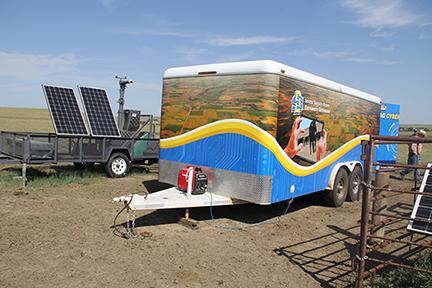
To provide more hands-on demonstrations of these technologies across the state, SDSU Extension created a precision agriculture mobile trailer. The livestock trailer includes virtual fence collars, weather data collection, stock tank monitoring systems, drones and a TV that can show real-time research at the Cottonwood Field Station. It has been used for demonstrations across the state and region, including educational events in Nebraska, Iowa and Minnesota, and has been extremely well-received at each stop.
“To be able to provide producers with close to the same experience as visiting Cottonwood without asking them to travel has been really valuable,” Vandermark said.