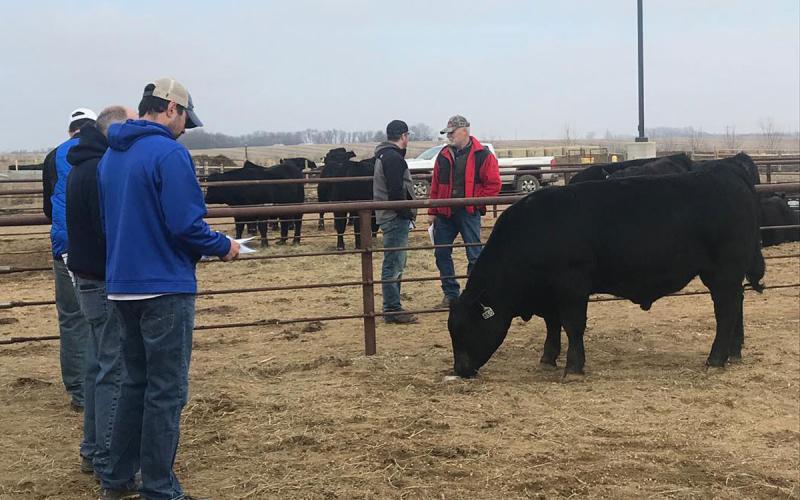
Bull sale season is here for many operations and cattlemen are spending nights scanning websites and catalogs in search or their next herd sire. The search for a new bull can be overwhelming if you are not familiar with how to interpret the numbers. Seedstock operations are going to put several numbers in the catalogs, made up of both performance data (ex. birth weight, weaning weight) and genetic data presented as expected progeny differences (EPDs) to help sell their animals. The EPDs are calculated by breed associations using the submitted performance data of the animal, as well as genetics of their sire and dam. An EPD is the best way to compare traits between animals of the same breed and a more accurate predictor of genetic potential than performance data only because it is exempt from management or environment influences. EPDs will change over time with DNA and progeny records.
To determine which EPDs to look at, one must first set up their breeding objective by working backwards. How do you select or market your calf crop? For example, if you are raising heifers, you may be looking for maternally driven bulls. Yet, if you are selling all calves at weaning and purchasing replacements, a terminal sire should be selected for more growth and performance. Keep in mind you may have one breeding objective when buying a bull to use on heifers versus cows if their calves are marketed differently.
So what do all the numbers mean? EPDs are expressed in units such as pounds or percentage that allows comparison between animals to determine which will give more or less of a certain trait. EPDs of animals within the same breed can be directly compared. If you don’t have another animal to compare it to, you can compare it to the breed average. Animals cannot be compared across breeds without an adjustment. To keep it simple, Angus bulls in one catalog can be compared to any other Angus bulls in another catalog.
Common EPDs
Common EPDs are listed in many sale catalogs in order of production, maternal, management, carcass and value indexes. The sections below explain many common EPDs, the abbreviation, unit of measure and how to use them. Keep in mind EPDs can be positive and negative. Single trait selection is not recommended so evaluating multiple EPDs or indexes is a better way to achieve balanced results.
| EPD | Abbreviation | Unit of measure | How to use |
|---|---|---|---|
| Calving Ease Direct | CED, CE | Percentage | Higher percent is greater calving ease, less assistance needed |
| Birth Weight | BW | Pounds | Lower number means lighter progeny at birth |
| Weaning Weight | WW | Pounds | Higher number means calves will be heavier at weaning |
| Yearling Weight | YW | Pounds | Higher number means calves will be heavier as yearlings |
| EPD | Abbreviation | Unit of measure | How to use |
|---|---|---|---|
| Heifer pregnancy | HP/HPG | Percent | Higher value predicts more heifers to conceive and calve at 2 years of age |
| Milk | Milk, MM | Pounds | Higher value means heavier weaning weight due to milk production |
| Calving Ease Maternal | CEM, MCE | Percent | Higher value predicts more of his daughters will calve unassisted |
| EPD | Abbreviation | Unit of measure | How to use |
|---|---|---|---|
| Docility | Doc | Percent | Higher value is more favorable docility |
| Pulmonary arterial pressure | PAP | mmHG | Lower value is lesser change to contract high altitude disease |
| EPD | Abbreviation | Unit of measure | How to use |
|---|---|---|---|
| Marbling | MARB | Marbling Score Units | Higher value means more intramuscular fat in the ribeye |
| Carcass Weight | CW | Pounds | Higher value means heavier actual hot carcass weight |
| Ribeye Area | REA | Square inches | Higher value predicts a larger ribeye area |
| EPD | Abbreviation | Unit of measure | How to use |
|---|---|---|---|
| Maternal Weaned Calf Value | $M | Dollars | Higher value predicts more value per head when retaining females |
| Weaning Calf Value | $W | Dollars | Higher value predicts more expected revenue preweaning |
| Feedlot Value | $F | Dollars | Higher value predicts more expected revenue postweaning |
| Beef Value | $B | Dollars | Higher value predicts more combined revenue from postweaning performance and carcass value |
| Combined Value | $C | Dollars | $M and $B combined to produce a value predicting more dollars per head received if retaining heifers and finishing cattle |
Accuracy
Accuracy (ACC) is a measure of confidence ranging from 0 to 0.99 with 0.99 indicating 99% accurate. Yearling bulls are going to have low accuracy until they have progeny registered to them. One way seedstock operators improve accuracy on young animals is to submit DNA which is used to produce genomically enhanced EPDs which produce progeny equivalents to improve the accuracy of their EPDs. Higher accuracy will yield more reliable results in expression of that trait. Accuracy is often reported under the EPD value.
Percentile Rankings
As you search through the catalogs and still find it hard to narrow down the list, you can also use percentile ranking to help identify bulls that excel in the top percent of the breed. Selecting bulls that rank in the top 10% of a trait may help you make faster progress towards a breeding objective. Keep in mind that traits interact with another, for example selecting for high weaning weights may also increase mature weight of heifers that are retained. Percentile ranks are listed under accuracy on an EPD profile.
Performance and Herd Data
Actual animal performance data is often provided in catalogs but should be utilized secondary to EPDs due to the influence of management on these values. Yet, looking at actual birth weight is something you can visit with the seller about and determine how their management may affect the data, including how their cows are fed, if any supplement is provided to preweaning calves and what the postweaning development is like. Ratios are developed to compare animals within the herd to each other when they were raised under these same conditions. Ratios average 100, therefore, if the ratio is 110 for Bull A, that indicates that Bull A performed 10% greater performance than herd average. Ratios should not be compared across herds as every operation is using different management, nutrition and environmental conditions.
Every breed will report some similar EPDs but there may be different abbreviations. In addition, each breed can report more EPDs and indexes if they collect the data from their registration membership. Make sure to only compare EPDs within a breed and find the correct EPDs and indexes that work for your breeding objective. If you are interested in comparing across breeds, there is a conversion published by the USDA Meat Animal Research Center annually. It is available on the Beef Improvement Federation website.
Summary
- EPDs are a tool to compare traits between animals within the same breed.
- Depending on the EPD, high or low values may be considered more desirable.
- To compare EPDs across two different breeds, an adjustment must be made.
- Higher accuracy will yield more reliable results in expression of that trait.
- Percentile ranks and breed averages can be used to compare an animal across the entire breed.
Sources
- EPD $Value Definitions, American Angus Association.
- 2025 Across-Breed EPD Table and Improvements – Beef Improvement Federation, Beef Improvement Federation.