Written collaboratively by Adam Varenhorst, Philip Rozeboom, Patrick Wagner, and Brad McManus.
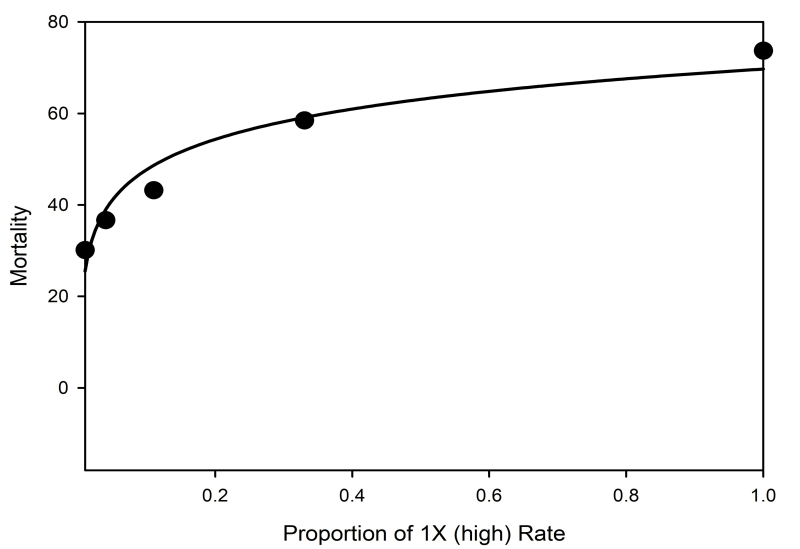
SDSU Extension entomologists are currently looking for alfalfa fields with a past alfalfa weevil insecticide failures. We are collaborating with North Dakota State University and the University of Minnesota on project to determine if pyrethroid resistance exists in our respective states. Results from an alfalfa field near Sturgis, SD in 2025 were indicative of poor lambda-cyhalothrin (pyrethroid) perfomance (Figure 1). For this test, the lethal dose to kill 50% of the population (LD50) was 1.26 times higher and the lethal dose to kill 90% of the population (LD90) was 19.34 times higher than the highest labeled rate of lambda-cyhalothrin for alfalfa weevil management. Additional evaluations will be conducted in 2026, but the preliminary results indicate potential pythroid problems for fields around the tested population.
If you have previously observed a pyrethroid failure when managing alfalfa weevils please report it to Adam Varenhorst. We will also be evaluating populations of alfalfa weevils for pyrethroid susceptibility during 2026. If you have a population of alfalfa weevils that you would like tested, please contact an SDSU Extension pest expert.