Written collaboratively by Eric Jones, Graig Reicks, Philip Rozeboom, Stephen Robertson, Jill Alms, and David Vos.
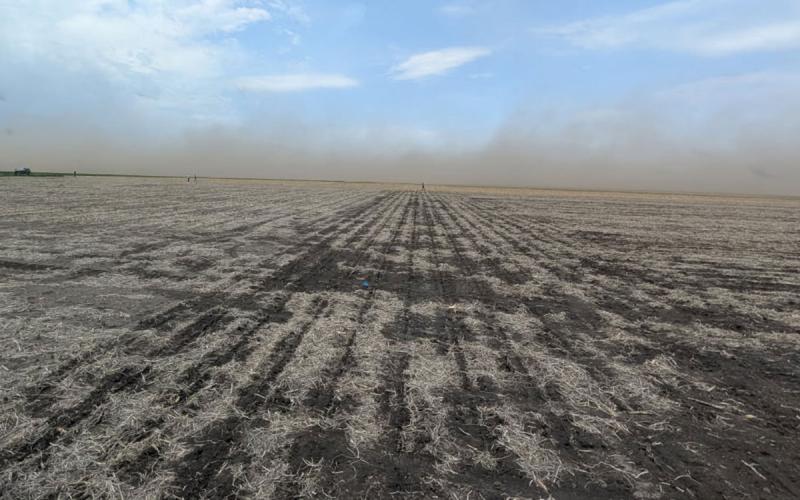
Dry conditions have accelerated the pace of planting this spring in South Dakota. Preemergence herbicides have been applied to many fields, but without rainfall (0.5 to 1 inches) to move that herbicide into the soil profile to kill germinating weed seeds, weeds will likely emerge and survive. Consequently, postemergence herbicides may need to be applied sooner to minimize weed interference with the crop. Drought conditions are forecasted to continue and postemergence herbicide activity on weeds can be affected.
Drought Impacts on Herbicides
All herbicides with foliar activity will have language on the respective label stating that applications should be made to actively growing weeds. While weeds are hardier during adverse conditions compared with crops, weeds are still plants and will exhibit reduced growth and photosynthesis in dry conditions. If weeds are not actively growing, the herbicide will be less effective because the weeds are not conducting the processes normally that the herbicides inhibit to kill the weed. Drought-stressed weeds will also exhibit reduced transpiration and increased cuticle thickness to retain water. These factors reduce herbicide absorption, which could result in weeds not being killed. Relative humidity can change with the time of day, where higher relative humidity occurs in the morning and late afternoon. While applying at these times of day can enhance herbicide activity, caution should be taken when making applications early or late in the day due to increased likelihood for temperature inversions (when cooler air is trapped beneath a warm layer). Additionally, herbicides can volatize with high temperatures and low humidity; applications should not be made during these conditions. Be sure to refer to the specific herbicide label to determine the acceptable weather conditions for application and consult the South Dakota State University Extension Mesonet Spray Tool.
Maximizing Herbicide Effectiveness
Weather cannot be controlled, but there are variables we can control to help increase the effectiveness of postemergence herbicides during drought conditions. Foremost, if weeds appear wilted due to excessively dry conditions, do not apply herbicides. Herbicides should be applied when weeds are small, approximately 2 inches or less, as smaller weeds are easier to kill with herbicides than larger weeds regardless of environmental conditions. Increased output (i.e., gallons per acre) will ensure more herbicide is being deposited on the weed leaf surface to ensure the maximum amount of active ingredient can be absorbed. Lower humidity and higher temperatures both increase drying times, causing herbicide droplets to dry on the leaf before being absorbed into the leaf. Humectants, adjuvants that slow evaporation, can be applied with herbicides to maximize the amount of time the droplets stay in contact with the cuticle to increase absorption into the leaf. However, the use of a humectant will not make the herbicide perform as if conditions were ideal.
Successful weed control during drought depends on optimizing every controllable factor—timely applications, small weeds, proper environmental conditions, adequate coverage, and appropriate adjuvants. Timely scouting and close watch on forecasted environmental conditions will help manage drought-stressed weeds with herbicides. While the focus of this article is for row crop weed management, the principles discussed here apply for weed management in pasture and rangeland.


