Written collaboratively by Adam Varenhorst, Philip Rozeboom, Patrick Wagner, and Brad McManus.
Banded sunflower moths are active in South Dakota, which means it is time to start scouting sunflowers for their eggs. The caterpillars of banded sunflower moths are capable of reducing yields and oil content by feeding on the developing florets and tunneling into developing seeds. This activity can inhibit pollination due to the destruction of the florets and decrease the number of viable seeds per head due to caterpillar feeding.
Description and Behavior
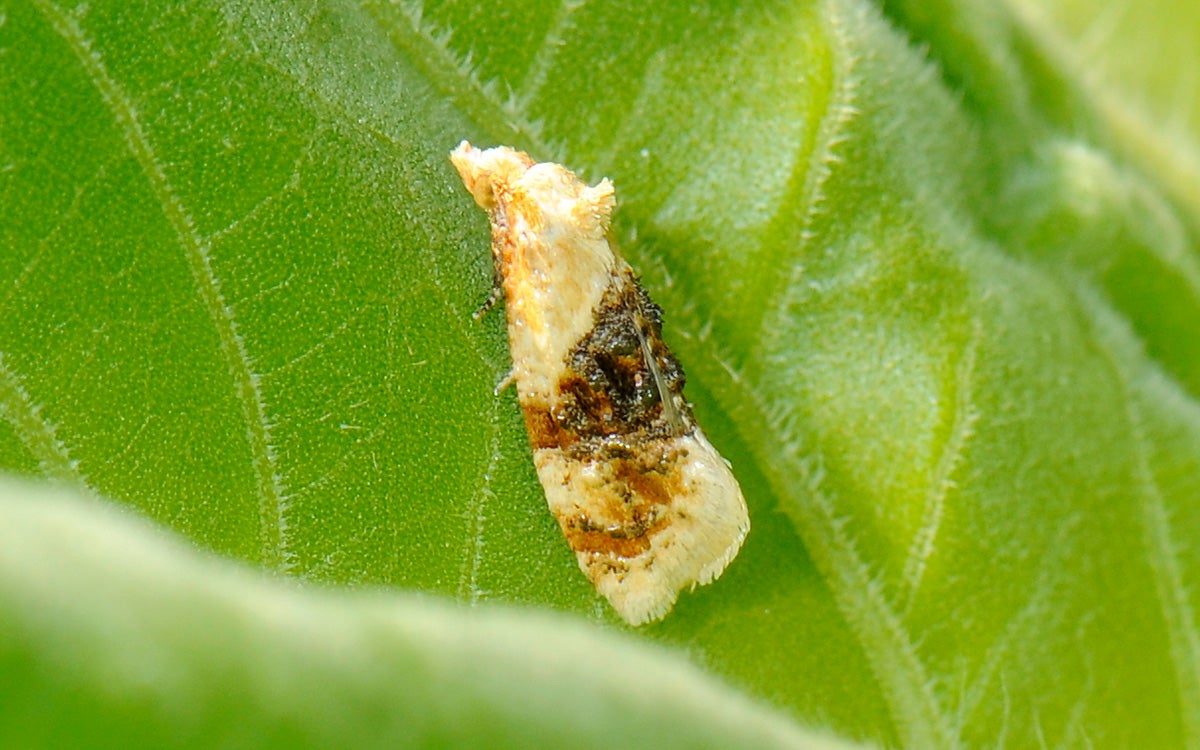
Banded sunflower moths are approximately ¼ of an inch long and have a wingspan that is approximately ½ of an inch. The moths are a white to cream color and have a distinct dark brown band that runs across their wings (Figure 1).
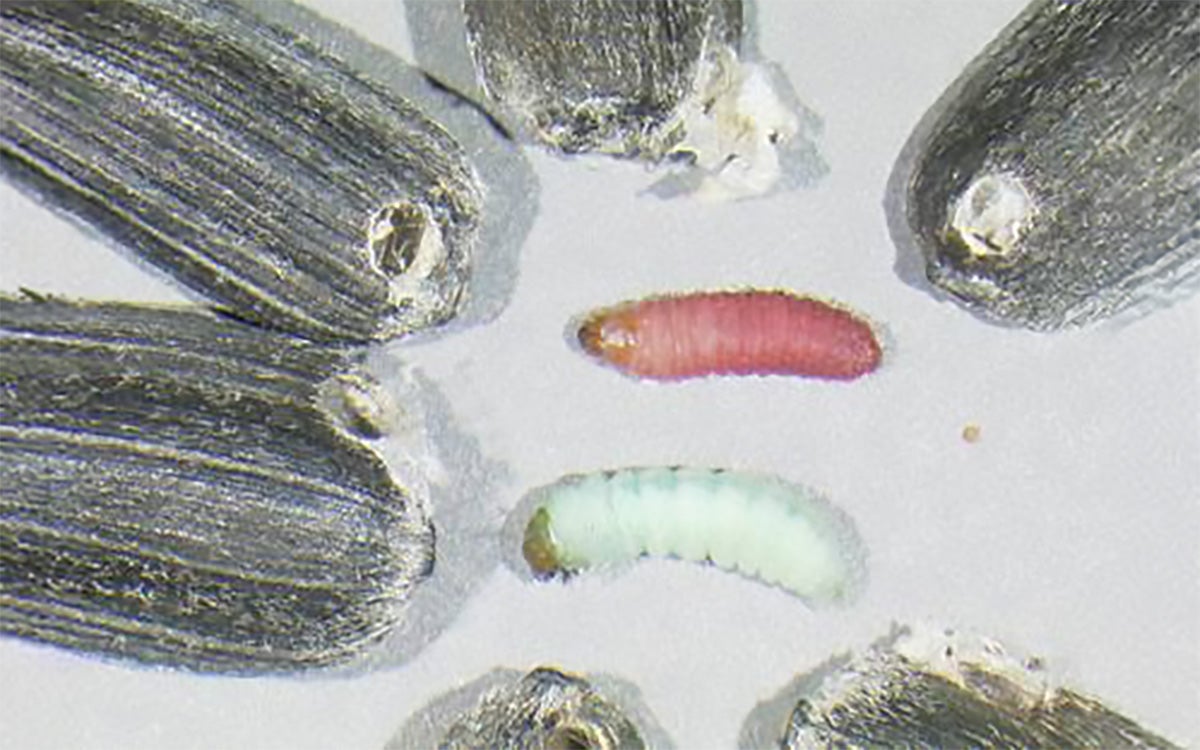
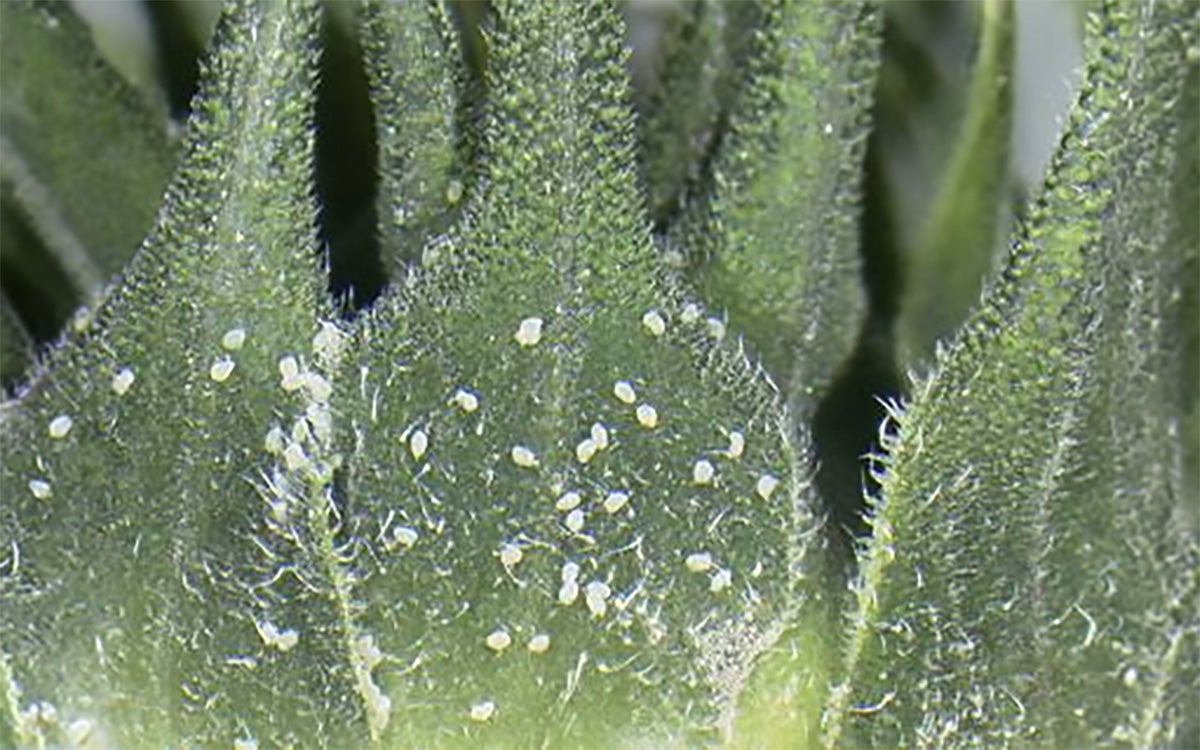
Banded sunflower moth caterpillars vary in color depending on what developmental stage they are at. Young caterpillars are white or cream colored. During the later stages of their development, the caterpillars are pink or red in color. During the final stage, the caterpillars are mint green colored and approximately 7/16 of an inch long (Figure 2). Banded sunflower moth eggs are very small and white in color (Figure 3).
Adult Moth
Caterpillars
Eggs
Banded sunflower moths overwinter in South Dakota and emerge as adult moths from late June through July. Soon after emergence, the moths begin laying eggs on the bracts of sunflower heads. Egg laying typically peaks during late bud stages. The larvae hatch about a week after the eggs are laid and start feeding on the sunflower heads. Larvae may be found on sunflowers from July through September. Once larvae have matured, they drop to the ground and pupate in the soil where they overwinter.
Scouting
Scouting for banded sunflower moths should begin when the majority of the sunflowers in the field have midsized buds (R3 growth stage). The majority of sunflower fields in South Dakota are now past this growth stage. Moths can be scouted for by either examining plants for egg masses or by looking for the adult moths.
For egg scouting, examine the outer six bracts of five sunflower plants located approximately 21 feet in from the field edge. This scouting method should be done on each side of the field for a total of four sampling sites. For each sunflower plant, count the number of eggs that are present on the outer layer of six floral bracts. Using a hand lens may be helpful as the eggs are very small in size. As mentioned, scouting for eggs should begin when the majority of the field has reached the R3 growth stage. Eggs may be found in singles or as clusters. An economic injury level (EIL) calculator has been developed by researchers at NDSU (Figure 4). In addition to the economic injury level, this tool also calculates the economic distance (ED) of the banded sunflower moth (Figure 5).


This distance (in feet) estimates how far into the field from the edge an economic population exists. The benefit of using eggs for scouting is an increased amount of time to make a management decision.
Banded sunflower moths can also be scouted by checking for adult moths on plants that are in the R3 growth stage. To scout for moths, select five sites that are 75 to 100 feet in from the field edge. These sites should be in a random pattern and can be selected by walking in an “X”, “W”, or “Z” pattern. At each sampling site, examine a total of 20 plants on the upper and lower sides of the leaves. The economic injury level for this method of scouting is between 1 and 2 banded sunflower moth adults per plant. For management of the banded sunflower moth please refer to the current edition of the South Dakota Pest Management Guide: Alfalfa and Oilseeds.