Written collaboratively by Adam Varenhorst, Govinda Shrestha, Kushal Giri, Philip Rozeboom, and Patrick Wagner.
During 2026, we will be producing a new weekly update on sunflower insect pest activity. This information will be attained via a sampling network of eight locations that are in central South Dakota. There are several pests that can attack sunflower throughout the season, and we will be monitoring traps and plants to determine if any of these pests are present and their population abundance.
August 13, 2026
This is the eighth weekly sunflower pest activity update (August 7–August 13, 2026) from central South Dakota, covering nine fields: one field in Hyde County, four fields in Sully County, and four fields in Hughes County. Sunflower pests were monitored using emergence traps and pheromone lure-baited traps. The results are summarized in Table 1. This work is supported by the SD Oilseed Council.
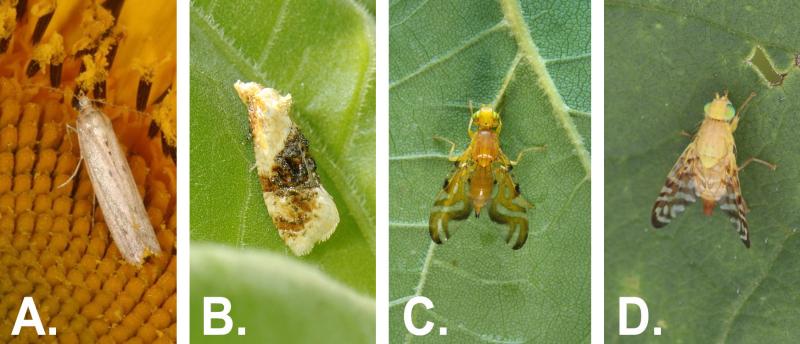
From August 7th to 13th, we caught a high number of banded sunflower moths (Figure 1B) with collections occurring at all nine fields. The banded sunflower moth captures varied from location to location in each county, but all locations had decreased banded sunflower moth activity when compared to the previous week. Hughes County captures ranged from 108-242, Sully County captures ranged from 48-200, and Hyde County had 97 captures. Sunflower moth captures remain very low. Arthur’s sunflower moth populations were detected at two locations but were low in comparison to the banded sunflower moth.
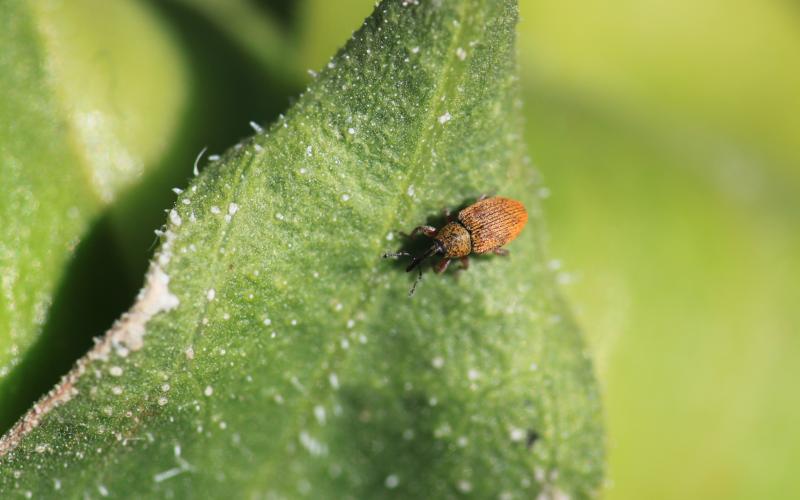
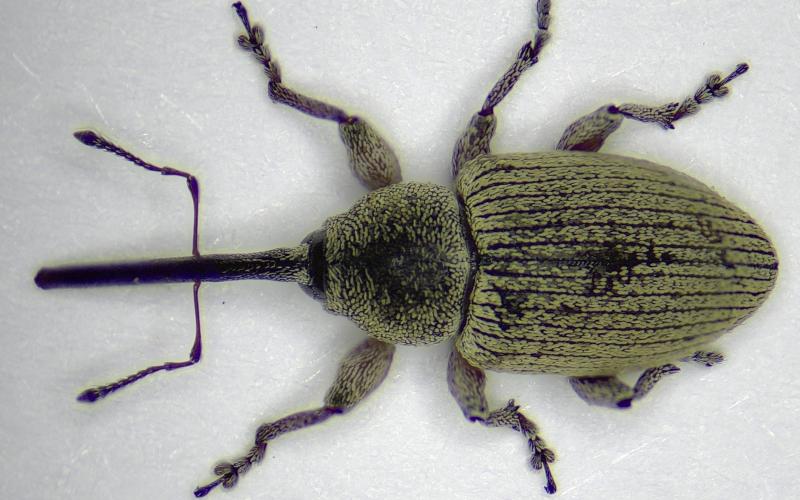
Emergence trapping for red sunflower seed weevils has ceased, and due to no captures in 2026 we will be re-evaluating our trapping method. Red sunflower seed weevils have been observed across South Dakota with many populations being treated. Overall, population densities appear to be similar to 2025, marking an overall decrease from 2019-2024. Sunflower fields should be monitored for red sunflower seed weevils until sunflower exceed the R5.7 (70% pollination) growth stage. Many sunflowers in South Dakota will be past R5.7 or will be within the next week.
| Location | Red sunflower seed weevil | Banded sunflower moth | Arthur’s Sunflower Moth | Sunflower Moth | Sunflower Receptacle Maggot | Sunflower Maggot | Redbacked Cutworm Moth |
|---|---|---|---|---|---|---|---|
| Highmore | 0 | 97 | 7 | 0 | 0 | 0 | 0 |
| Pierre 1 | 0 | 134 | 2 | 0 | 0 | 0 | 0 |
| Pierre 2 | 0 | 242 | 6 | 0 | 0 | 0 | 0 |
| Pierre 3 | 0 | 108 | 0 | 0 | 0 | 0 | 0 |
| Pierre 4 | 0 | 137 | 18 | 0 | 0 | 0 | 0 |
| Onida 1 | 0 | 99 | 2 | 0 | 0 | 0 | 0 |
| Onida 2 | 0 | 97 | 1 | 0 | 0 | 0 | 0 |
| Onida 3 | 0 | 200 | 7 | 0 | 0 | 0 | 0 |
| Onida 4 | 0 | 48 | 0 | 0 | 0 | 0 | 0 |
As a reminder, this pest monitoring update is to provide a basis for areas where sunflowers should be monitored for the detected pests and does not provide enough clarity on populations per field for making management decisions based on these data alone. As early planted sunflower fields are beginning to reach the bud stage, scouting for major insect pests should begin.
Previous Recaps
This is the seventh weekly sunflower pest activity update (July 29 – August 7) from central South Dakota, covering nine fields: one field in Hyde County, four fields in Sully County, and four fields in Hughes County. Sunflower pests were monitored using emergence traps and pheromone lure-baited traps. The results are summarized in Table 1.
From July 29-August 7, we caught a high number of banded sunflower moths (Figure 1B) with collections occurring at all nine fields. The banded sunflower moth captures varied from location to location in each county, but all locations had decreased banded sunflower moth activity when compared to the previous week (Table 1). Hughes County captures ranged from 35-213, Sully County captures ranged from 73-543, and Hyde County had 80 captures. Sunflower moth captures remain very low. Arthur’s sunflower moth populations were detected at two locations but were low in comparison to the banded sunflower moth.
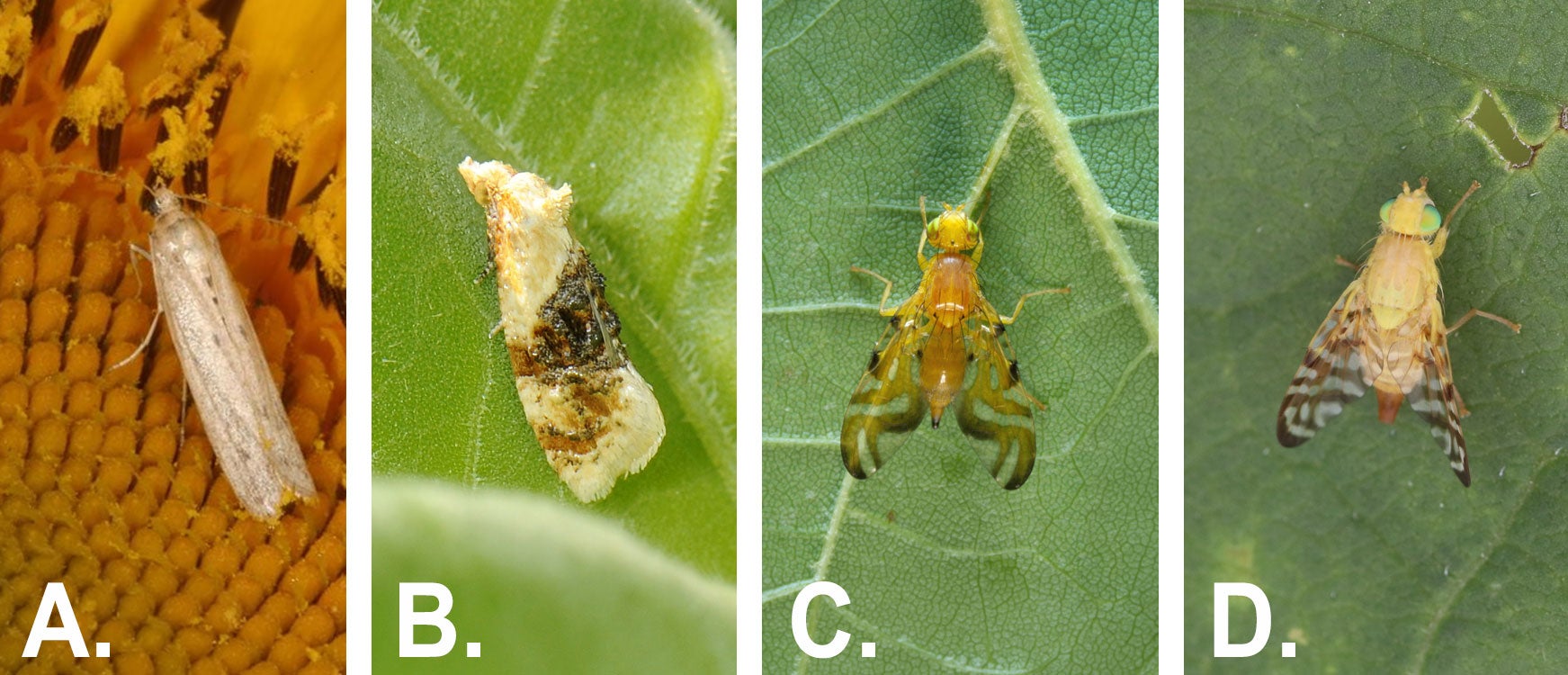
No red sunflower seed weevil adults were captured in emergence traps at this time, but we have detected increased adult activity in fields across all sampled counties. Late planted sunflower fields should be monitored until sunflower exceed the R5.7 (70% pollination) growth stage. Most sunflowers in South Dakota will be past R5.7 within the next week. Other insects that we found in traps include sunflower maggot adults (Figure 1C), and sunflower receptacle maggot adults (Figure 1D).
| Location | Red sunflower seed weevil | Banded sunflower moth | Arthur’s Sunflower Moth | Sunflower Moth | Sunflower Receptacle Maggot | Sunflower Maggot | Redbacked Cutworm Moth |
|---|---|---|---|---|---|---|---|
| Highmore | 0 | 80 | 38 | 2 | 0 | 0 | 0 |
| Pierre 1 | 0 | 60 | 0 | 0 | 0 | 0 | 0 |
| Pierre 2 | 0 | 171 | 0 | 0 | 0 | 0 | 0 |
| Pierre 3 | 0 | 35 | 1 | 0 | 0 | 0 | 0 |
| Pierre 4 | 0 | 213 | 23 | 0 | 0 | 0 | 0 |
| Onida 1 | 0 | 116 | 1 | 2 | 0 | 1 | 0 |
| Onida 2 | 0 | 73 | 2 | 0 | 0 | 2 | 0 |
| Onida 3 | 0 | 543 | 5 | 0 | 0 | 0 | 0 |
| Onida 4 | 0 | 199 | 0 | 0 | 4 | 1 | 0 |
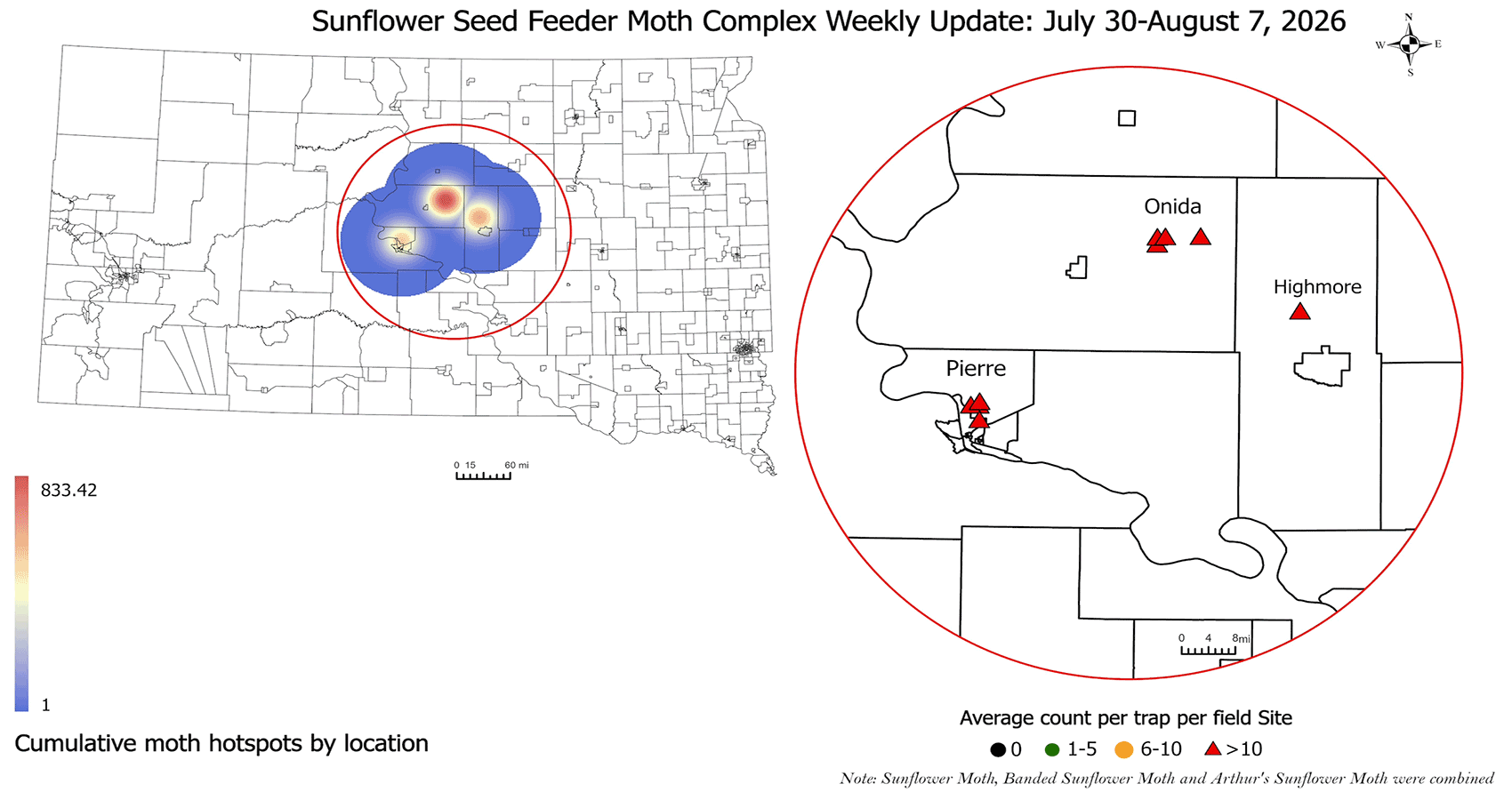
This is the sixth weekly sunflower pest activity update (July 23–July 29, 2026) from central South Dakota, covering nine fields: one field in Hyde County, four fields in Sully County, and four fields in Hughes County. Sunflower pests were monitored using emergence traps and pheromone lure-baited traps. The results are summarized in Table 1. This work is supported by SD Oilseed Council.
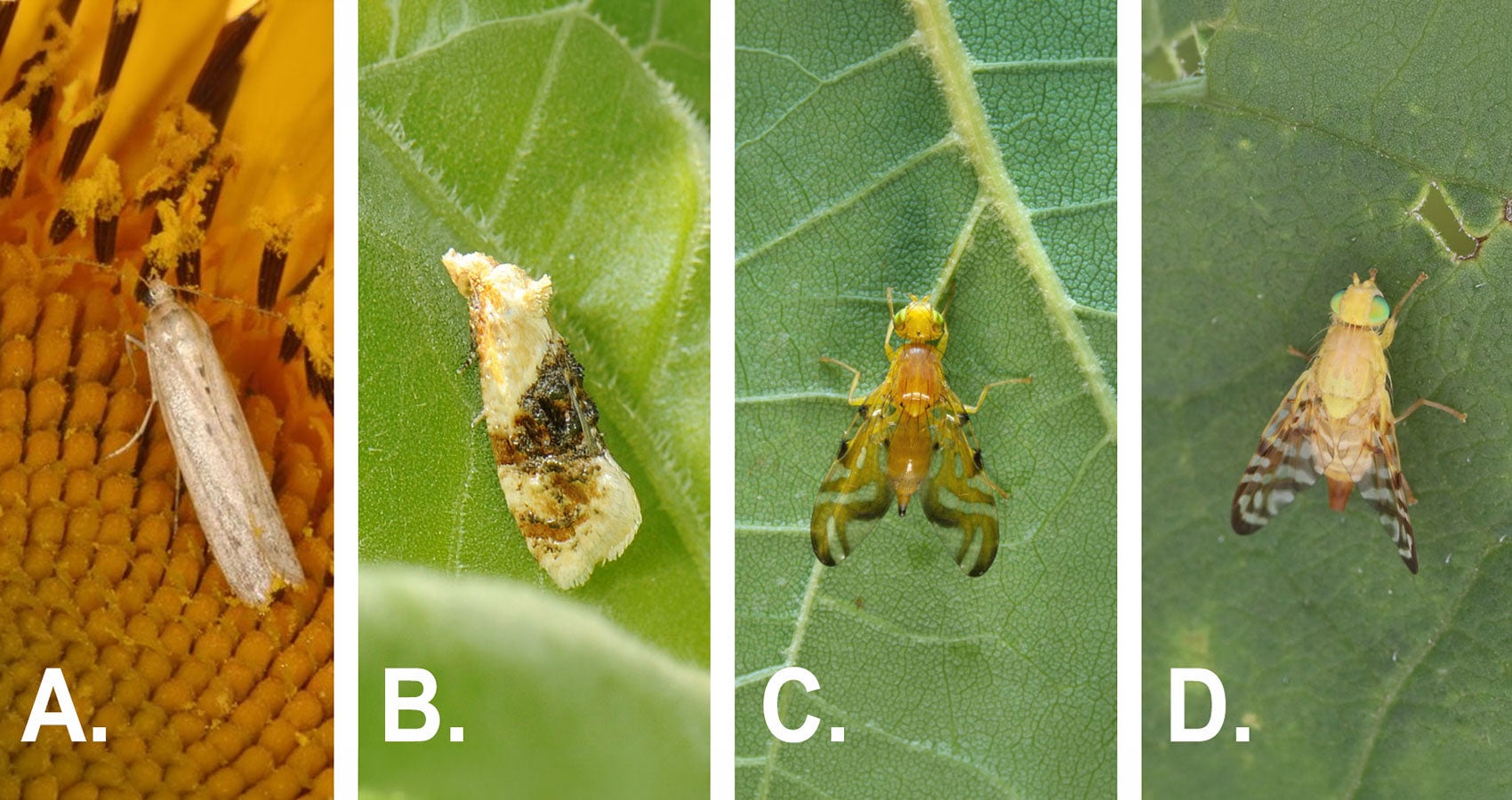
From July 23-July 29, we caught a high number of banded sunflower moths (Figure 1B) with collections occurring at all nine fields. The banded sunflower moth captures varied from location to location in each county, but almost all of the locations had increased banded sunflower moth activity (Table 1). Hughes County captures ranged from 53-210, Sully County captures ranged from 170-667, and Hyde County had 201 captures. We observed single captures of sunflower moths from two locations in Sully County and one location in Hughes County. Arthur’s sunflower moth populations were detected at two locations but were low in comparison to the banded sunflower moth.
No red sunflower seed weevil adults were captured in emergence traps at this time, but we have detected adult activity on flowering wild sunflower plants that are present in road ditches in Sully and Hyde County. We have also received reports of red sunflower seed weevil infestations in early planted sunflower. Fields should be monitored as sunflower reach the R5 growth stage. Many of the early planted sunflower have now grown past the R5.7 growth stage, and scouting should be focused on sunflowers planted later. Other insects that we found in traps include sunflower maggot adults (Figure 1C), and sunflower receptacle maggot adult (Figure 1D).
| Location | Red sunflower seed weevil | Banded sunflower moth | Arthur’s Sunflower Moth | Sunflower Moth | Sunflower Receptacle Maggot | Sunflower Maggot | Redbacked Cutworm Moth |
|---|---|---|---|---|---|---|---|
| Highmore | 0 | 201 | 12 | 0 | 0 | 0 | 0 |
| Pierre 1 | 0 | 114 | 0 | 0 | 0 | 0 | 0 |
| Pierre 2 | 0 | 200 | 0 | 0 | 0 | 0 | 0 |
| Pierre 3 | 0 | 53 | 0 | 0 | 0 | 0 | 0 |
| Pierre 4 | 0 | 210 | 15 | 0 | 0 | 0 | 0 |
| Onida 1 | 0 | 219 | 0 | 2 | 2 | 0 | 0 |
| Onida 2 | 0 | 170 | 0 | 0 | 0 | 2 | 0 |
| Onida 3 | 0 | 667 | 0 | 0 | 0 | 0 | 0 |
| Onida 4 | 0 | 285 | 0 | 0 | 5 | 0 | 0 |
As a reminder, this pest monitoring update is to provide a basis for areas where sunflowers should be monitored for the detected pests and does not provide enough clarity on populations per field for making management decisions based on these data alone. As early planted sunflower fields are beginning to reach the bud stage, scouting for major insect pests should begin.
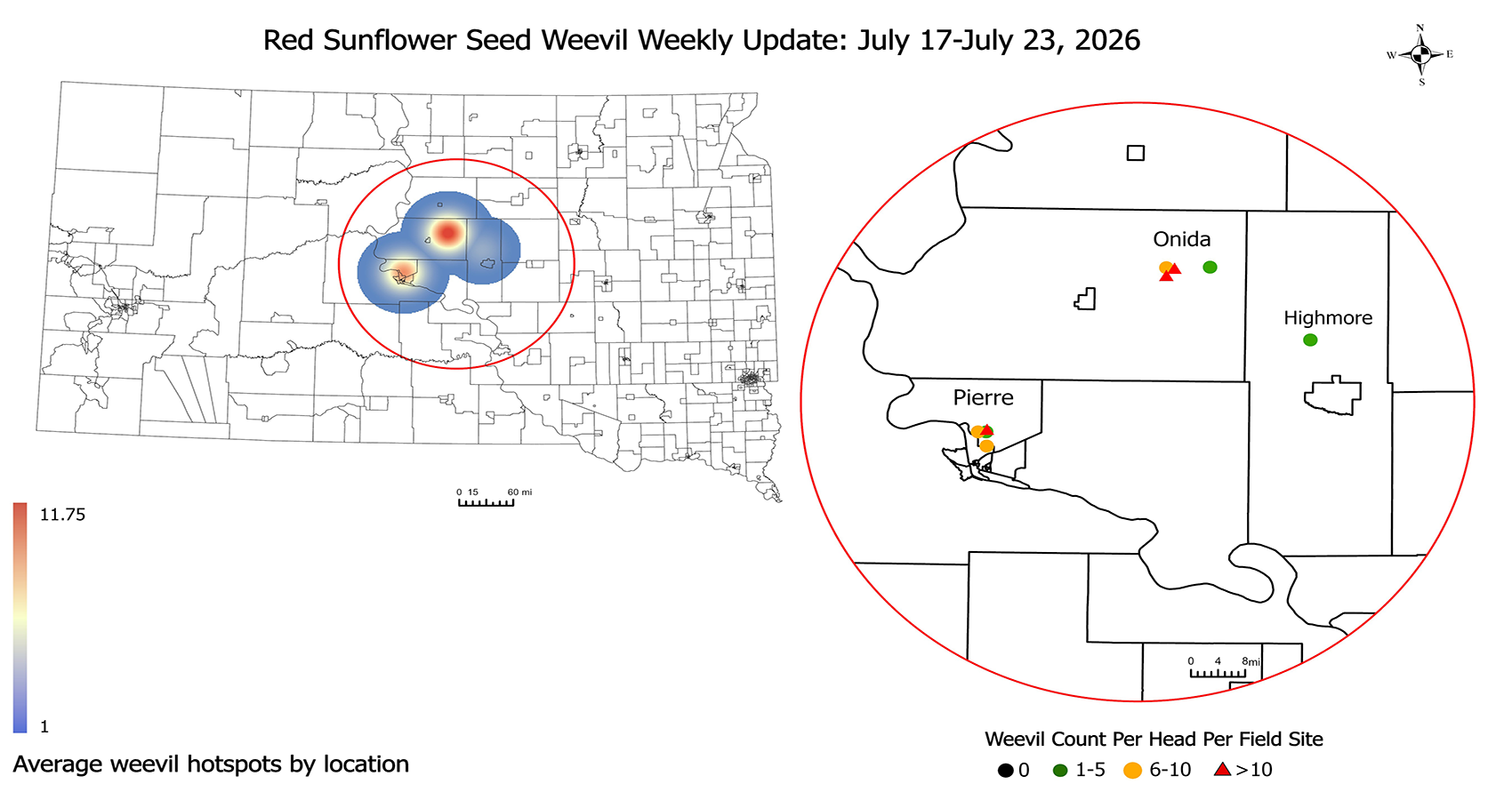
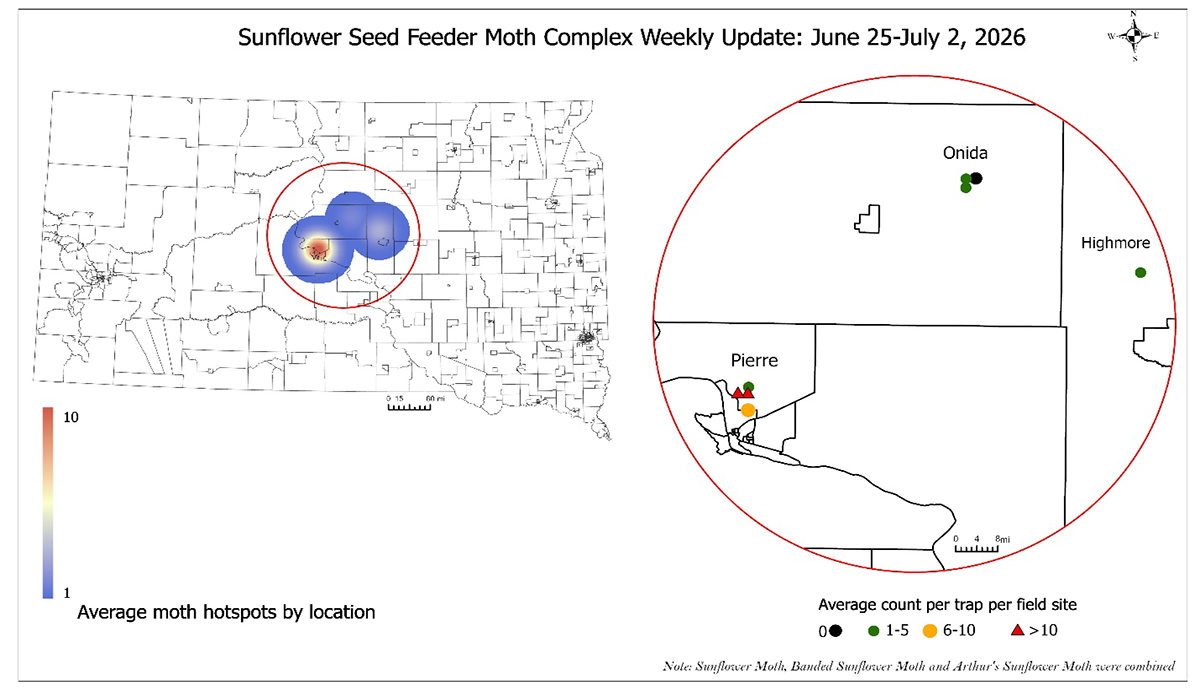
This is the fifth weekly sunflower pest activity update (July 16–July 23, 2026) from central South Dakota, covering nine fields: one field in Hyde County, four fields in Sully County, and four fields in Hughes County. Sunflower pests were monitored using emergence traps and pheromone lure-baited traps. The results are summarized in Table 1 and the hotspot map and density map (Figure 2). This work is supported by SD Oilseed Council.
From July 16-July 23, we caught a high number of banded sunflower moths (Figure 1B) with collections occurring at all nine fields. The highest banded sunflower moth captures were in Hughes (31-163 per banded sunflower moth trap) and Sully (108-211 per banded sunflower moth trap) counties. No sunflower moths were captured during this sampling period. Arthur’s sunflower moth populations continued to be low in all three counties, but did increase from previous sampling dates.
No red sunflower seed weevil adults were captured in emergence traps at this time, but we have detected adult activity on flowering wild sunflower plants that are present in road ditches in Sully and Hyde County. We have also received reports of red sunflower seed weevil infestations in early planted sunflower. Fields should be monitored as sunflower reach the R5 growth stage. Other insects that we found in traps include sunflower maggot adults (Figure 1C), and sunflower receptacle maggot adult (Figure 1D). A hotspot and pest density map of sunflower moth complex are presented in Figure 2.
| Location | Red sunflower seed weevil | Banded sunflower moth | Arthur’s Sunflower Moth | Sunflower Moth | Sunflower Receptacle Maggot | Sunflower Maggot | Redbacked Cutworm Moth |
|---|---|---|---|---|---|---|---|
| Highmore | 0 | 138 | 23 | 0 | 0 | 0 | 0 |
| Pierre 1 | 0 | 35 | 0 | 0 | 0 | 0 | 0 |
| Pierre 2 | 0 | 167 | 3 | 0 | 0 | 0 | 0 |
| Pierre 3 | 0 | 62 | 9 | 0 | 0 | 0 | 1 |
| Pierre 4 | 0 | 210 | 0 | 0 | 0 | 0 | 0 |
| Onida 1 | 0 | 241 | 0 | 0 | 1 | 1 | 0 |
| Onida 2 | 0 | 141 | 1 | 0 | 0 | 1 | 0 |
| Onida 3 | 0 | 248 | 11 | 0 | 0 | 0 | 0 |
| Onida 4 | 0 | 117 | 0 | 0 | 5 | 0 | 0 |
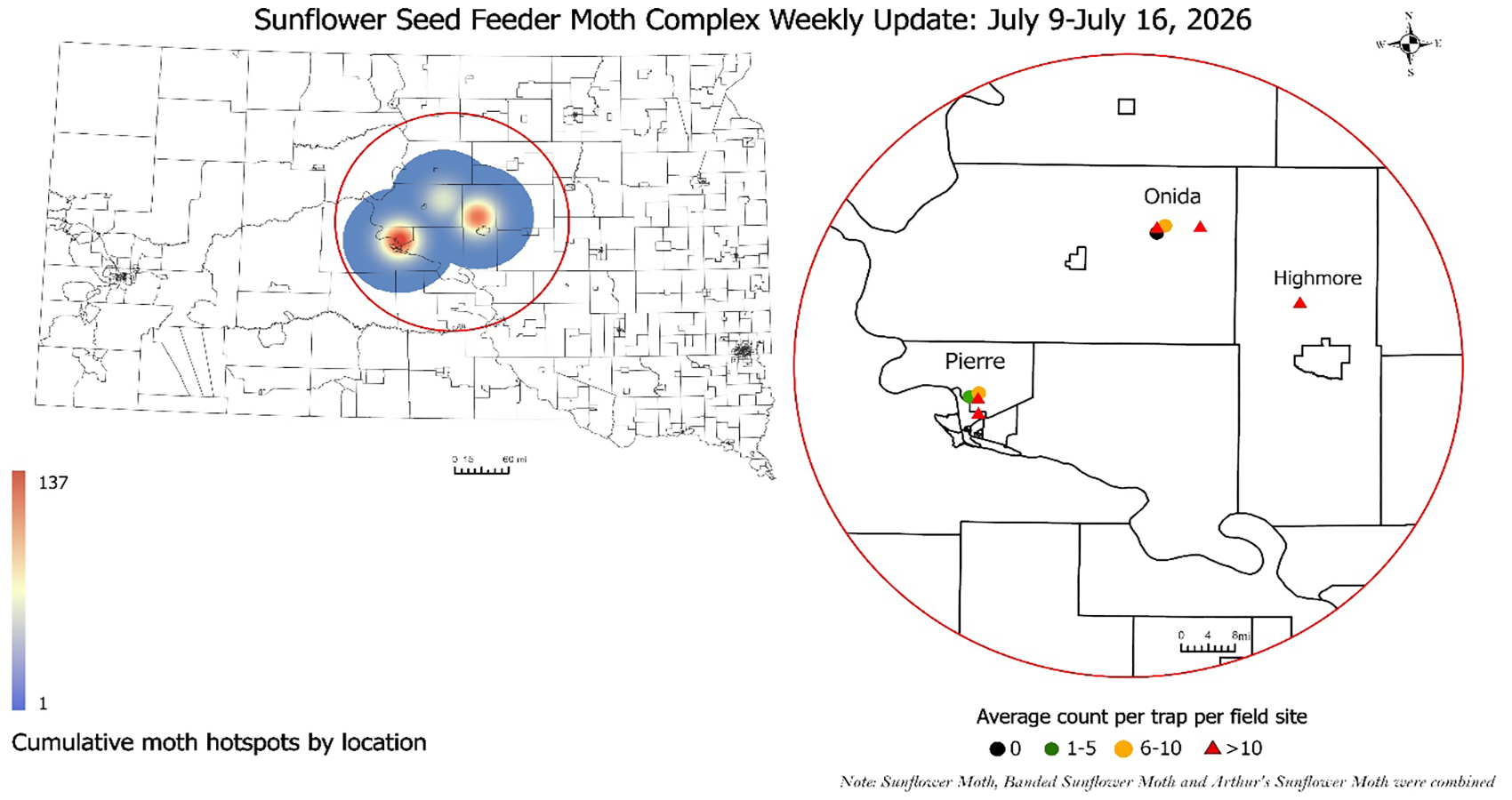
This is the fourth weekly sunflower pest activity update (July 9–July 16, 2026) from central South Dakota, covering eight fields: one field in Hyde County, three fields in Sully County, and four fields in Hughes County. Sunflower pests were monitored using emergence traps and pheromone lure-baited traps. The results are summarized in Table 1 and the hotspot map and density map (Figure 1). This work is supported by SD Oilseed Council.
From July 9-July 16, we caught sunflower moths (Figure 1A) at two of the eight locations with the only captures in Hughes County (0-5 per trap) (Table 1; Figure 2). This is a substantial decrease in sunflower moth activity from the previous week. We also caught an increased number of banded sunflower moth males (Figure 1B) in Hughes (2-122 per trap) and Sully counties (6-118 per trap) (Table 1). Arthur’s sunflower moth population continued to be low in all three counties.
No red sunflower seed weevil adults were captured in emergence traps at this time, but we have detected adult activity on flowering wild sunflower plants that are present in road ditches in Sully and Hyde County. This indicates that red sunflower seed weevil activity is increasing and at the onset of flowering fields should be scouted for infestations. Other insects that we found in traps include sunflower maggot adults (Figure 1C), and sunflower receptacle maggot adult (Figure 1D). A hotspot and pest density map of sunflower moth complex are presented in Figure 2.
| Location | Red sunflower seed weevil | Banded sunflower moth | Arthur’s Sunflower Moth | Sunflower Moth | Sunflower Receptacle Maggot | Sunflower Maggot | Redbacked Cutworm Moth |
|---|---|---|---|---|---|---|---|
| Highmore | 0 | 49 | 2 | 0 | 6 | 4 | 0 |
| Pierre 1 | 0 | 11 | 0 | 5 | 0 | 0 | 0 |
| Pierre 2 | 0 | 2 | 0 | 2 | 0 | 0 | 0 |
| Pierre 3 | 0 | 7 | 1 | 0 | 0 | 0 | 0 |
| Pierre 4 | 0 | 122 | 0 | 0 | 1 | 0 | 0 |
| Onida 1 | 0 | 70 | 0 | 0 | 0 | 9 | 0 |
| Onida 2 | 0 | 6 | 0 | 0 | 6 | 4 | 0 |
| Onida 3 | 0 | 118 | 2 | 0 | 0 | 1 | 0 |
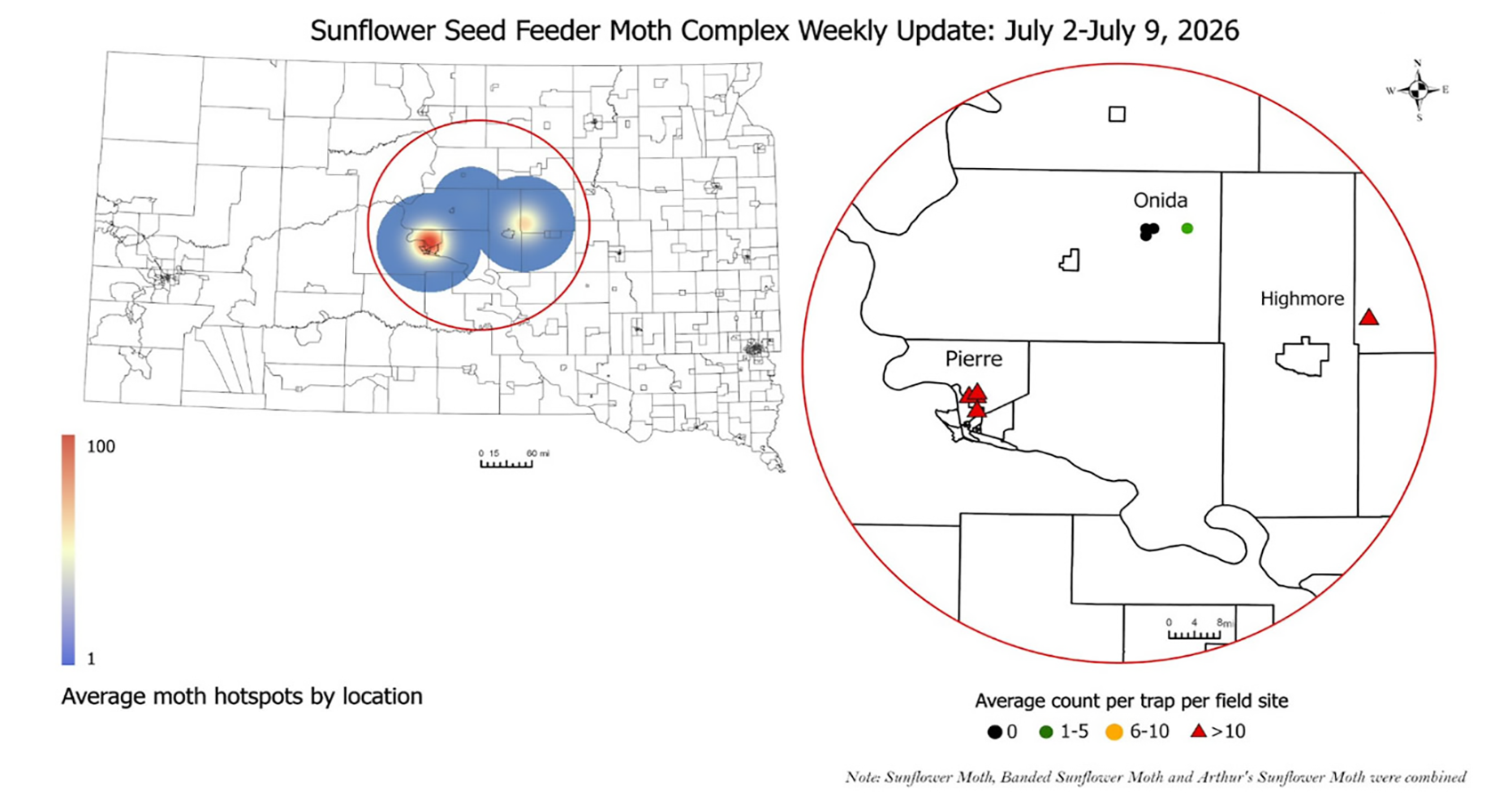
This is the third weekly sunflower pest activity update (July 2-July 9, 2026) from central South Dakota, covering eight fields: one field in Hyde County, three fields in Sully County, and four fields in Hughes County. Sunflower pests were monitored using emergence traps and pheromone lure-baited traps. The results are summarized below in Table 1 and the hotspot map and density map (Figure 2). This work is supported by SD Oilseed Council.
The activity of the complex of moths in sunflower continues to increase in central South Dakota. This indicates that growers should begin scouting sunflower fields for moth activity, especially if fields are at bud stage (R3) or later. For more information on scouting, please review previous articles on sunflower moth and banded sunflower moth scouting methods and management recommendations. We collected sunflower moth, banded sunflower moth and Arthur’s sunflower moth, which are all species capable of damaging developing sunflower seeds. We captured sunflower moths (Figure 1-A) in six of the eight traps with the highest capture in Hughes County (1-114 per trap), and the fewest in Sully County (0-3 per trap) (Table 1). We also caught an increased number of banded sunflower moth in Hughes and Sully counties (Table 1). In addition, we detected low populations of Arthur’s sunflower moth in Hyde and Sully counties.
No red sunflower seed weevil adults were captured in emergence traps at this time. Other insects that we found in the traps included the adult sunflower maggot, adult sunflower receptacle maggot, and a redbacked cutworm moth (Figure 1). A hotspot and pest density map of sunflower moth complex are presented in Figure 2.
As a reminder, this pest monitoring update is to provide a basis for areas where sunflowers should be monitored for the detected pests and does not provide enough clarity on populations per field for making management decisions based on these data alone. As early planted sunflower fields are beginning to reach the bud stage, scouting for major insect pests should begin.
| Location | Red sunflower seed weevil | Banded sunflower moth | Arthur’s Sunflower Moth | Sunflower Moth | Sunflower Receptacle Maggot | Sunflower Maggot | Redbacked Cutworm Moth |
|---|---|---|---|---|---|---|---|
| Highmore | 0 | 0 | 2 | 51 | 0 | 0 | 1 |
| Pierre 1 | 0 | 3 | 0 | 116 | 0 | 0 | 0 |
| Pierre 2 | 0 | 1 | 0 | 101 | 0 | 0 | 0 |
| Pierre 3 | 0 | 1 | 0 | 28 | 0 | 0 | 0 |
| Pierre 4 | 0 | 8 | 0 | 7 | 3 | 0 | 0 |
| Onida 1 | 0 | 0 | 0 | 0 | 8 | 2 | 0 |
| Onida 2 | 0 | 0 | 0 | 0 | 5 | 22 | 0 |
| Onida 3 | 0 | 11 | 3 | 3 | 0 | 1 | 0 |
This is the second weekly sunflower pest activity update (June 25–July 2, 2025) from central South Dakota, covering eight fields: one field at Highmore, two fields at Onida, and four fields at Pierre. Sunflower pests were monitored using emergence traps and pheromone lure-baited traps. The results are summarized via. Table, hotspot map and density map. This work is supported by SD Oilseed Council.
From June 25-July 2, we caught sunflower moths (Figure 1-A) in all eight traps with highest capture in Hughes County (13-46 per trap) and fewest in Hyde (6 per trap) and Sully (1-4 per trap) counties (Table 1; Figure 2). We also caught one banded sunflower moth male adult Sully County (Figure 1-B). No red sunflower seed weevil adults were captured in emergence traps at this time. Other insects that we found in traps include sunflower maggot adults (Figure 1-C), sunflower receptacle maggot adult (Figure 1-D) and a redbacked cutworm moth. A hotspot and pest density map of sunflower moth complex are presented in Figure 2.
As a reminder, this pest monitoring update is to provide a basis for areas where sunflowers should be monitored for the detected pests and does not provide enough clarity on populations per field for making management decisions based on these data alone. As early planted sunflower fields are beginning to reach the bud stage, scouting for major insect pests should begin.
| Location | Red sunflower seed weevil | Banded sunflower moth | Sunflower Moth | Sunflower Receptacle Maggot | Sunflower Maggot | Redbacked Cutworm Moth |
|---|---|---|---|---|---|---|
| Highmore | 0 | 0 | 6 | 0 | 0 | 0 |
| Pierre 1 | 0 | 0 | 46 | 0 | 0 | 0 |
| Pierre 2 | 0 | 0 | 42 | 0 | 0 | 0 |
| Pierre 3 | 0 | 0 | 13 | 0 | 0 | 0 |
| Pierre 4 | 0 | 0 | 16 | 0 | 1 | 0 |
| Onida 1 | 0 | 0 | 1 | 2 | 8 | 0 |
| Onida 2 | 0 | 1 | 4 | 0 | 0 | 1 |
During this week, we observed very minimal populations of insect pests, which is not a surprise as most of the major sunflower insect pests attack the sunflower bud or developing seeds. We positively identified sunflower moths, sunflower maggot adults, redbacked cutworm moths, and sunflower receptacle maggot adult (Table 1). At this time, no action is needed based on the small populations of the observed insect pests.
| Location | Red sunflower seed weevil | Banded sunflower moth | Sunflower Moth | Sunflower Receptacle Maggot | Sunflower Maggot | Redbacked Cutworm Moth |
|---|---|---|---|---|---|---|
| Highmore | 0 | 0 | 1 | 0 | 1 | 1 |
| Pierre 1 | 0 | 0 | 1 | 1 | 0 | 1 |
| Pierre 2 | 0 | 0 | 0 | 0 | 0 | 1 |
| Pierre 3 | 0 | 0 | 1 | 0 | 0 | 0 |
| Onida 1 | 0 | 0 | 0 | 0 | 0 | 0 |
| Onida 2 | 0 | 0 | 0 | 0 | 0 | 0 |
| Onida 3 | 0 | 0 | 0 | 0 | 0 | 0 |
| Onida 4 | 0 | 0 | 0 | 0 | 1 | 1 |