Reviewed by Logan Brown, Wildland-Urban Interfare (WUI) Specialist for the South Dakota Department of Agriculture and Natural Resources.
Wildfires pose a significant risk in western South Dakota, particularly within the Black Hills region, where periods of minimal precipitation (both snow and rainfall) can lead to drought conditions that elevate fire risk. Over the past 30 years, the Black Hills National Forest has reported an average of 92 wildfires annually, burning approximately 7,507 acres each year. Approximately 70% of these fires are attributed to lightning, with the remaining incidents resulting from human activity (USDA).
Property owners and land managers in these high-risk areas should implement comprehensive mitigation measures to reduce the likelihood of structural loss caused by wildfires.
Research comparing homes destroyed by wildfire to those that survive indicates that embers and small flames are the primary causes of structure ignition. Embers are burning pieces of wood and vegetation that can be carried long distances by wind.
The Home Ignition Zone
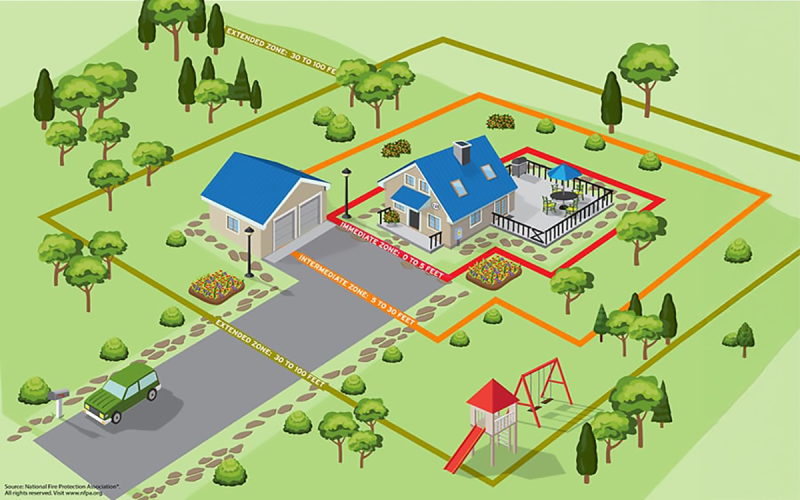
These factors considered, homeowners should prepare their homes to withstand ember attacks, paying special attention to everything around the home, up to 200 feet from the foundation. This is called the Home Ignition Zone (HIZ). This can be further divided into three managed zones (immediate, intermediate, and extended). There are several “firewise” practices that can be implemented in each of these zones. Most of these actions can be accomplished within a few days and at minimal cost. The main goal is to create a defensible space around structures to protect against embers.
Immediate Zone
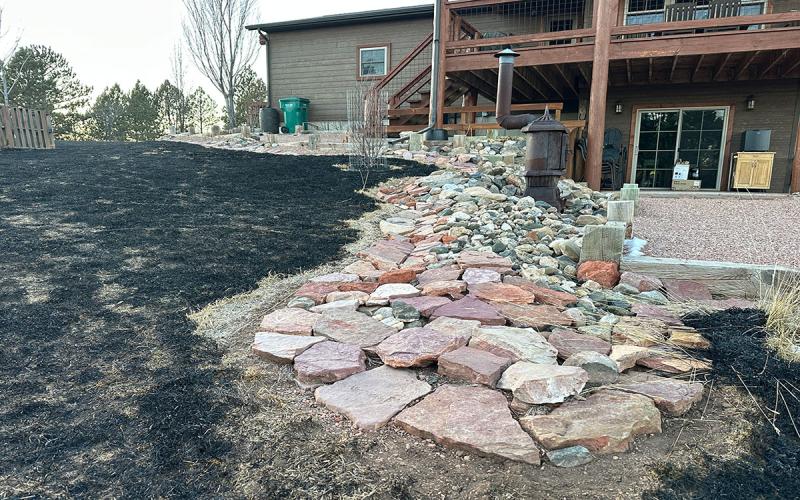
- Keep the immediate zone (0–5 ft from your house) fuel free.
- Clean gutters and roof frequently so they do not build up with pine needles and other dry leaves.
- Use hardscape surfaces (gravel, rock mulch, concrete) directly against siding instead of wood mulch or shrubbery. Do not use shredded bark or rubber mulch near structures as they are highly flammable.
- Move firewood and wood piles at least 30 feet away from the house. Rake up leaves and twigs that accumulate under trees and shrubs.
- Clear the area under decks, balconies, and stairs of flammable materials.
Intermediate Zone
- Keep the intermediate zone (5-30 feet from structures) "lean, clean, and green." Lawns should be frequently irrigated and mowed to 4 inches or less.
- Prune tree limbs 6–10 ft from the ground to prevent providing a “ladder” for low flames to reach up into tree canopies.
South Dakota Wildland Fire recommends specific low flammability plants for the immediate and intermediate zones. There are no “fireproof” plant species, but selection can be critical to reducing risk. Common flammable trees include junipers, pines, firs and spruces. Planting conifers is discouraged in the immediate and intermediate zones and if they are already present, consider replacing them. Deciduous trees tend to be more fire resistant and when they are dormant, as there is less “fuel” to carry fire through their canopies.
Extended Zone
- Within the extended zone (30–200 ft from structures), limit vegetation, but if there are existing trees and shrubs, ensure they are pruned, thinned, and remove dead materials regularly.
- Break up continuity of plants to prevent embers from jumping canopy to canopy.
Other General Tips
- When remodeling, choose construction materials that are fire-resistant or noncombustible.
- On red flag warning days, move your patio furniture into storage.
- Make sure firefighters can reach your property by placing driveways/roads, fences, trees, etc. in areas that do not restrict firefighting equipment access.
- Cut tall grass near structures.
Resources for South Dakotans
Visit the “Firewise” demonstration garden at Outdoor Campus West in Rapid City to see these practices in person.
South Dakota Wildland Fire offers a home assessment and a cost-share program to homeowners for reducing hazardous fuels, such as thinning trees and removing ladder fuels. To schedule a home assessment or discuss the cost-share program, contact South Dakota Wildland Fire Division at 605-394-5203 or the Rapid City Fire Department at 605-394-5233.
Master Gardeners promote resilient landscapes by educating communities on sustainable gardening practices to withstand drought, heat, and extreme weather. Follow your local Master Gardener club to learn about programs that they offer.
References
- South Dakota Department of Public Safety. (2026). South Dakota Wildland Fire.
- National Fire Protection Association (NFPA). (2026). Firewise USA.
- USDA Black Hills National Forest (2025). Homeowner Fire Prevention Guidance.
- Langelo, L., Carter, S., Goecker, N., Julian, C., Dennis, C., and Lowstuter, D.W. (2025). Firewise Plant Materials. Colorado State University.
- Fire Safety Resources. Utah State University.