Organic herbicides are becoming more common on the market due to the perception that these products as safer towards humans, pets, and the environment compared to their inorganic counterparts (2,4-D, dicamba, quinclorac, and several others). For those interested in organic products, there are several factors to consider.
Selection Considerations
Use in Lawns
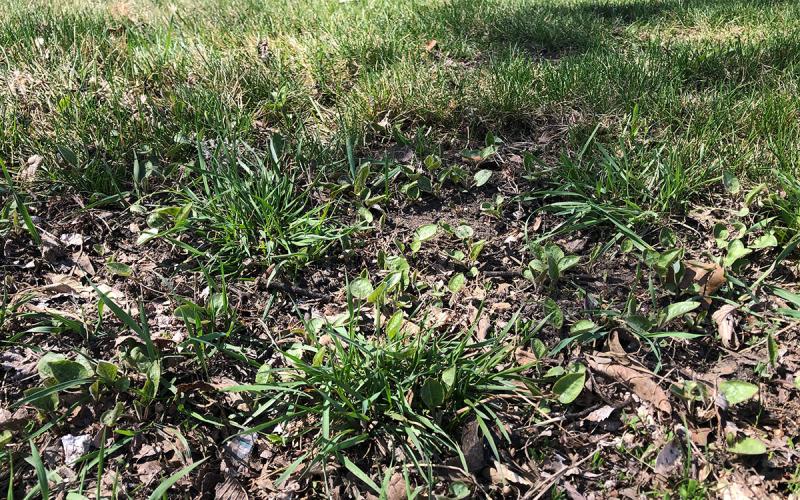
Many organic herbicides are non-selective, meaning that they will kill or injure most plants, including lawns. Instead, choose a selective herbicide, which will have verbiage on its label stating, “kills weeds but not lawns” or something similar. If no such language is on the label, assume the product is non-selective and will injure lawn.
Effectiveness
A two-year study by Carroll et al. (2022) in Pennsylvania evaluated Fiesta®, a certified organic product, for its effectiveness in controlling dandelion and white clover. This is a similar product to Dandelion Doom and Captain Jack’s Lawnweed Brew. Fiesta® contains iron HEDTA, which is often used as a foliar fertilizer to correct iron deficiency in crops. It’s typically harmless to grasses, but broadleaf plants can absorb it in large quantities through their leaves. For this reason, iron HEDTA can be a fertilizer when applied at low doses, but a herbicide when applied at high doses. It only kills the foliage it lands upon and does not move within the plant, which classifies it as a contact herbicide. This was apparent in their study, as Fiesta® rapidly killed the foliage, but new foliage generated from the roots of both dandelion and white clover within weeks after application. Fiesta® needed at least two applications to provide the same weed control as a single application of the popular inorganic product, Trimec® Classic, which contained the active ingredients 2,4-D, MCPP, and dicamba. Trimec® Classic is a systemic herbicide, meaning that the weed absorbs the active ingredients through its roots and/or foliage and then transports them throughout the plant. This is important, because to control perennial weeds, such as a dandelion or white clover, the roots must be killed.
Repeatedly killing a perennial weed’s foliage with contact herbicides, such as iron HEDTA, can eventually kill the weed by starving its roots. This can be a long process requiring persistent applications shortly after new foliage generates. Spotting new weed foliage in a lawn is very difficult, as most weeds aren’t seen from a distance until they produce a flower. This gives ample time for the foliage to produce energy that replenishes the roots and keeps the perennial weed thriving. Organic herbicides may be better suited to control annual broadleaf weed species, as killing their above ground foliage often kills the weed. Some annual broadleaf weeds found in lawns include prostrate knotweed, common chickweed, black medic, yellow wood sorrel, and prostrate spurge.
Costs
For whole yard treatment, organic iron HEDTA herbicides are nowhere close to cost-competitive compared to inorganic herbicides such as Trimec®. Spraying a 1/4 acre yard with Trimec® or similar product would cost around $15. Treating the same sized area with an organic iron HEDTA herbicide would cost at least $150 per application, with the likelihood of needing multiple applications per year over several years.
If weed infestations are light and spot spraying is practical, then the iron HEDTA treatment may be worthwhile for those who prefer organic weed control. Spot spraying involves spraying weeds individually with a spray wand as opposed to covering the area with uniform amount of spray. A gallon of “Ready-to-Use” (no mixing with water necessary) product can be purchased at many retailers for around $25 per gallon. Concentrated forms (needing to be mixed with water) can be purchased online and shipped to one’s home or to a store for a significantly lower price than “Ready-to-Use” products.
Other Options
Although labor intensive, hand removal of perennial weeds can be more effective than spraying contact herbicides, especially if a significant portion of the root can be removed. Specialized digging tools for this task can be found in most garden sections and are more effective on weeds with a single taproot, such as dandelions. Remove as much of the root as possible, but keep in mind that perennial weeds can regenerate from root segments that remain in the soil. Maintain a healthy lawn by mowing at a relatively tall height (>3 in.) and supplying ample, but not excessive amounts of water and nitrogen (N) fertilizer. Delaying N fertilization until mid- to late May also promotes a healthier root system in lawns. Thinner areas should be overseeded.
Additional Considerations
Dandelions and white clover aren’t always considered weeds, as they can be food sources for early pollinators. Since white clover is a legume, it can also provide nitrogen for your lawn. Be considerate of neighbors if you decide to let these species grow and produce seed. See Buzzworthy Backyards: How Bee Lawns are Reinventing Green Spaces or Why those Dandelions in Your Yard Aren’t so Bad for more information.
References
- Bachmann, A., R. Buterbaugh, and P. Walkling. 2024. Buzzworthy backyards: how bee lawns are reinventing green spaces. SDSU Extension.
- Carroll, D.E., J.E. Kaminski, and J.A. Borger. 2020. Efficacy of natural herbicides on dandelion (Taraxacum officinale G.H Weber ex Wiggers) and white clover (Trifolium repens L.) populations. Int. Turfgrass Soc. Res. J. 14:759-769.
- Varenhorst, A., P. Rozeboom, A. Bachmann, and P. Wagner. 2025. Why those dandelions in your yard aren’t so bad. SDSU Extension.