When Larry Janssen learned that one of his most frequently used land sales databases was no longer available, the South Dakota State University Professor Emeritus of Economics and his colleague, Burton Pflueger, former SDSU Extension economist, launched their own survey in 1991.
“We said we’d try it for three years and see how it worked,” Janssen said. “And it continued.”
He and Pflueger continued partnering on the survey, with Janssen conducting the research and Pflueger handling most of the outreach. The first SDSU Farm Real Estate Market Survey was published in 1991, and Janssen said it was well-received. 2025 marked the 35th year of the annual report, which provides an overview of agricultural land values and cash rental rates by land use and quality in different regions of the state.
While the survey is not meant to dictate a specific piece of property’s value, it provides producers and industry professionals with valuable data on estimates of a region and trends over time.
“That’s where a lot of its strength is. It’s over time, not identifying the value of your property at this date. It can get you a start,” said Jack Davis, retired SDSU Extension Crops Business Management Specialist.
One of the survey’s unique traits is that it selects “key informants,” a model that selects people with expert knowledge on a specific topic for in-depth interviews, rather than a random sampling of the general public. Key informants for this survey include agricultural lenders in banks and financial service companies, loan officers, rural appraisers and realtors/brokers who deal with agricultural land sales.
Davis, Janssen and Hoanh Le, assistant professor and SDSU Extension Economics Research Specialist and current survey administrator, all testify to the strength of the key informant model and how it helps the data remain unbiased.
“We are an independent party, and we’re working with independent parties that have a good knowledge of the land values and trends,” Davis said.
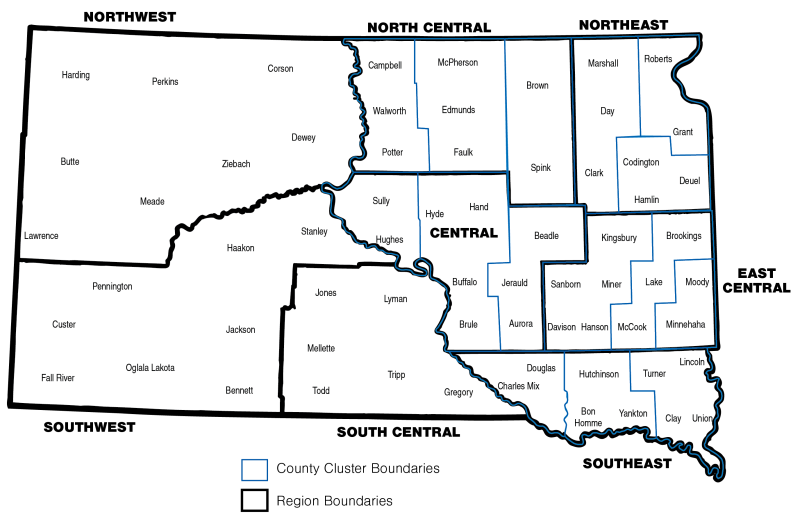
Another key part of the survey is its breakdown of counties. As they developed the survey, Janssen and Pflueger wanted to collect annual data at the county level – something not readily available from sources like the U.S. Department of Agriculture. Reckoning with South Dakota’s disparate landscape, Janssen separated the state’s 66 counties into eight regions: Northwest, Southwest, South Central, Central, North Central, Northeast, East Central and Southeast. Most of the agricultural land west of the Missouri River, for example, is pasture or rangeland compared to the domination of cropland east of the Missouri River.
For the five regions east of the Missouri River, they further divided them into county clusters with similar land values and considerably different land values than other county clusters in the same region.
Key informants are asked to provide estimates for their region for high-, medium- and low-productivity land. Those numbers are aggregated for each county cluster and reported through charts and text.
“People trust that kind of information, because you’re giving them more than just a shot in the dark,” Janssen said.
Not only did the survey provide valuable data for farmers, agricultural landowners and industry professionals, Janssen said the survey was a valuable training tool for the undergraduate and graduate students who worked as his assistants.
“We used it in a variety of teaching as well as outreach situations. The idea was to also train future agriculture professionals on how to do that kind of research,” Janssen said. “The students I had worked with were just excellent to deal with.”
When Janssen retired from his full-time position in 2015, Davis took over the survey. In his role as an SDSU Extension Crops Business Management Specialist, Davis said he used the survey regularly with his clientele and saw its value.
Davis managed the survey for nearly a decade until his own retirement in 2024. One of the biggest changes he oversaw was its transition from physical to digital a few years after he took over. When Davis retired, the survey was taken over by Hoanh Le who was already familiar with the survey.
She has continued the key informant model and only makes small tweaks to the survey questions based on informant feedback. It’s a lengthy project – she starts working on the survey questions in November or December, so she is ready to distribute the surveys in February. She collects data in February and March, then analyzes the data and sends out the report in May.
The rest of the year, she dedicates time on a regular basis to promoting the survey, presenting its results at conference seminars and taking calls or emails from people interested in the results.
“I talk about the survey everywhere I go,” Le said. “Many people say thanks for continuing to do this.”
If you are interested in participating in the SDSU Extension Farm Real Estate Market Survey, contact Hoanh Le. View the 35th annual survey online.