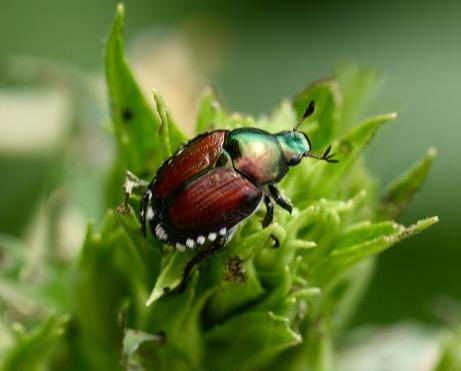
In the last 10 years, Japanese beetle populations have remained low to absent in my garden in Brookings. However, last week I observed large aggregations of beetles feeding on smartweed that was present in my rain garden. These beetles can be identified by their bronze-green metallic head and thorax, and their reddish-brown hardened forewings. They also have white tufts of hair that are present around the sides and back of their abdomens (Figure 1). Japanese beetles can be problematic for gardens, flowers, and trees in residential areas. In other states, they also feed on corn and soybean, but to date we haven’t observed Japanese beetles attacking row crops in South Dakota. Japanese beetles are polyphagous insect pests, feeding on over 300 plant species.
The presence of Japanese beetles in South Dakota isn’t new, but they aren’t common in all towns at this time. They are most common in the southeastern portion of South Dakota, and along the I-29 corridor. This invasive pest has been moving west across the country since it was first discovered in New Jersey in 1916.
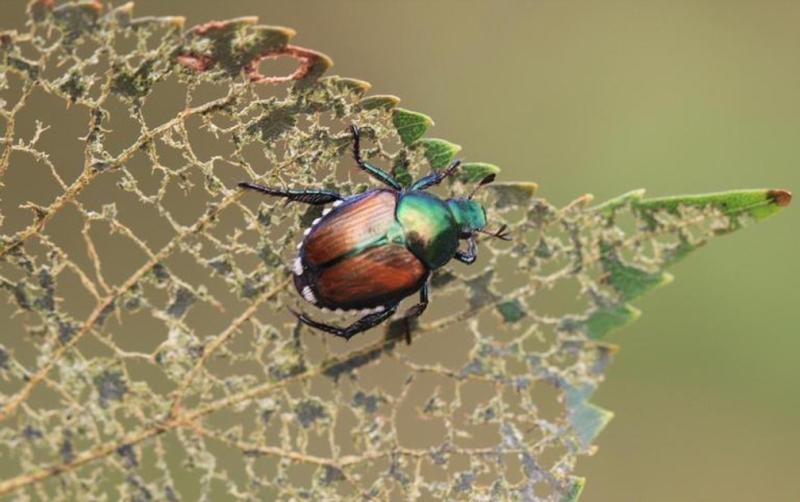
Japanese beetles get so much attention because as adults they aggregate (feed in large populations) and skeletonize leaves (remove all green leaf tissue except for the veins) and feed on flowers and fruits (Figure 2). Adult Japanese beetles prefer rose, grape, linden, apple, crabapple, cherry, plum, birch, elm, raspberry, currant, basil, hollyhock, Virginia creeper, marigold, soybean and corn silks. When leaves are completely skeletonized, they turn brown and may fall off the plant. Although Japanese beetles can cause a lot of feeding injury in a relatively short amount of time, their feeding normally only affects the aesthetics especially for otherwise healthy plants and trees. However, the Japanese beetles can destroy rose blossoms along with fruits and vegetables. In some cases, plants may be stunted following early season Japanese beetle feeding.
As larvae, they are white grubs that feed on grass roots. Like other grub feeding, this will cause the grass to turn brown with dead patches eventually showing up. Distinguishing one grub from another requires looking at the pattern of hairs present on the end of their bodies. Japanese beetle larvae have a small V-shaped pattern of hairs. Managing grubs (including Japanese beetle grubs), is best done in mid-summer when they are small and still feeding close to the surface (late July – mid-August). There are granular and liquid insecticides available for grub control, and most require some form of irrigation or rainfall to be most Weffective. Make sure to scout for grubs and then read and follow the label directions of any insecticides used.
Management of Adult Japanese Beetles
Complete management is often difficult because adult Japanese beetles can fly long distances. Management should start when you first observe the beetles in your yard. In gardens, physical removal of the beetles from plants and destroying them can be effective. This can be done by shaking them off of the plant and into a container of slightly soapy water. If large populations are present, an insecticide application may be necessary if there is excessive damage to high value flowers and vegetables. Always read the insecticide label and follow instructions. If plants are blooming, insecticide applications may not be possibly due to the risk to pollinators. We do not recommend using Japanese beetle lure-based traps for yards and gardens. These will often attract more beetles into a yard and result in increased defoliation.