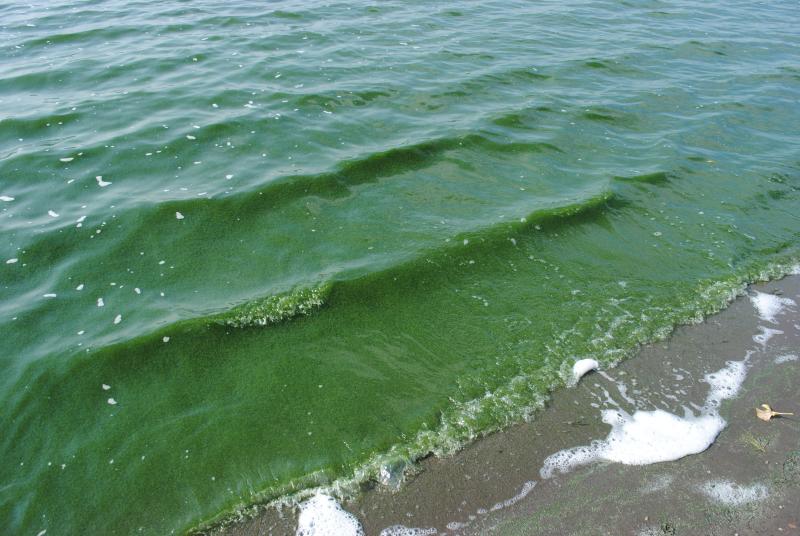
Recently, the City of Mitchell issued a swimming advisory and public beach closing effective July 31, 2026. The reason for this was due to an elevated concentration of microcystin in the lake due to a harmful algal bloom (HAB). Microcystin is a toxin that can be released by a number of genera of freshwater cyanobacteria (blue-green algae), but Microcystis aeruginosa is typically the most common species of cyanobacteria responsible for microcystin production here in South Dakota. The policy of the City of Mitchell’s Department of Parks & Recreation is to test for the microcystin toxin on a weekly basis from Memorial Day to Labor Day but would likely go longer if conditions persist. Public Health Watches in Mitchell are issued when the microcystin toxin is detected at a concentration of 4 micrograms/liter to less than 8 micrograms/liter. A Public Health Warning is issued when concentrations are equal to or greater than 8 micrograms/liter. The South Dakota Department of Agriculture and Natural Resources has adopted the national water quality criteria of 8 micrograms/liter for recreation. Once concentrations reach that level, immersion and limited contact recreation is not recommended. It is also highly recommended to keep animals away from a water body that has experienced a bloom as well.
So why do certain cyanobacteria species produce and release toxins? The biggest reason that toxins evolved was as a defense mechanism against predators that would graze on them. Cyanobacteria may also release toxins to act as a growth suppressant towards other species that may compete with them, called allelopathy. While toxins can be released by living cells, most toxins are released when bacterial cells die or rupture. At low levels, this release would not be a concern. But when a harmful algal bloom occurs, cyanobacteria cell densities are high (typically exceeding 20,000 cells/mL) and the potential for a toxin release in concentrations that affect human, pet, and livestock health increases as well.
Remember, not every algal bloom is a cyanobacteria bloom. And not every cyanobacteria bloom means that toxins are or will be present. You cannot tell if a toxin is present just by observing the bloom. If you encounter an algal bloom, protect yourself, your pets, and livestock by staying out of contact with the water. When in doubt, stay out!
Additional Information:
- Harmful Algal Blooms (HABs), South Dakota Watershed Protection Program.
- Algal Bloom Action Team, North Central Region Water Network.
- Guidelines for Addressing Harmful Algal Blooms in Lake Mitchell, City of Mitchell.
- Recommended Human Health Recreational Ambient Water Quality Criteria or Swimming Advisories for Microcystins and Cylindrospermopsin, U.S. Environmental Protection Agency.
- Learn about Harmful Algae, Cyanobacteria and Cyanotoxins, U.S. Environmental Protection Agency.