Crucial conversations can be tricky for a variety of reasons. For example, the fear of damaging a relationship may cause a volunteer coordinator to hesitate to tell a volunteer their behavior is discouraging others from participating. Or perhaps a fear of conflict may lead a committee member to stay silent to avoid a contentious meeting when they disagree with a group's direction. People rarely avoid difficult conversations because they don't care - they avoid them because they care deeply about the potential consequences.
Regardless of why a conversation is avoided, unresolved issues are a lot like a tiny sliver in your finger. At first, it's easy to ignore. You tell yourself it isn't serious and that it might work out on its own. But when left unattended, the area can become irritated, inflamed, and eventually infected. The discomfort grows, not because the sliver was large, but because it was not properly addressed.
Crucial conversations often follow the same pattern. A small misunderstanding, unmet expectation, or lingering frustration can grow into resentment and damage trust when left unspoken. While removing the sliver may cause a moment of discomfort, it also allows healing to begin. In the same way, having a difficult conversation may feel uncomfortable in the moment, but honest dialogue creates the opportunity for understanding, resolution, and stronger relationships.
What is a Crucial Conversation?
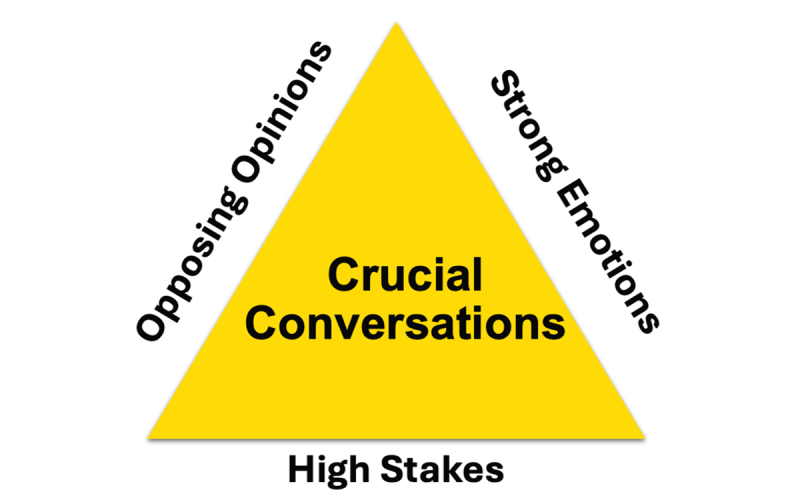
As outlined in the bestselling book Crucial Conversations (Grenny et al., 2022), a crucial conversation is any discussion between two or more people where three things come together:
- First, the stakes are high.
The outcome matters and can heavily impact your life, career, relationships or your well-being and may involve significant consequences. - Second, opinions differ.
The people involved do not see eye-to-eye. Each person brings a different perspective, expectation, or demand to the table, creating an immediate sense of conflict or disagreement. - And third, emotions run strong.
Because the issue matters, and perspectives clash, people begin to feel threatened, fearful, or angry. The physical fight-or-flight response kicks in and clear thinking can quickly give way to reaction.
This combination is what makes these conversations so difficult and why it is so important to recognize our part in making them better.
Closing the Lag Time Gap
One of the most critical factors in whether these conversations succeed or fail,according to Grenny et al. (2022), is something called lag time. Lag time is the gap between when a problem emerges – at times revealing itself before we even know it is there - and when those involved find a way to honestly and respectfully resolve it.
When it comes to handling crucial conversations, we tend to fall into one of three patterns, with the majority of people defaulting to the first two:
- We avoid it entirely.
- We face it but handle it poorly.
- Or, we face it and handle it well.
The more that gap grows, the more time an issue has to fester into gossip, frustration, misunderstanding or covert resentment. The sooner an issue is correctly identified and addressed, the better the outcome. Ironically, the more important the conversation is, the more likely we are to handle it poorly. Speaking up sooner is one of the most powerful things we can do to close the gap.
Creating Safety
A common theme that runs through crucial conversations is that they require us to speak honestly when it would be easier to stay silent. This leads us to a critical insight - a conversation becomes crucial the moment people no longer feel safe. The greatest risk is often not conflict itself, but silence.
When you step into a high-stakes conversation, the first 30 seconds sets the tone for everything that follows. This is called the hazardous half minute (Christiansen, 2023). These first moments determine whether a conversation succeeds or fails. Your goal is not to win. It is not to prove your point. Your goal is to create safety.
Safety is built on two things: mutual purpose and mutual respect - showing that you care about the other person’s concerns, not just your own, and demonstrating that you value them as a person. (Grenny et al., 2022)
If you step back and think about past conversations, oftentimes people don’t become defensive because of what you say. They become defensive because of how you say it and what they think you mean. More often than not it is not the content, it is what the other person believes your motive is. It’s the perceived intent. If your intent feels threatening, the conversation breaks down.
When safety is lost, people tend to respond in one of two ways (Grenny et al., 2022):
- They withdraw into silence (avoiding, withholding, masking)
- They react with verbal violence (controlling, labeling, attacking, demeaning, getting louder to control the conversation, etc.).
Neither response leads to productive dialogue. So, the challenge and the opportunity is to recognize these moments as they happen, and to develop the skills to navigate them effectively. People need to believe you are not against them but working with them. Once safety is established together you create the conditions to talk openly, honestly, and productively about even the most difficult issues.
The Power of Dialog

The acronym STATE is a simple framework to help you remember the key points for navigating high-stakes conversations with confidence while expressing your views in a way that makes it safe for others to hear them. The first three letters describe the “WHAT” skills and the last two letters represent the “HOW” skills.(Grenny et al., 2022)
- S – Share ‘your’ facts only
Start with what you observed. Use “seeing” phrases such as, “this is what I saw.” When you acknowledge these are your facts, you make space for other facts – things that other person may have seen or heard. Facts are less threatening than opinions and can lead us into a conversation. - T – Tell your story
Explain what you are beginning to think or conclude. These are feelings – NOT a fact. You are sharing your assumptions. For example, “this is the conclusion I am starting to draw.” Be clear, but not absolute. - A – Ask for their perspective
Invite them into the conversation and let them tell their story while listening to what they have to say. You can start by asking “what is your perspective” or “this is the story I am getting, I know there is more to the story.” A simple but powerful question is, “What am I missing?” Be prepared to abandon or reshape your story as more information surfaces. - T – Talk tentatively
Remind yourself that your assumptions and conclusions are not facts. Talking tentatively simply means we tell our story as a story rather than disguising it as a hard fact. Keep your tone open, curious, and collaborative. - E – Encourage testing
Get them talking. Make it safe to disagree. Encourage other person to share their viewpoint even if it is opposite from yours – no matter how different. Let them challenge you. If no one is saying anything, you can try playing devil’s advocate with your own views to help encourage conversation.
There will be times where something important is at stake, people see things differently, and emotions begin to rise. You cannot avoid those moments, and they are rarely comfortable, but avoiding them usually comes at a far greater cost. Like removing a sliver, a crucial conversation may create a brief moment of discomfort, but it also creates the possibility for healing. By reducing lag time, creating safe environments for dialog, and employing the STATE framework, we can address issues before they become larger problems. Remember, you need not be perfect to make progress. The greatest risk isn't having a difficult conversation. The greatest risk is not having it at all.
For additional information and ideas, check out our resources on Leadership and Organization Management.
References
- Grenny, J., Patterson, K., McMillan, R., Switzler, A., & Gregory, E. (2022). Crucial conversations: Tools for talking when stakes are high (3rd ed.). McGraw Hill.
- Crucial Dimensions. (2018, July 29). What to do in the first 30 seconds of a tough conversation [Video]. YouTube.
- Christiansen, J. (2023, March 22). Lonely at the top: New people managers are struggling to step into leadership. Crucial Learning.
- Grenny, J. (2010, April 16). Avoiding conflict is killing your bottom line. Crucial Learning.