Written collaboratively by Sarah Sellars and Whoi Cho.
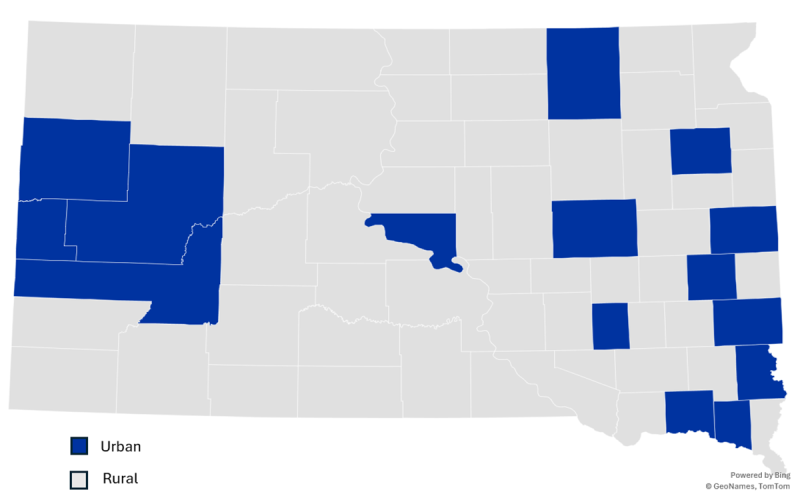
South Dakota is a majority rural state, with a total population of 935,094 (U.S. Census Bureau, 2025a). Using the U.S. Bureau of Census definition of rural as settlements with fewer than 2,000 housing units and 5,000 residents (U.S. Department of Agriculture, Economic Research Service, n.d.), 15 counties contain a city that qualifies them as urban, and 51 qualify as rural (Figure 1).
Broadband Subscriptions
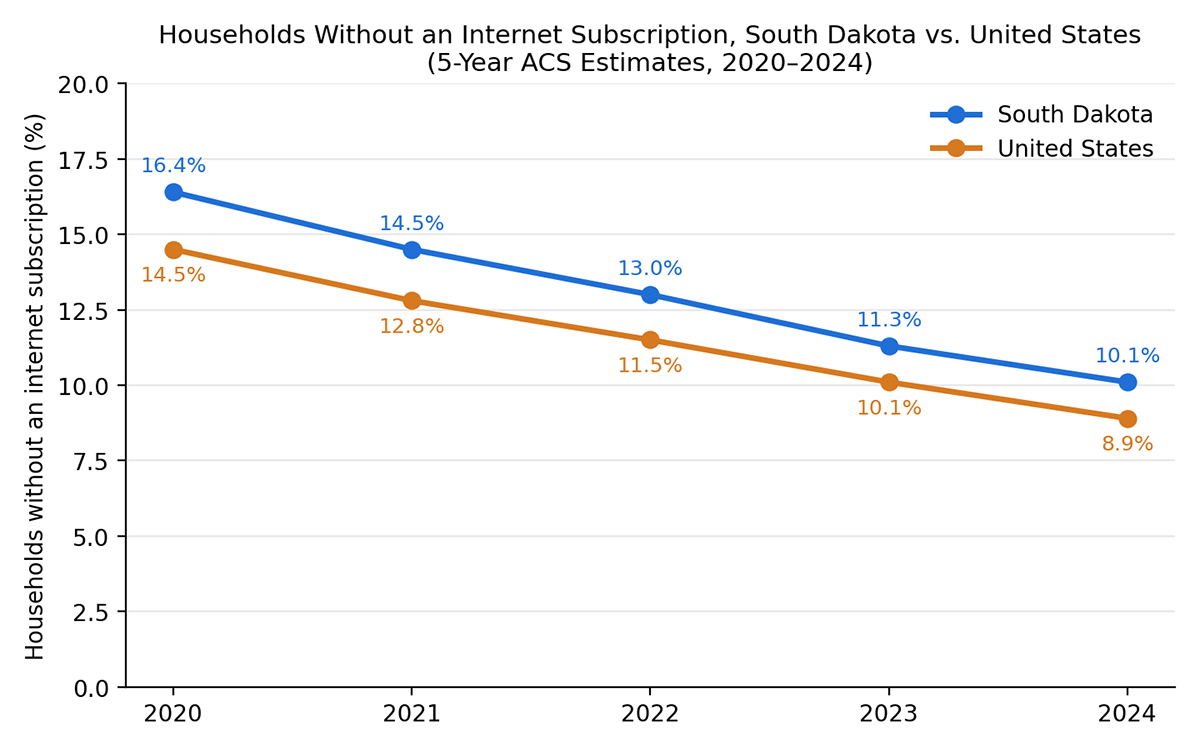
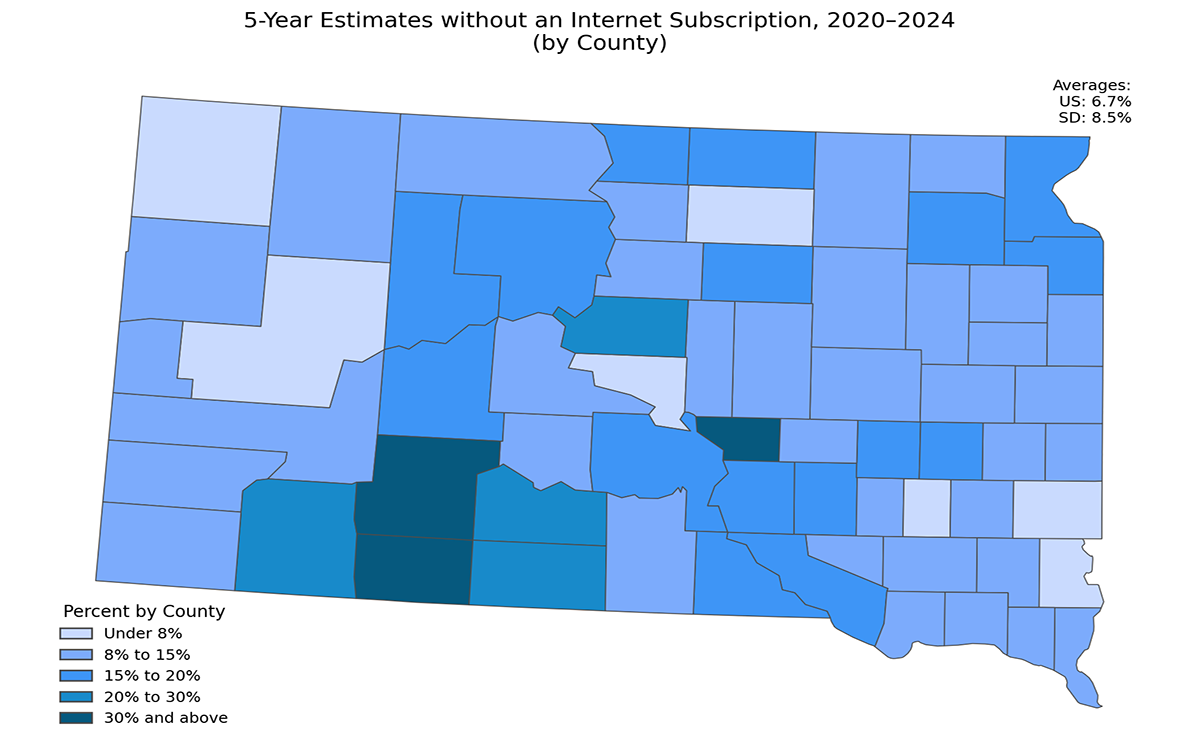
According to the U.S. Census Bureau (2025a), 90% of households in South Dakota had a broadband internet subscription from 2020 to 2024, which is only 1% lower than the national average of 91% (U.S. Census Bureau, 2025b). While South Dakota is in line with the national average overall, there are coverage gaps and internet access disparities across the state compared to other states. Challenges with internet access, such as affordability, availability, and speed, in rural areas have affected the internet subscription rate in South Dakota. Although the percentage of South Dakotans without an internet subscription is declining, the subscription rate remains below the national average in many parts of the state (Figure 2).
The percentage of the population without an internet subscription varies considerably across South Dakota.While most residents in the Sioux Falls and Rapid City areas subscribe to internet service, 40-45% of residents in Oglala Lakota and Bennett counties remain without internet subscriptions.
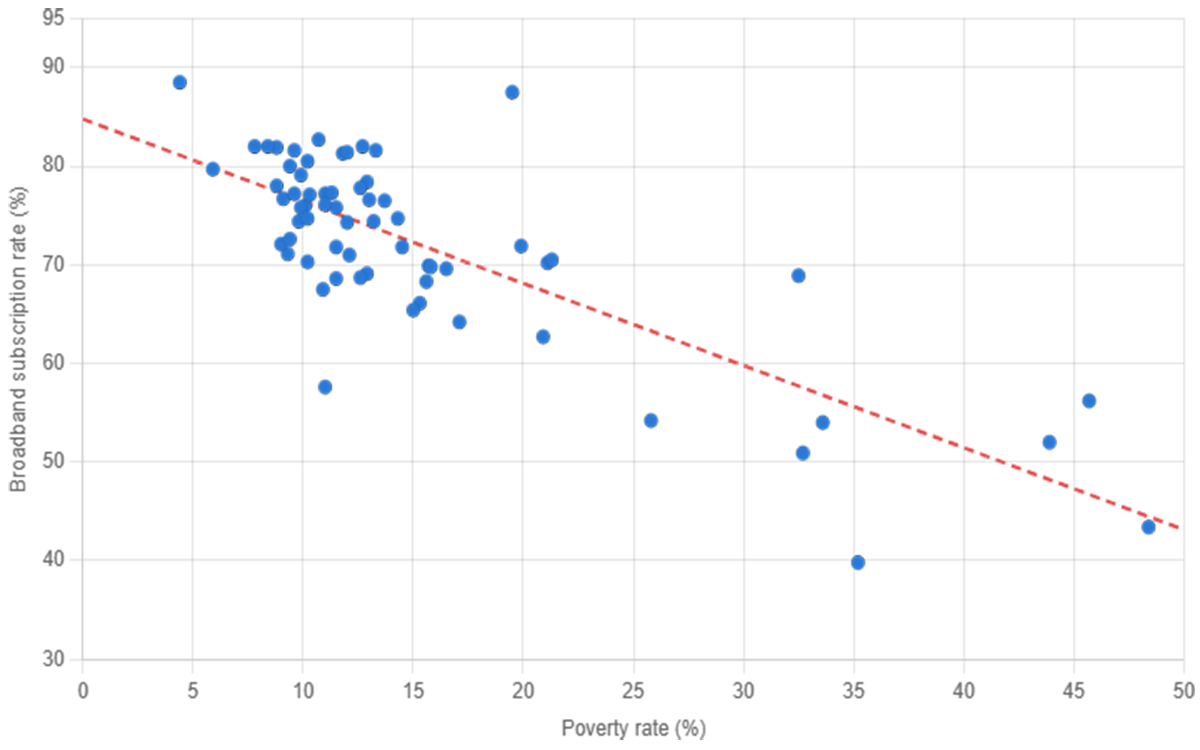
The regional disparities observed in South Dakota are consistent with a previous USDA report showing lower household internet subscription rates in counties with persistently high poverty rates (Dobis and Thomas, 2022). As shown in Figure 3, South Dakota counties with higher poverty rates tend to have lower internet subscription rates, with a correlation coefficient of -0.79.
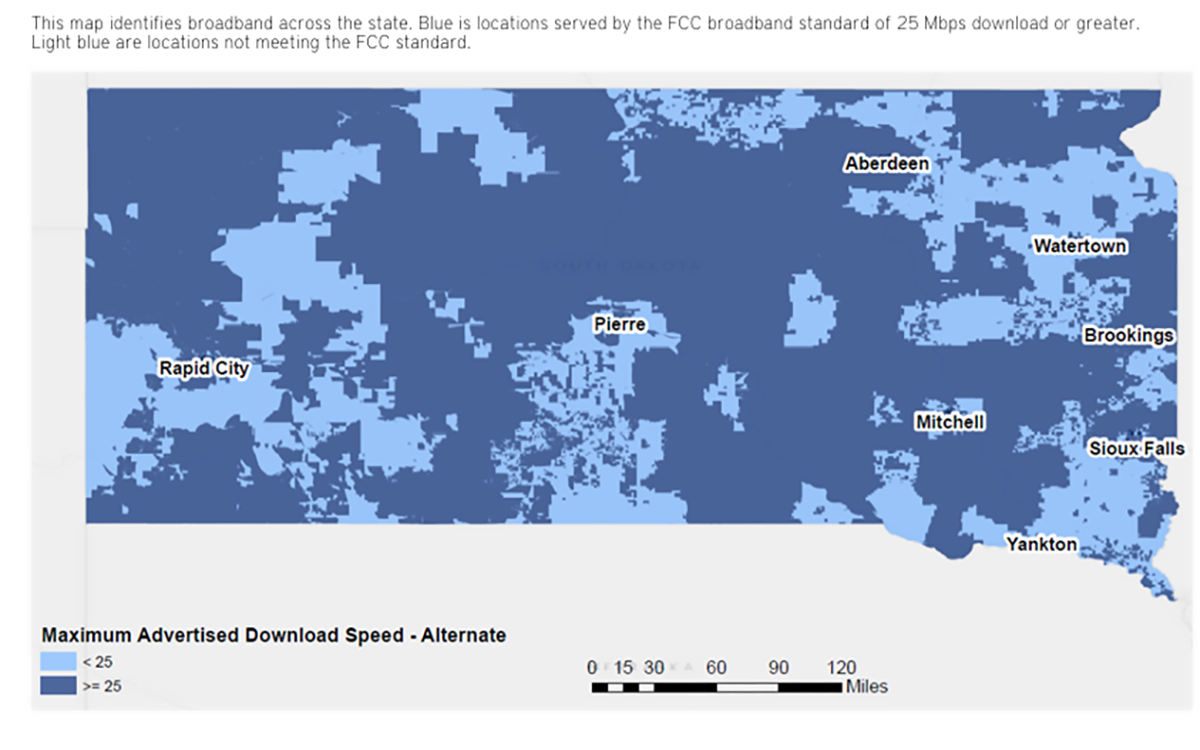
Another possible reason for these regional disparities is differences in internet connection speeds. Reliable, high-speed internet service is not available in all areas of South Dakota. Many of South Dakota’s rural areas do not meet the FCC standard of 25 MBps download or greater (Figure 4).
Rural Libraries Hotspot Lending Program
The Rural Libraries Hotspot Lending Program was launched in 2026 to help address disparities in internet access in rural areas of South Dakota. The program aims to provide rural libraries in need with 8 mobile hotspot devices to lend to their patrons. The patron can check out the device just like a physical book and access the internet at home or on the go. The device can typically be borrowed for one to two weeks, depending on each library’s lending policy. The device can be used so the patron can access the internet at home, opening the door to job applications, virtual doctor visits, remote learning, and entertainment.
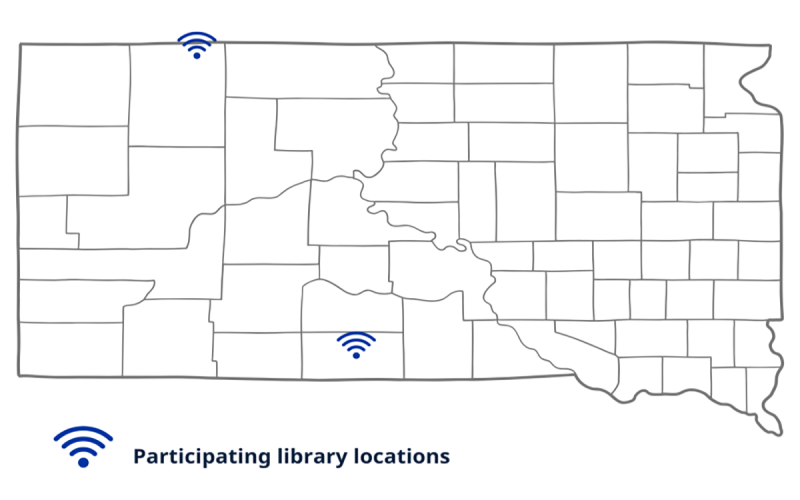
The Rural Libraries Hotspot Lending Program is a partnership between SDSU Ness School of Management and Economics, SDSU Extension, AARP South Dakota, and the South Dakota Community Foundation. The current Rural Libraries Hotspot Location is shown in Figure 6, and the program will expand to 5 new locations in 2026.
References
- Dobis, E. A., & Thomas, K. L. (2022, August 24). Households in rural counties with persistent poverty have less access to internet at home. U.S. Department of Agriculture, Economic Research Service.
- South Dakota Governor's Office of Economic Development. (2020). State broadband plan.
- U.S. Census Bureau. (2025a). QuickFacts: South Dakota.
- U.S. Census Bureau. (2025b). QuickFacts: United States.
- U.S. Census Bureau. (2025c). American Community Survey, 2020–2024 5-year estimates, Table S2801: Types of computers and internet subscriptions.
- U.S. Department of Agriculture, Economic Research Service. (n.d.). What is rural?.
*Note: Figure 2 and Figure 3 created with the assistance of Claude AI.