Futures prices are from organized trades that provide price information for buyers and sellers of commodities. Local cash prices can be compared to futures prices using a basis measure. Basis is defined as the cash price minus a futures price. With an expected basis measure, producers can observe futures prices and infer cash prices.
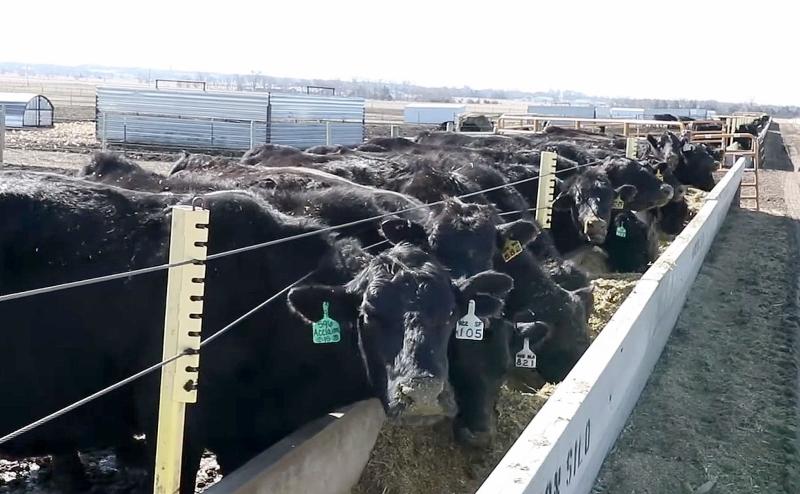
For feeder cattle, the futures market reflects the expected value of beef type feeder cattle steers weighing between 700 and 899 pounds traded throughout plains states. The underlying cash price follows a weak seasonal pattern that is somewhat low from January through May and somewhat high from July through November.
Historic basis levels for livestock are generally computed monthly and are usually a cash price relative to a nearby futures price, that being the futures contract that is the closest to expiration. Feeder cattle futures are listed and traded for eight months of the year: January, March through May, and August through November. Thus, historic feeder cattle basis for June, July, and August would be the cash prices for those months relative to the August futures price during each month.
The basis levels observed during 2025 specific to South Dakota locations were higher than expected throughout 2025 and sharply higher in November and December, perhaps reflecting a tight supply of feeder cattle nationally. Basis was also 4% to 9% of the futures price, within its longer-run range of percentages. The last time that futures were similarly high, 2014-2015, a type of basis risk on feeder cattle increased (Bina, Schroeder, and Tonsor 2022).
For 2026, there is nothing about local supplies or transportation cost changes that would suggest the basis levels would be different from trend levels. A five-year average of historic basis levels smooths out small variations for a given year and incorporates more persistent seasonal patterns in the underlying cash prices (Table 1). Basis levels have been found to be consistently higher in northern states compared to southern states (Berg et al. 2024).
The expected basis varies by month and can be added to observed futures contracts arriving at expected cash prices. The basis fluctuates around $8.50 per cwt., thus, the cash price in South Dakota would be expected to be higher than the nearby futures price. The basis is a little stronger or higher in April, May, November, and December. The basis is the weakest or lowest in June, reflecting the underlying seasonality of cash prices.
| Month | Expected basis |
|---|---|
| January | 7.24 |
| February | 5.95 |
| March | 7.62 |
| April | 10.09 |
| May | 10.43 |
| June | 4.63 |
| July | 7.40 |
| August | 6.69 |
| September | 7.83 |
| October | 8.01 |
| November | 12.42 |
| December | 12.13 |
*Note: Basis reflects the difference between the average cash price at South Dakota locations and the average of the nearby futures price by month. The entries reflect the historic average observed from 2021-2025 by month.
References
- Berg, N.L., A.W. Thayer, M. Fischer, and D. Feuz. 2024. “Feeder Cattle Basis in the Western United States Over the Last Decade.” Western Economics Forum 22(1):18-36.
- Bina, J.D., T.C. Schroeder, and G.T. Tonsor. 2022. “Feeder Cattle Basis Risk and Determinants.” Journal of Agricultural and Applied Economics 54(2):137-156.


