Written collaboratively by Eric Jones, Philip Rozeboom, Jill Alms, and David Vos.
“Still working? Quitting time was 3 hours ago!” “Clock tells the time of day, not when the work is done!” Common banter at the farm gate implies farmers work long days to get the job finished. However, weed management may improve if spraying stops at a particular time of day. An ongoing study (Enlist One (2,4-D) and Liberty (Glufosinate) Applied Alone or Mixed During the Day and Night: Weed Control and Soybean Yield Implications) at South Dakota State University is investigating the effect of time-of-day (day [12:00 pm] and night [9:00 pm]) application with Enlist One (2,4-D choline) and Liberty (glufosinate). Over the past two years, data has suggested that control with either herbicide alone or in mixture could reduce effectiveness by 20%.
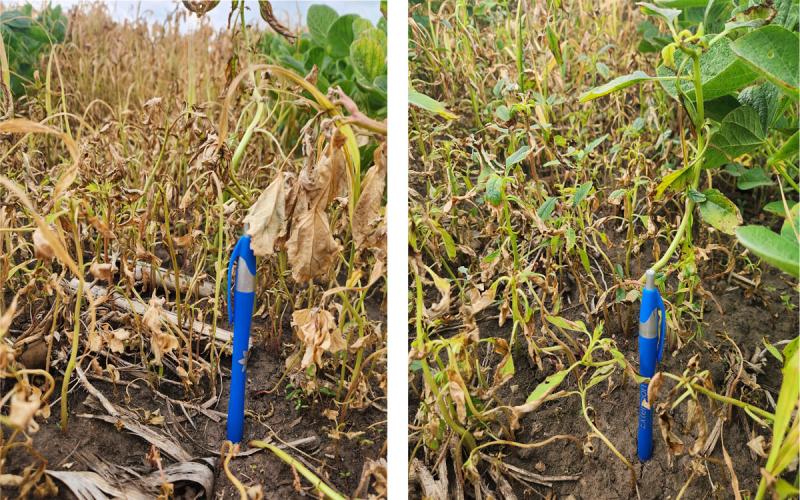
The study was repeated in 2026 to determine if the difference in effectiveness between a 12:00 pm application and a 9:00 pm application was consistent. Enlist One was applied at 32 fl oz per acre while Liberty was applied at 43 fl oz per acre (equivalent to 29 fl oz per acre of Liberty Ultra) in a tank mixture containing 3 lbs per acre of ammonium sulfate at an output of 20 gallons per acre at 12:00 pm or 9:00 pm. Seven days after treatment (6-26-26), stark difference were confirmed for a third time. The daytime application (Figure 1, left) caused more injury on weeds than the nighttime application (Figure 1, right).
While this research was set up to intentionally make applications at these timepoints, making timely applications at a farm operation scale is not as easy. Wind, temperature, rain, and machinery malfunctions can hinder a timely herbicide application. Therefore, the mindset of “got to get this sprayed today” can set in and cause for later applications in the day if conditions are favorable.
Many are done with sprayer applications long before 9:00 pm and labels for specific herbicides (i.e., Liberty) require stopping application prior to sunset, these research results are being shared as a reminder that “hanging it up early and getting after it tomorrow” may be a wise decision. If the herbicide application is made at nighttime, there is a likelihood that the weeds may not die and will need to be sprayed again costing money and an even more valuable commodity – time.