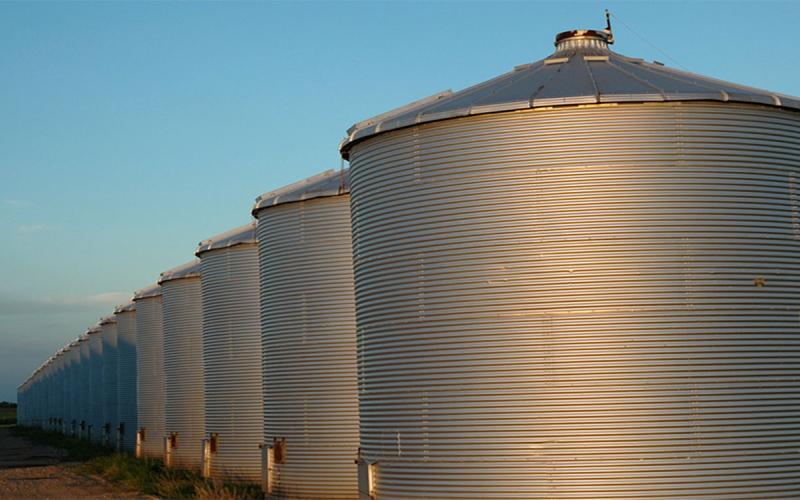
Corn is coming out of the field wetter than usual this fall, and wet corn can spoil quickly in the bin. To ensure that stored grain remains marketable, moisture and temperature inside the bin must be closely monitored and managed using airflow. If the necessary steps are not taken, it is likely that hotspots will develop within the grain, resulting in mold growth and eventually spoilage.
Know Your Moisture Target
How dry the corn needs to be depends on how long you plan to store it, the intended purpose of the grain, grain quality, and the capacity of bin systems to maintain airflow through the pile.
Target moisture levels:
- Through winter, sold by spring: 15%
- 6 to 12 months: 14%
High-moisture corn harvesting is an option for producers who raise both crops and cattle, or plan to market their corn through feeders such as dairies or feedlots. While typically harvested much earlier in the fall with moisture content ranging from 28-34%, inclement weather can cause high-moisture corn to remain in the fields late into the season and presents an opportunity for producers to market grain without incurring drying costs or delayed harvest windows. For more information on high-moisture corn, see SDSU Extension’s article on Harvesting High-Moisture Corn and Earlage.
Cool the Grain Early and Often
Warm, wet grain spoils fastest. Start cooling while the bin is filling, keep the fans going as the weather cools, and make sure heat-dried grain is cooled afterward.
- Bring grain below 40°F as conditions allow.
- Run the fans whenever outdoor temperatures average 10 to 15°F below the grain temperature.
- For winter storage, SDSU recommends 20 to 30°F.
- The wetter the corn, the colder it needs to stay.
- Running fans only at night catches the coolest air, but it halves run time, so each cooling cycle takes about twice as long.
Aeration Cools, It Doesn’t Dry
Cooling only buys time. It doesn’t replace drying.
- Each cycle may remove roughly 0.25 to 0.5 points of moisture, mostly near the air inlet. Over multiple cycles, grain may lose as much as 2%.
- A stirring device helps spread the drying out but doesn’t guarantee even results.
Drying for Long-Term Storage

Corn above optimum moisture levels needs to be dried first. Both natural-air and heat drying work, provided stirators are installed and functioning properly.
- Natural air: A well-designed system needs four to eight weeks of good fall weather and airflow of at least 1 CFM/bu to remove several points of moisture. That generally means filling by mid-October with corn at 22% or less, which is tough with a November fill.
- Fan timing: Don’t start natural-air fans until average air temperatures are about 40°F. Fans can run on freezing nights with low relative humidity, but turn them off before the air warms in the morning.
- Heated drying: Use it when airflow is limited, the weather won’t cooperate, or the corn must reach market moisture quickly. The faster the target moisture is reached, the better suited the grain is for long-term storage.
- If you wait until spring: Keep the grain cold, monitor it weekly, and have a drying or marketing plan ready before it warms up.
Keep Air Moving Evenly
Fines (broken kernels and debris) collect under the spot where the bin is filled and block airflow. To reduce the problem:
- Pull out the fines by unloading some grain through the center sump, ideally after each harvest, and maintain auger screens to prevent fines from re-entering.
- Level the grain surface by removing the peak.
- Don’t count on unloading and reloading to fix airflow, especially if the fines go back in.
- Keep much wetter grain separate. Mixing it with drier grain doesn’t make it safe, and a wet pocket in the middle will cool slowly.
Estimate Your Airflow and Fan Time
Airflow is measured in cubic feet per minute per bushel (CFM/bu):
Airflow = fan airflow (CFM) ÷ bushels in the bin
A fan moving 2,000 CFM through 20,000 bushels delivers 0.1 CFM/bu. The same fan on 10,000 bushels delivers 0.2.
Horsepower alone doesn’t tell you the airflow. Deeper grain resists air more, so a fan moves less air through a fuller bin. Check the fan’s performance chart against your bin size and grain depth.
To estimate the time for one cooling cycle:
Hours = 15 ÷ airflow (CFM/bu)
At 0.1 CFM/bu, that’s about 150 hours, or just over six days of nonstop running. At 12 hours per night, it’s about 12½ days. This is how long one cooling front takes to move through the bin, not the time needed to dry the corn or reach winter temperatures.
Check the Whole Bin
One temperature reading can’t tell you what’s happening in the bin. Use sensors or probes near the walls, near the top surface, and deep in the grain.
- Check wet corn at least weekly for warm spots, condensation, crusting, and musty smells, and address any changes right away.
- In bins with upward airflow, confirm the cooling reaches the top layer.
- Measure moisture separately. Cold grain isn’t necessarily dry grain.
- Never enter flowing grain or walk on a crust or bridge.
Bin Safety First

Whenever you are dealing with stored grain, safety should be the main priority. Never enter a grain bin with corn or other grain in it without appropriate safety equipment, a spotter, and your emergency plan in place.
Gas accumulation, dust exposure, bridged and collapsing grain have caused deaths across the nation. Also, use caution when using heat to dry the corn. Keep all equipment free of dust and other debris to reduce combustion opportunities.
For more information on corn drying, aeration, storage management, and marketing, check out the following resources: Best Management Practices for Corn Production, A Few Considerations for Fall and Winter Grain Storage, and the SDSU Extension Grain Storage Calculator.
Declaration of Generative AI and AI-Assisted Technologies in the Writing Process
During the preparation of this work, the author used artificial intelligence to review and format the text. After using this tool/service, the authors reviewed and edited the content as needed and take full responsibility for the article’s content.
References
- Carlson, C. G. (2016). Corn storage and drying. In D. E. Clay, C. G. Carlson, S. A. Clay, & E. Byamukama (Eds.), Best Management Practices for Corn Production (Chapter 53). South Dakota State University.
- McKenzie, B. A., & Van Fossen, L. (n.d.). Managing dry grain in storage (AED-20). Purdue University Cooperative Extension Service.
- North Dakota State University. (2010, October 18). Aeration key to storing 16 to 20 percent moisture corn. Extension and Ag Research News.
- Rusche, W. (2023, August 11). Harvesting high-moisture corn and earlage. SDSU Extension.
- SDSU Extension. (2023, March 15). Best management practices for corn production.
- Shouse, S., & TeBockhorst, K. (2021, March 11). 2021 stored grain management. Iowa State University Extension and Outreach.
- Shouse, S., TeBockhorst, K., Hurburgh, C. R., & Maier, D. (2020, October 14). Tips for handling, drying, and storing damaged grain. Iowa State University Extension and Outreach.
- Varenhorst, A., Bauder, S., Pritchard, S., Rozeboom, P., & Wagner, P. (2022, January 14). Forecasted cold temperatures can be used to cool down stored grain. SDSU Extension.
- Varenhorst, A., Rozeboom, P., Wagner, P., McManus, B., & Bauder, S. (2024, January 16). A few considerations for fall and winter grain storage. SDSU Extension.
- Wilcke, W., & Morey, R. V. (n.d.). Natural-air corn drying. University of Minnesota Extension.